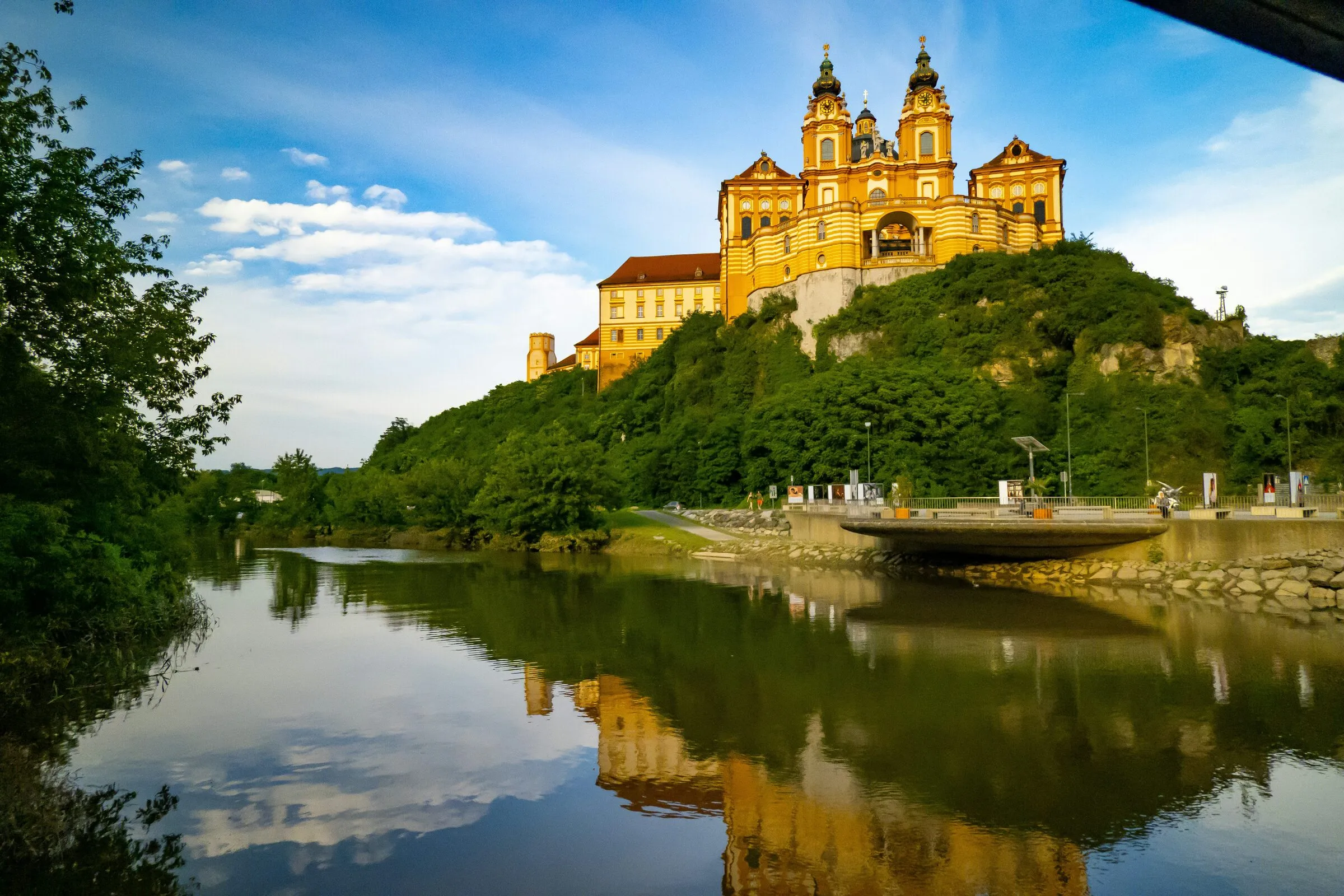
Melk is a town of 5,000 people with a single famous building, and it’s worth the day in port anyway. The famous building is Stift Melk — the Benedictine abbey that has stood on a bluff over the Danube since 1089, was rebuilt in baroque grandeur in the 1700s, and is one of the most visually striking buildings on the entire Danube. Melk is often cited as an inspiration for the unnamed monastery in Umberto Eco’s The Name of the Rose. The abbey alone earns the half-day of port time most river-cruise itineraries allocate.
Most clients arrive in Melk on a Danube river cruise — the AmaWaterways, Viking, Avalon, or other sailings that stop here for half a day en route between Vienna and Passau. The standard itinerary: docked along the Danube embankment in the morning, shuttle bus up the steep hill to the abbey, 90-minute guided tour of the abbey church, library, and Marble Hall, walk back down through the small town, back on the ship by lunch. Done that way, it’s a perfectly satisfying half-day. The version that’s better is the same half-day with one or two small adjustments — the abbey from the right angle, the Wachau wine region acknowledged in passing, the small town of Melk itself walked rather than sprinted through.
Here’s how I think about it.
At a Glance
| How most travelers arrive | Danube river cruise — Melk is a standard half-day or full-morning port on virtually every Danube itinerary running west-to-east or east-to-west. |
| How long in port | Most ships allocate 4–5 hours, typically morning. Some itineraries dock overnight; most do not. |
| Best time to visit | Late April–June and September–October. The Wachau Valley is at its prettiest in late spring and early fall, when the Danube vineyards are leafed in. December has the small Melk Christmas market in the town square below the abbey. |
| Currency / language | Euro. German is official; English is widely spoken at the abbey and tourist-facing settings in town. |
| One thing most guides won’t tell you | The abbey from the outside is as worth seeing as the inside. Walk a hundred meters down the riverside path west of the dock and look back at the bluff: the yellow baroque façade against the green Wachau hills is the photograph the brochures use, and it’s better at ground level than from inside. |
Why Travelers Stop Here
Because Melk is the entry point to the Wachau Valley — the 22-mile UNESCO-listed stretch of Danube between Melk and Krems with vineyards, baroque abbeys, ruined castles, and the most concentrated picturesque-Danube imagery in Austria. The valley is the visual highlight of the Vienna-to-Passau or Vienna-to-Nuremberg sailing, and ships almost universally cruise it during daylight on a stretch where they slow down for views. Melk anchors the western end.
It’s also the city on the Danube journal post — the AmaReina trip report — where the abbey paragraph has stood as the strongest single-port-day section of that post since publication. The Stift Melk hour is the kind of port hour clients describe by name a year later.
If you’re considering a Danube river cruise, the Rivers & Small Ships specialty page covers how I think about which itinerary fits which traveler. Melk appears in essentially every Danube line’s standard schedule.
What I’d Do With Your Half-Day in Port
Most river-cruise lines include a guided abbey tour as the standard excursion. Take it. Tour-guide access to the Marmorsaal (Marble Hall), the baroque library (with its 80,000 volumes, fresco-domed ceiling, and famous painted cherubs that nearly outnumber the books), and the abbey church is meaningfully better with an experienced guide than self-guided — the building’s structure, history, and decoration are layered in ways that benefit from narration.
After the included abbey tour, don’t get back on the bus immediately. Walk down from the abbey rather than riding the shuttle — it’s about 20 minutes downhill through the town’s small streets, past the Stiftspark (abbey park) gates, and into Melk’s compact medieval Hauptplatz (main square) at the foot of the bluff. Stop at one of the small bakeries for a Wachauer Marillenknödel (apricot dumpling) — the Wachau is famous for its apricots, and the local Marillen bakery products are the regional specialty.
If you have an extra hour after the walk, take a riverside stroll west of the dock for the abbey-from-below photograph (better than the photograph from inside the courtyard), or pop into the small Melk town museum in the Posthof building near the square — a 15-minute visit on local Wachau history, free with the standard Wachau Card most cruise lines distribute.
Specific Things I’d Tell You About
Stift Melk’s library has 365 windows — one for every day of the year. It’s not a coincidence; it was a deliberate architectural decision by the baroque builders. Look up at the windows during the library tour. The cherubs on the ceiling are the part everyone photographs; the windows are the part everyone misses.
Melk is often cited as an inspiration for the unnamed monastery in The Name of the Rose. Eco set the novel in a northern Italian abbey and never named it, but Melk’s baroque library and dramatic bluff position match the architectural atmosphere closely enough that the connection has become part of the abbey’s own story. If you’ve read the book, the library tour is a different experience.
The Wachau Valley is one of the most scenic stretches on the Danube. Almost every river-cruise itinerary cruises the Wachau between Melk and Krems in daylight, on purpose, slowing down so passengers can see the vineyards, the baroque abbeys, and the ruins of Aggstein Castle on the cliff above the river. Be on deck for that hour. It’s the one cruising-segment where the river itself is the star.
The Wachau wine region is real and underrated. Grüner Veltliner and Riesling produced in Wachau vineyards are among Austria’s best, and the region’s small Heurigen (wine taverns) are open through the warm months. If your itinerary includes a Wachau winery visit excursion, take it; if not, the bottles available at the small Melk wine shops are the genuine article.
Dürnstein, just east of Melk, is where Richard the Lionheart was held captive. The 12th-century castle ruins above Dürnstein village are the literal location where Richard I was imprisoned for ransom by Duke Leopold V in 1192–93. Most cruise itineraries pass Dürnstein from the river but don’t stop; the castle ruins are visible high above the town as you sail past. Look for them on the cruise.
What I’d Skip
Trying to add a non-included Wachau excursion if your time in port is tight. The half-day in Melk is allocated for the abbey, and most ships’ included excursions take you straight there. Adding a Wachau wine drive on the same day risks missing the abbey or the boat; if you want a serious Wachau wine experience, build it in as a pre- or post-cruise day from Vienna instead.
The Schallaburg castle excursion unless you specifically want a small Renaissance castle. Some cruise lines offer Schallaburg as an alternative to the abbey; the abbey is the better choice for almost everyone.
Restaurants on the abbey courtyard with multilingual menus. Most cruise passengers eat back on the ship. If you do eat in town, the small Wirtshaus (taverns) on the Hauptplatz are honest and inexpensive; the abbey-courtyard cafés are tourist-priced.
For Travelers With an Overnight or Pre/Post Cruise Stop
Some itineraries dock in Melk overnight; some travelers extend pre- or post-cruise to spend a night here. If you’re staying, Hotel Stadt Melk in the town center is the convenient walkable option, and Schloss Schallaburg offers a more atmospheric Renaissance-castle stay 7 km outside town. Neither is in my hotel program — for travelers who want a Grand Hotel base for the Wachau Valley, anchor in Vienna and day-trip to Melk via train (1h15m on the Westbahn) or with a hired car-and-driver.
The deeper conversation about Danube cruise pacing — and whether your itinerary is a fit for adding pre- or post-cruise nights — lives on the Rivers & Small Ships specialty page, and on the full Danube journal trip report.
Plan Your Danube With Me
If you’re thinking about a Danube river cruise that includes Melk — and how to make the Wachau Valley days feel like the highlight they deserve to be — that’s exactly the kind of planning I do. A 30-minute discovery call is where it starts. No fee, no pressure. Just the river, your timeline, and the version of the Danube week most travelers don’t know to ask for.
Book Your Free Discovery Call →︎
Last updated: April 2026. I keep this guide current. If access to a site shifts or a cruise-line itinerary changes, the page changes. Travel changes. The work doesn’t stop when the page goes live.
Plan this trip with me.
A 30-minute discovery call is where it starts. No fee, no pressure.
Book a Discovery Call