About the Destination
Fez is the one people mean when they say they want the real Morocco. Where Marrakech has been polished for the traveler, Fez has mostly declined to be — its medieval core, Fes el-Bali, is the largest car-free urban area on Earth, a labyrinth of some nine thousand alleys where donkeys still carry the freight and the trades are still worked in the streets where they’ve been worked for a thousand years. It is the oldest continuously inhabited medieval city in the world, and it feels it — denser, older, less performed than Marrakech, and for a certain traveler, far more moving.
It’s also Morocco’s intellectual and spiritual capital. Al-Qarawiyyin, founded here in 859 by a woman named Fatima al-Fihri, is recognized by UNESCO and Guinness as the oldest continuously operating university on the planet — a fact that reorders how you see the place: this warren of alleys was a center of learning while most of Europe was still in the dark. The medina isn’t a museum of that history. It’s the same city, still running.
The thing to understand before you go is that Fez does not hand itself over. The medina is genuinely disorienting — that’s not a failure of your map, it’s the design — and the difference between a great two days and a stressful one is entirely about how you enter it. This is the most guide-dependent city I plan, and the most rewarding when it’s planned right.
At a Glance
| Best time to visit | March–May and October–November — mild and walkable, which matters in a city you cover entirely on foot. Summer is hot and airless in the medina’s tight lanes; winter is cool, quiet, and atmospheric if you don’t mind gray days. Spring catches the surrounding hills green. |
| How long to stay | Two nights minimum, three if Fez is the point rather than a stop. The medina rewards a full guided day and a second unhurried one; a single day only skims it. Many travelers pair Fez with Marrakech and the desert, and two nights is the right weight inside that larger loop. |
| Currency / Language | Moroccan Dirham (MAD), a closed currency — get it on arrival. Arabic (Darija) and Amazigh are the mother tongues; French is the working second language and English is fluent at the riads I use. Fez is more conservative than Marrakech; dress a touch more modestly and it’s returned in kind. |
| How to get there | Fès–Saïss (FEZ) takes regional and European flights, but many travelers arrive overland — the train from Casablanca or Rabat is genuinely good (first class, a few hours, along the way most people skip), and the drive from Marrakech runs through the Middle Atlas. Arrange the riad’s porter service: cars can’t enter most of the medina, so you’re met at a gate and walked in, luggage carried, through lanes you would not want to find alone on arrival. |
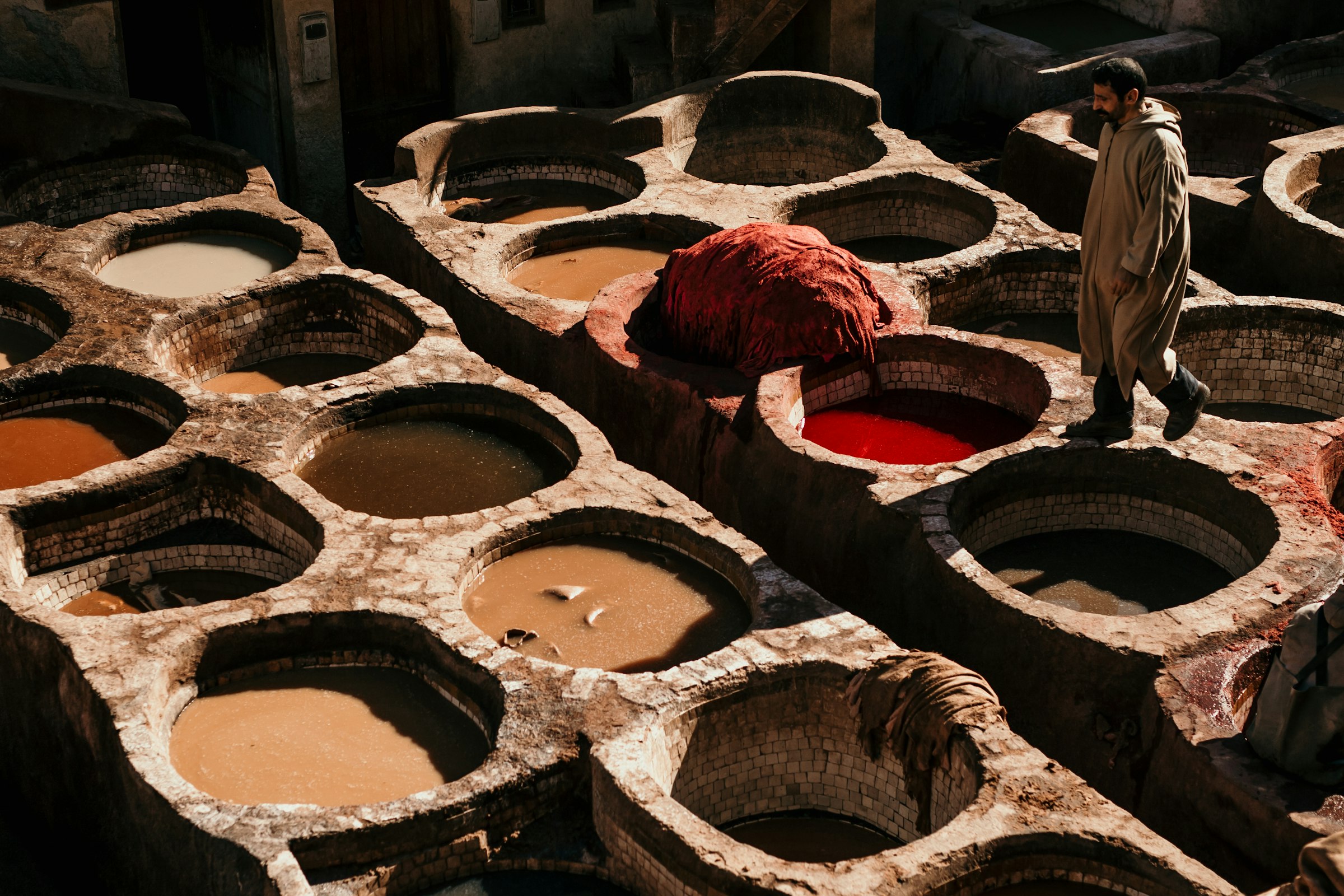
| One thing guides won’t tell you | The famous view over the Chouara tanneries comes from the leather shops that ring them — you’re shown up to a terrace, handed a sprig of mint for the smell, and there’s a soft expectation you’ll look at the goods after. That’s the deal, and it’s a fair one; the view is worth it. Go in the morning when the light is on the dye vats and the day’s work is fresh. |
Why I Send Travelers Here
Because Fez is the deepest, oldest, most intact version of Morocco, and the travelers who want depth over ease never regret trading a night of Marrakech for it. Because the crafts here are not a heritage performance — the coppersmiths, the dyers, the weavers, the mosaic-cutters are working, and a morning spent watching them is a morning you keep. Because Al-Qarawiyyin and the great madrasas — the Bou Inania, the Al-Attarine, with their carved cedar and endless zellige — are among the most beautiful interiors in the Islamic world, and they’re nearly empty compared to Marrakech’s set-pieces.
Fez earns the slot for the traveler on their second Morocco trip, or the first-timer who wants the country’s soul and not just its glamour; for history and architecture people; for anyone who found Marrakech a little too handled and wants the version that hasn’t been. It is not the easy city. It is the rich one.
Where I’d Anchor
The lodging question in Fez is really one question: inside the medina or outside it. Both are right, for different travelers.
Inside the medina — the riad
A riad is a traditional courtyard house turned inward around a fountain, and Fez’s restored riads are some of the most beautiful in Morocco — hand-carved plaster, cedar ceilings, tiled courtyards open to the sky, a rooftop over the medina for breakfast and the evening call to prayer. Staying inside the walls means you’re in the city — you step out of your door into the thousand-year-old lanes. It also means the porter-and-arrival choreography I mentioned; that’s the trade for the intimacy. This is the choice for travelers who want the medina to be the whole experience. There’s no single Signature-program house here the way there is in Marrakech — this is pure relationship-and-taste matching, and picking the right riad for how you actually travel is exactly the call.
Outside the walls — the hotel
For travelers who want a pool, a car to the door, and a quieter base to return to, the hotels in the Ville Nouvelle and the hills above the medina trade the immersion for ease and space. Best for a first-timer who wants the medina by day and a conventional hotel by night, or for anyone doing Fez as one stop in a driving loop where the logistics of a medina riad add friction.
Tell me which shape fits and I’ll match you to the specific house — the riads vary enormously in size, light, and where in the medina they sit, and that’s the difference between a magical stay and a cramped one.
What I’d Do with Two Days
Day One — The Medina, with a Guide
There is no substitute for a good guide in Fes el-Bali, and the right one turns the labyrinth into a story. A full morning through the trades — the Chouara tanneries in the good light, the coppersmiths’ square, the weavers, a mosaic workshop where you see how the zellife is actually cut — then the architectural set-pieces: the Bou Inania Madrasa, the Al-Attarine, the exterior of Al-Qarawiyyin (the mosque-university complex is closed to non-Muslims, but the doorways and the sense of the place carry). Lunch in a medina courtyard. The afternoon is for the parts of the souk the guide’s route skips — the food market, the dyers’ street, the babouche stalls. Back to the riad for the rooftop at dusk.
Day Two — Slow Fez
The unhurried day. The Bab Bou Jeloud — the blue gate, built in 1913, blue-tiled facing the city and green facing the medina — and the streets beyond it that the tour groups don’t reach. The Nejjarine museum of woodcraft in its restored funduq. A pause at the tomb of Moulay Idriss II, the city’s spiritual heart. Time to buy properly if you’re buying — Fez is the place for the real thing, the hand-knotted rug, the cedar box, the ceramic, and an afternoon with a maker beats an hour with a middleman. A last mint tea on the roof.
Specific Things I’d Recommend
A guide for the first full day — non-negotiable. The medina is the point and it’s genuinely bewildering; a good guide is the difference between seeing Fez and understanding it. I have specifics; we sort it on the call.
The madrasas at opening. The Bou Inania and Al-Attarine are staggeringly beautiful and best early, before the light gets high and the small courtyards fill.
Buying the real thing here, not in Marrakech. Fez is Morocco’s craft capital, and the rug, the copper, the ceramic bought here from the maker is a better object at a better price than the tourist-grade version further south. Bring room in the bag.
A cooking afternoon or a food walk. Fez’s food is distinct — the b’stilla, the preserved-lemon tagines, the street sweets — and an afternoon in a medina kitchen or on a proper food walk is the most delicious way to read the city.
What I’d Skip
Fez as a day trip. It gets sold as a long day from elsewhere and it’s a mistake — the drive is long, the medina wants hours, and a rushed Fez is worse than no Fez. Give it two nights or leave it for the next trip.
The medina alone, on arrival, with luggage. The lanes aren’t signed the way you expect and the first entrance is not the time to learn them. Let the riad walk you in.
Trying to “see everything.” Fes el-Bali has nine thousand alleys; you will not see them, and the traveler who tries leaves frazzled. Let the guide choose the spine and let the rest be atmosphere.
Onward — Fez in the Larger Loop
Most travelers I send to Fez are building a longer Morocco: Marrakech for the glamour, Fez for the soul, and the interior — the Atlas and the desert — between or beyond them. Fez sits at the northern end of that arc, and the classic route runs Fez to the Sahara down through the Middle Atlas and the cedar forests, or Fez as the finale after Marrakech and the dunes. However it’s sequenced, Fez is the chapter people are quietest about afterward, and the one they bring up first when someone else is planning a Morocco trip. The wild interior it connects to — the mountains, the kasbah road, the desert — lives on Wild Places & Luxury Lodges.
Plan Fez With Me
If you’re thinking about Fez as the deep half of a Morocco trip, as a craft-and-culture pilgrimage, or as one leg of a longer imperial-cities-and-desert loop — that’s exactly the kind of planning I do. A 30-minute discovery call is where it starts. No fee, no pressure. We talk through the time you have, whether a medina riad or a hotel outside the walls is right for how you travel, and how Fez sequences into the rest of the country.
Last updated: July 2026. I keep this guide current. If a riad I recommend slips, a workshop changes hands, or access to a site shifts, the page changes. Travel changes. The work doesn’t stop when the page goes live.
Plan this trip with me.
A 30-minute discovery call is where it starts. No fee, no pressure.
Book a Discovery Call