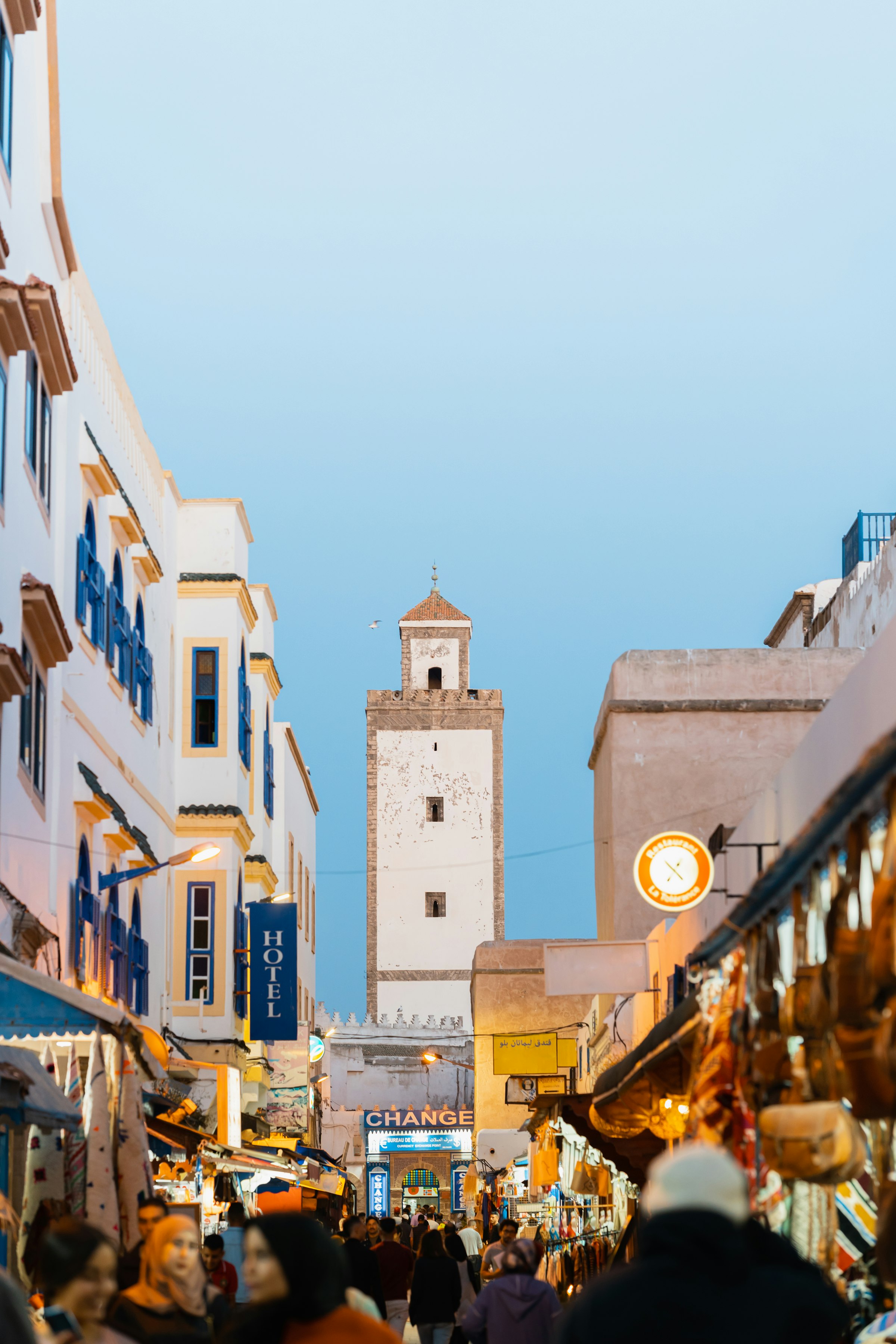
About the Destination
Essaouira is the trip’s exhale. Two and a half hours west of Marrakech, the road drops out of the argan hills and there it is — a low, walled, blue-and-white port on the Atlantic, ramparts running along the sea, gulls over the fishing harbor, the wind moving everything. After Marrakech’s intensity, Essaouira is a different Morocco entirely: breezy, unhurried, artsy, and cool in both senses. The Atlantic trade winds keep it a good ten degrees cooler than the interior, which is why it’s the summer bolt-hole for Marrakchis and the reason a certain traveler builds a whole trip around it.
The walled medina is a UNESCO World Heritage Site — an 18th-century fortified town laid out on a rational grid (unusual for Morocco), with sea-facing ramparts, the Skala de la Ville and the Skala du Port, lined with old bronze cannons and open to the wind and the light. It’s a working town, not a resort: the fishing fleet still lands the day’s catch at the port, the gnaoua musicians still play in the squares, and the medina’s craft is thuya wood and argan oil rather than the carpets and metal of the imperial cities. Orson Welles filmed Othello on these ramparts; a half-century later the same walls played Astapor in Game of Thrones, where Daenerys buys her army — and you can walk the whole of it, mostly for free, in an afternoon.
What Essaouira is for is slowing down. It’s the honeymoon add-on after the medina, the two nights that reset the trip, the place where the plan is to have no plan beyond a rampart walk, a long seafood lunch, and the light going gold on the water.
At a Glance
| Best time to visit | April through October for warmth and long days, though Essaouira is a year-round town — the wind is the constant, not the temperature. June brings the Gnaoua World Music Festival, when the whole medina becomes a stage; magical, but book far ahead. If you want beach-still air rather than steady wind, this is the one Moroccan coast where you check the forecast — the breeze that makes it a windsurfing capital also means the beach is often for walking, not lying. |
| How long to stay | Two nights is the sweet spot as a Marrakech add-on — enough to feel the town’s rhythm without it going slack. Three if Essaouira is the point, or if you’re the kind who wants a genuinely empty day. As a day trip it’s a tease; the town only unlocks after the day-trippers leave and the light turns. |
| Currency / Language | Moroccan Dirham (MAD), closed currency — get it on arrival. Arabic and Amazigh, with French widely spoken and English common in the medina’s tourist-facing trade. Essaouira is relaxed and cosmopolitan by Moroccan standards — a long artist-and-expat presence shows. |
| How to get there | The drive from Marrakech is 2.5–3 hours through the argan country (stop for the tree-climbing goats if they’re out — yes, really). There’s a small airport (Essaouira-Mogador, ESU) with limited European service, but most travelers come overland from Marrakech, and a private driver makes the argan stops and the timing easy. |
| One thing guides won’t tell you | The wind is the whole personality of the place, and whether you love Essaouira depends on whether you lean into it. It is not a lie-on-the-beach resort town — the Atlantic breeze is near-constant and can be strong. Come for the ramparts, the light, the food, and the calm; come for a still beach tan and you’ve picked the wrong coast (that’s Taghazout or the far south). |
Why I Send Travelers Here
Because Essaouira is the easiest, most charming decompression in Morocco — the walled-port equivalent of a deep breath. Because it’s genuinely beautiful in a way that photographs can’t cheapen: the blue boats, the white ramparts, the gulls, the Atlantic light that painters have chased here for a century. Because the seafood is absurdly good and completely unfussy — you pick the fish off the ice at the port and they grill it in front of you — and the medina’s shopping (thuya-wood boxes, argan oil, the town’s own painters) is a pleasure rather than a gauntlet.
Essaouira earns the slot as the two-night exhale after Marrakech, as the calm half of a honeymoon that needs both intensity and rest, and for music, art, and food people who’d rather a working port than a resort. It’s also the gentlest possible Morocco for a traveler who found the imperial cities a lot — same country, none of the crush.
Where I’d Anchor
Essaouira splits three ways — inside the ramparts, just outside them on the beach, or down the coast for surf.
Inside the medina — the riad
The town’s restored riads sit within the 18th-century walls, courtyard houses a short walk from the ramparts and the port. Staying inside means the medina is your neighborhood — the morning market, the evening squares, the sea a few lanes away. This is the choice for travelers who want the character and the walkability, and I match you to the specific house on the call (there’s no Signature-program property in Essaouira, so this is pure taste-and-relationship matching — which is exactly where an advisor earns the trip).
On the beach, just outside
For a pool, more space, and the beach at the door, a handful of properties sit just outside the walls along the bay — the trade being a short walk into the medina rather than living in it. Best for travelers who want a resort rhythm with the town in reach.
Down the coast — Taghazout, for surfers
If the trip is really about the water, the surf coast runs south toward Taghazout, where Fairmont Taghazout Bay — on my Signature relationship, with the amenities auto-applied — anchors a proper beach-and-surf stay about three hours down the coast. It’s a different trip from Essaouira’s walled-port charm; I’ll tell you honestly which coast fits what you’re after.
What I’d Do with Two Days
Day One — The Ramparts and the Port
Arrive from Marrakech by early afternoon, check in, and let the town set the pace. A walk along the Skala de la Ville — the sea-facing rampart with its row of bronze cannons — as the light starts to turn, then down to the fishing port where the blue boats come in and the Game of Thrones ramparts are exactly as they look on screen. Dinner is the port grills or a medina rooftop; either way, seafood, simply done.
Day Two — Medina, Beach, and Nothing
A slow morning through the medina — the thuya-wood workshops, the art galleries the town is quietly known for, the argan cooperatives. Lunch long. The afternoon is deliberately unstructured: the beach for a walk (the wind decides whether it’s more), a hammam, a nap, a book on the rooftop. Essaouira’s gift is the empty afternoon; the traveler who fights that hasn’t understood the town. Sunset on the ramparts, then one more seafood dinner.
Specific Things I’d Recommend
The port fish grills. Pick your fish off the ice, watch it hit the grill, eat it at a plastic table with the boats behind you. It is the best meal in town and it costs nothing to speak of.
A rampart walk at golden hour. The Skala de la Ville and the light off the Atlantic — this is the photograph everyone takes home, in person, with the wind in it.
The argan stop on the drive. Between Marrakech and the coast, the argan cooperatives (and, if the season’s right, the goats that climb the trees to eat the fruit) are a genuinely worthwhile pause — the real oil, bought where it’s pressed.
Timing around the Gnaoua festival — one way or the other. If you want the music, come in late June and book months ahead; if you want the quiet, avoid that week. Both are the right answer for different travelers.
What I’d Skip
Essaouira as a rushed day trip. The town only turns on after the day-trippers leave; a few hours gives you the postcard and none of the point. Stay the night.
Expecting a beach resort. The wind is real and near-constant. Come for the ramparts and the calm, not a still-air tan — and if the beach is the priority, we plan the surf coast instead.
Over-scheduling. Essaouira punishes ambition; its whole value is the unstructured afternoon. Build in nothing and let the light do the rest.
Onward — Essaouira in the Trip
Essaouira is almost always a chapter, not a whole trip — the two-night exhale that balances Marrakech’s intensity, the calm bookend to a honeymoon, the coast leg of a longer loop. It pairs most naturally with Marrakech (2.5 hours away) and slots beautifully before or after the mountains and the desert, when the trip needs somewhere to breathe. For travelers who want the water to be the trip rather than the rest stop, the surf coast and the broader wild-and-coastal end of Morocco is where that lives — see Wild Places & Luxury Lodges.
Plan Essaouira With Me
If you’re thinking about Essaouira as the calm half of a Morocco trip, as a honeymoon’s exhale, or as the coastal chapter of a longer loop — that’s exactly the kind of planning I do. A 30-minute discovery call is where it starts. No fee, no pressure. We talk through the time you have, whether a medina riad or a beach base is right, and how the coast plays into the rest of the country.
Last updated: July 2026. I keep this guide current. If a riad I recommend slips, a restaurant changes hands, or access to a site shifts, the page changes. Travel changes. The work doesn’t stop when the page goes live.
Plan this trip with me.
A 30-minute discovery call is where it starts. No fee, no pressure.
Book a Discovery Call