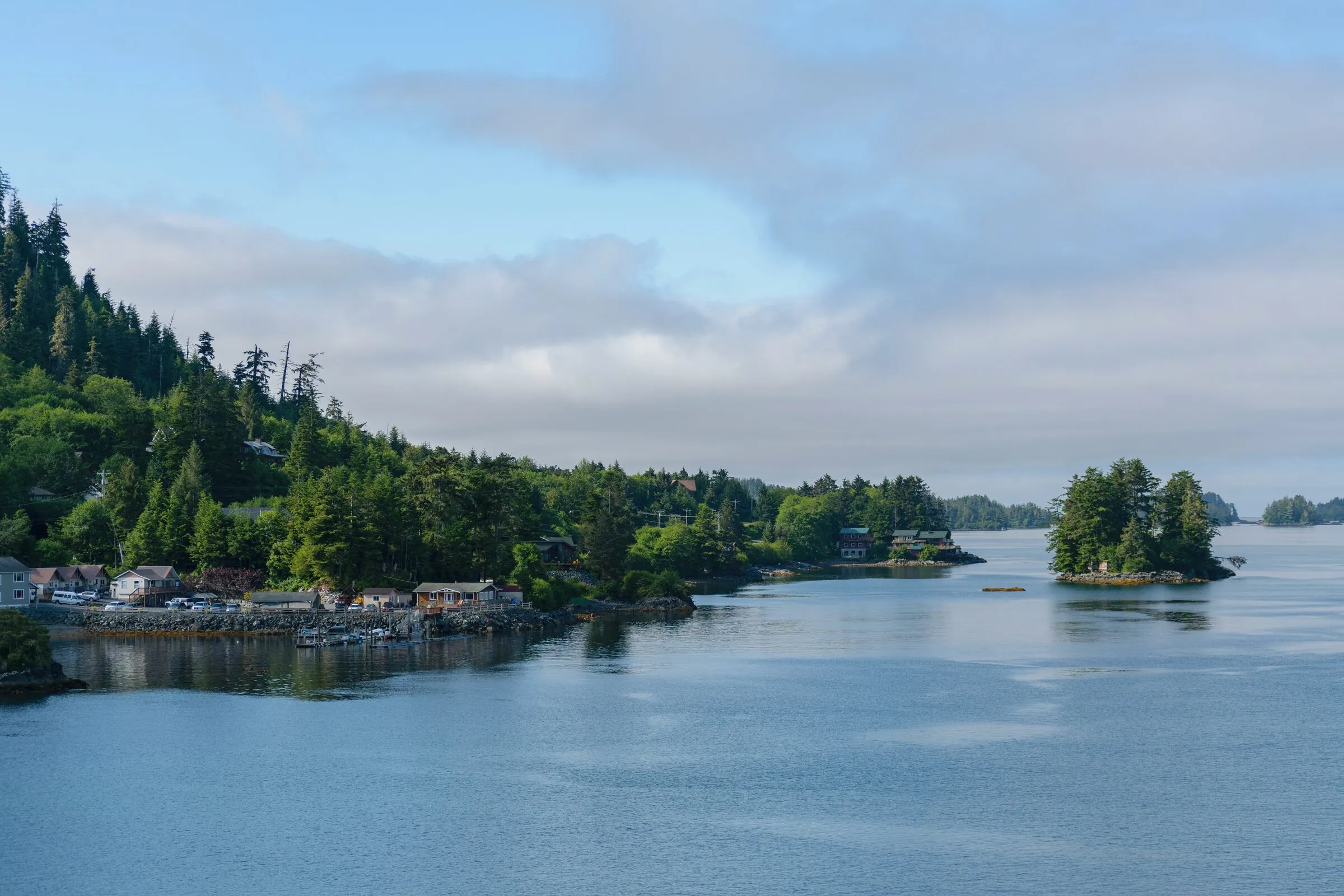
Sitka is the port most small-ship captains recommend and most cruise-ship itineraries skip — which tells you something about the experience. The big cruise lines dock in Juneau and Skagway (the glacier and the gold rush), leaving Sitka to the smaller ships and travelers with better research. That’s the strategic advantage: Sitka is the most culturally layered port on the Inside Passage, where Russian colonial history (the Russians held Alaska and established Sitka as their colonial capital in 1799) overlaps with Indigenous Tlingit heritage, where bald eagles congregate in visible numbers, and where the downtown core is small enough and human-scaled enough that it actually feels like a place rather than a port-of-call.
Most travelers who see Sitka either come via small ship (UnCruise, Lindblad, American Cruise Lines) or as an overnight add-on before or after other Inside Passage sailing. The port-day experience is shorter than Juneau or Skagway (typically 7–8 hours) but deeper — because there’s less crowding and more time for actual engagement with the place.
Here’s how I think about Sitka.
At a Glance
| Setting | A tranquil bay on Baranof Island, surrounded by dense evergreen forest and water on three sides. Small downtown core of about 8,000 people. Less crowded and more residential than other Inside Passage ports. Feels more Alaskan, less tourism-optimized. |
| Cultural significance | The Russian colonial capital of Alaska from 1799 to 1867 (when the Russians sold Alaska to the U.S.), and the center of Tlingit Native heritage. The layering of these two cultures is what makes Sitka distinctive. |
| Best season | May–September for cruise arrivals. Late May through mid-June offers longer days, lower cruise-ship crowds, and manageable weather. |
| Typical port day | 7–8 hours is the standard, usually arrived morning, departed late afternoon. Less time than Juneau or Skagway, but enough for the classic Sitka experience. |
| How to get there (overnight) | Float-plane from Juneau (45 minutes) or the Alaska Marine Highway ferry (about 9 hours from Juneau). Most visitors arrive via cruise ship or small-ship itinerary. |
| One thing most guides won’t tell you | Sitka is genuinely the port that rewards slower travel and small-ship itineraries. Large cruise ships dock here less frequently, which keeps the town from feeling like a cruise destination. You’ll encounter more local residents than tourists. |
Why I Send Travelers Here
Because Sitka is one of the great cultural-immersion ports in Alaska — small enough to walk, rich enough in history (Russian + Tlingit) to spend real time, and less touristically developed than the big cruise-ship ports. The Sheldon Jackson Museum has one of the strongest Alaska Native collections anywhere, the Russian Orthodox Cathedral is the oldest Orthodox church still in use in the U.S., the Sitka National Monument preserves totem poles and the location of the Alaska Native village of Kiks.ádi, and the Totem Square downtown holds the Sitka Pioneers Monument and the original-site totems.
Wildlife is visible here in a way it isn’t in other towns — bald eagles are genuinely common (hundreds nest in the area), and you’ll see them without a specialized wildlife tour just by walking around and looking up.
I send travelers here as part of the Inside Passage extension, or as part of a small-ship Alaska itinerary. For first-time Inside Passage travelers who want something beyond glaciers and gold-rush history, Sitka delivers the cultural-immersion and wildlife-viewing combination that justifies the longer sailing time to get here.
For Cruisers: Port Day Planning
Sitka is less commonly on big cruise-ship itineraries than Juneau or Skagway, which means if you’re here, you’re likely on a smaller ship or a more thoughtful itinerary. You’ll have 7–8 hours in port, usually morning to mid-afternoon departure.
The main decision: guided tour or independent exploration.
Guided option: Most small-ship operators and some larger cruise lines offer Sitka cultural tours (2–3 hours, often including the Sheldon Jackson Museum, a Russian cathedral, and a walk through town). These are solid if you want context and don’t want to self-navigate. Cost varies, typically $80–120 per person.
Independent option: Rent a car or walk/taxi downtown and navigate on your own. The town is small enough that you can cover the main sights in a few hours, and the pacing is more flexible.
Honest recommendation: For Sitka specifically, the guided tour is worth the cost if available — the Russian-colonial-history and Tlingit-heritage context makes the museums and monuments more meaningful. But a solo walking tour of downtown + the Sheldon Jackson Museum is a solid Sitka experience if you’re budget-conscious.
For Overnight Travelers
If staying overnight in Sitka (pre-cruise or post-cruise add-on), you have time for a genuine visit.
Where to Anchor:
Westmark Sitka (Katlian Street, overlooking Crescent Bay, 105 rooms) — the main hotel, with views and a downtown location. Standard Westmark formula, but well-positioned for access to the town.
Totem Square Inn (downtown, 12 rooms) — smaller, more intimate, directly in the historic core. Better character, fewer amenities, genuinely different from the chain hotels.
Sitka Hotel (Metlakatla Street, 10 rooms, historic building) — the most characterful option, in a restored historic building in downtown. Minimal amenities, maximum atmosphere.
Any of these works depending on your priority (property amenities vs. historic location).
What I’d Do With a Day in Port
Early Morning — Early-Bird Wildlife Walk
Start before 8 a.m. with a walk through the downtown core and the surrounding neighborhoods. Bald eagles are visible throughout Sitka in season; the early morning is your best chance of spotting them without a formal wildlife tour. Walk along the waterfront, through the residential areas near the harbor, and along Totem Square.
Mid-Morning — Museums & Russian History
Visit the Sheldon Jackson Museum (small but genuinely excellent Alaska Native collection — Tlingit, Haida, Athabascan, and other cultures well-represented). Allow 45 minutes to an hour. The context on Tlingit heritage sets up the rest of the day.
Walk to the Russian Orthodox Cathedral (New Archangel Michael Cathedral, the oldest Orthodox cathedral still in use in the U.S., built 1844). The interior is small but architecturally distinctive.
Late Morning / Early Lunch
Coffee or a light lunch at Bay Cafe or Ludvig’s Bistro (both genuinely good local spots, not cruise-ship food).
Browse the Sitka Pioneers Home and the Alaska Native cultural spaces if you want more context.
Afternoon — Nature & Reflection
The Sitka National Monument hike (easy 2-mile round-trip forest trail to Tlingit totem poles in their original context and the site of the original Kiks.ádi village). The trail is peaceful and genuinely interesting — not a heavily touristed experience, just a forest walk with cultural significance.
Or spend time at Crescent Bay or the Sitka Sound waters if wildlife viewing is the priority — the bay has sea otters, eagles, and water traffic that makes for good observation.
Late Afternoon — Departure Prep
If your ship departs early evening, allow time to return to the port with a buffer. If departing later, a final coffee and a walk back through downtown.
What I’d Do With Two or More Days
Take a full-day guided kayaking tour through Sitka Sound (eagle viewing, sea otter habitat, small islands and coves — a genuinely immersive water-based experience). Or book a float-plane flightseeing trip to nearby glaciers or wilderness areas. The longer you stay, the more Sitka opens up as a quiet place rather than a port of call.
Specific Things I’d Tell You About
The Sheldon Jackson Museum is one of Alaska’s best-curated small museums. The Alaska Native art collection is genuinely excellent — Tlingit totem-poles and carvings, Haida work, Athabascan pieces. The curatorial approach is respectful and historically serious. This museum alone justifies the Sitka visit.
The Russian Orthodox Cathedral is the oldest Orthodox church still in use in the continental U.S. Built in 1844, during the Russian colonial period, the interior is small and architecturally distinctive. The Russian-American cultural layering is visible in the architecture and the decorative details.
Bald eagles are common in Sitka Sound. You’ll see them without a formal wildlife tour — they’re visible on the water, in trees, and overhead throughout the area. No specialized tour required; just look up.
The Sitka National Monument preserves the site of the original Tlingit settlement, Kiks.ádi, with totem poles in their forest context. The 2-mile hiking trail is easy, peaceful, and genuinely culturally significant. Not a heavily touristed experience.
The Tlingit and Russian cultural heritage are genuinely layered here, not separate. Sitka is the place where you can understand how the Russian colonial period and the Indigenous heritage coexist and interact, rather than seeing them as separate stories.
What I’d Skip
Heavy shopping-focused time. Sitka’s downtown has shops and galleries, but it’s not a shopping destination like Juneau or Ketchikan. Spend your time on culture and nature, not retail.
The gold-rush tourist experiences. Sitka’s story is Russian colonial + Tlingit heritage, not gold rush. If you’re looking for that narrative, you want Skagway, not Sitka.
Packaged wildlife tours if you have port-day confidence. The wildlife here (eagles especially) is visible from walking and observation. A formal tour is overkill unless you specifically want naturalist interpretation.
Trying to cover too much. Sitka is small and walkable. Slow down. Spend real time at one or two places rather than rushing through multiple museums.
For Cruisers — The Ship vs. Independent Decision
What I’d recommend: If you’re on a small ship (UnCruise, Lindblad, American Cruise Lines), your itinerary likely includes a guided cultural component that’s well-designed. Trust your ship’s program. If you’re on a larger cruise ship and Sitka is offered as a port, the independent walking option (town + museums) is solid and gives you more flexibility than a guided excursion.
Either way, the Sheldon Jackson Museum and a walk downtown are the core Sitka experience. The Russian cathedral and the Sitka National Monument are excellent if time permits.
From the Journal
- Extending Your Alaska Trip: Inside Passage and Denali — the framework for making Sitka part of a bigger Alaska story
- Juneau Travel Guide — the sister Inside Passage port, 130 miles northeast
- Skagway Travel Guide — the sister Inside Passage gold-rush port
- Rivers & Small Ships — the small-ship sailing framework where Sitka shines
Plan With Me
If Sitka belongs in your trip — whether as a small-ship port, an overnight add-on, or part of a deeper Inside Passage exploration — I plan the logistics. The discovery call is where we figure out which version of Sitka works for your timeline and interests.
Book your free discovery call →︎
Last updated: April 2026. I keep this guide current. If a museum closes, a trail shifts, or cultural programs change, the page changes. Travel changes. The work doesn’t stop when the page goes live.
Plan this trip with me.
A 30-minute discovery call is where it starts. No fee, no pressure.
Book a Discovery Call