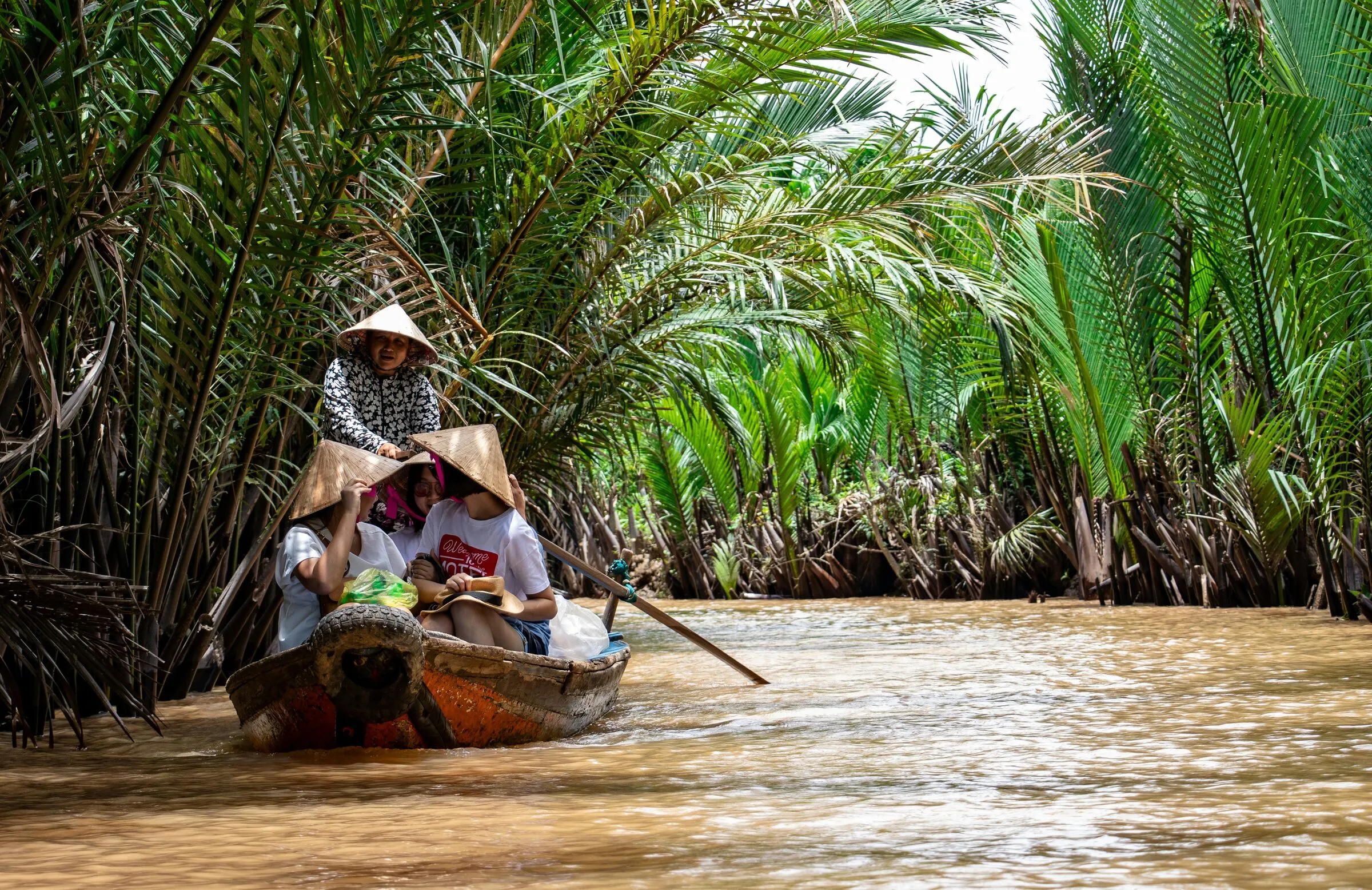
The Mekong at first light is described as improbable — the water carrying the color of the landscape it moves through, fishing villages still in morning quiet, the river surface wide enough that the far bank feels like a different country because it is. Between Siem Reap in Cambodia and Ho Chi Minh City in Vietnam, the Mekong connects two of Southeast Asia’s most layered destinations — and the ship is how you thread between them at the speed at which the region actually operates, not the speed of a flight itinerary.
This is the river on my list that I want people to know about. The Danube converts you to river cruising. The Mekong shows you what river cruising can be at its most transportive.
At a Glance
| Best season | October–April (dry season); November–February is peak, with cooler temperatures and low river levels ideal for navigation; avoid May–September monsoon season |
| Typical duration | 11–15 nights total package (3–4 land + 7-night river is the standard ‘Mekong Splendors’ shape; ‘Riches of the Mekong’ runs 14 nights total) + Thailand or Japan extension adds 5–8 nights |
| Classic routing | Siem Reap (fly in) →︎ Kampong Cham →︎ Phnom Penh →︎ Cai Be / Mekong Delta →︎ Ho Chi Minh City (fly home) — or reverse |
| Operator I recommend | AmaWaterways — the AmaDara was purpose-built for the Mekong and includes the most comprehensive Angkor province access of any river program in this category |
| One thing most guides won’t tell you | The floating villages between Kampong Cham and Phnom Penh change with the river’s water level — in low season, entire communities that sit on water are resting on dry land. The excursion here looks different depending on when you arrive. Both versions are worth understanding before you go. |
Why I Plan This River
The European rivers reward a specific kind of traveler: someone who wants to understand a place through its wine and its architecture and its thousand-year civic infrastructure. The Mekong rewards a different kind — someone who wants to be close to a country that hasn’t been designed for their comfort, where the beauty is less composed and the history is less processed, where the river is still infrastructure and not scenery.
Cambodia and Vietnam are extraordinary destinations on their own terms. What the Mekong does is connect them in a sequence that makes both comprehensible: the pre-colonial temple civilization at Angkor, the French colonial port cities, the delta rice economy, the markets, the wats, the street food culture that’s been refined for centuries without consultation from the outside world. The ship is slow. That’s the point.
I plan this river through AmaWaterways’ AmaDara program — my relationship with AmaWaterways means I know how this itinerary gets built and what makes it work specifically on the Mekong. The Angkor excursion program is the strongest in the category: three days based in Siem Reap before boarding, which is enough time to see Angkor Wat and Ta Prohm and Bayon without rushing any of them.
What I do with the Mekong that most advisors don’t: I build the extension. The Mekong sailing is seven nights on the river, eleven to fifteen days for the full package. It’s also the middle of a three-week Southeast Asia trip for travelers who are willing to do the thing properly. Thailand before (Bangkok and Chiang Mai), or Japan after — Tokyo and Kyoto — are the two extensions I’d put in front of you depending on what you’ve already seen and what you want to understand next. That full architecture is the trip worth planning.
The Ship I’d Book
AmaWaterways — the AmaDara
The AmaDara was purpose-built for the Mekong’s specific conditions: shallower draft than a European river vessel, air-conditioned public spaces that acknowledge the Southeast Asian climate, open-air deck areas for the evening boat experience. 124 passengers maximum — intimate by cruise standards, large enough to have the culinary and excursion programming that makes this category work.
The included excursion programming on the AmaDara is the most comprehensive thing AmaWaterways does on this itinerary: village temple visits, a school visit (with school supply donations the program coordinates), the floating village excursions, the sunset sampan ride in the Mekong delta. The local guides are the program’s best asset — trained, English-fluent, and from the communities you’re visiting.
For the ultra-luxe alternative — Aqua Mekong
Aqua Expeditions runs the Mekong on a different scale: forty passengers maximum (a third of the AmaDara), all-suite, all-inclusive, with a private-tender excursion model that gets you to villages and floating markets the larger ships can’t reach. The food register is closer to fine-dining-resort than river-cruise; the service register is closer to small-luxury-cruise than mass-product. This is the call when the trip is also a wellness or design-led experience — when the ship itself needs to feel like a destination rather than a vessel. The same Angkor pre-cruise frame works on either platform; the choice between AmaDara and Aqua Mekong is about the texture of the seven days on the river.
The Ports
Siem Reap (pre-cruise, 3 nights recommended) — The base for Angkor province. Three days is the minimum to see the Angkor complex without running through it: Angkor Wat at sunrise on day one (the reflection in the moat in the early morning light is the image you’ve seen; it’s better in person), Bayon and Ta Prohm on day two, the outlying temples and the Tonlé Sap lake on day three. The town of Siem Reap itself has a night market and a restaurant scene that’s disproportionately good for a city of its size.
Kampong Cham — The colonial-era Cambodian city with French-influenced architecture and the pre-Angkorian temples at Wat Nokor within easy reach. For decades, an iconic seasonal bamboo bridge across the Mekong was rebuilt each year before the wet season took it — replaced in 2017 by a permanent concrete bridge, though the tradition still influences how the river crossing is experienced and a smaller bamboo span is sometimes built between low-traffic areas.
Phnom Penh — The Cambodian capital. The Royal Palace and the Silver Pagoda are the composure of Khmer culture at its most formal. The Tuol Sleng Genocide Museum and Choeung Ek memorial are not easy visits — they’re necessary ones, for anyone who wants to understand the country beyond its temple civilization. I’d tell you how to approach both before you arrive.
Cai Be / Mekong Delta — The Vietnamese delta, where the river spreads into branches wide enough to feel oceanic. Floating markets, rice paper factories, coconut candy workshops, sampan rides through the narrow canals between fruit orchards. The delta is the working engine of Vietnam’s agricultural economy and also one of its most photogenic landscapes.
Ho Chi Minh City — The departure city, or the beginning of the Vietnamese extension. The Reunification Palace, the War Remnants Museum, the Ben Thanh Market, the Dong Khoi colonial quarter — Ho Chi Minh City is dense and fast and not interested in slowing down for you. Give it two nights minimum before flying home or continuing north.
Before You Board / After You Disembark
Siem Reap arrival (3 nights pre-cruise): The right hotel here puts you within walking distance of the old French quarter and the night market, with tuk-tuk access to the temple complex. There are several boutique properties in the category I love for this trip — the right one depends on your priorities. Discovery call is where that conversation goes.
Ho Chi Minh City post-cruise: Most passengers are here for one night before flying home. Two nights is better, especially if you want to see the city’s newer food and cocktail culture alongside the historical sites.
The Extension
This is where the Mekong itinerary becomes a three-week Southeast Asia trip — and where I do my best work on this river.
A note on how I build the land extensions. The trip-shaping is mine — which extension, what shape, how the energy threads through. The on-the-ground execution runs through a ground partner I match to the trip. My role on that side is matchmaker: each leg gets the operator whose local depth fits what the country needs from the trip. The Thailand extension runs through specialists who handle the Bangkok–Chiang Mai pairing the right way (the proper guides, transport that respects the heat and the traffic, food access at the level you came for). The Japan extension runs through cultural-immersion operators with deep local Japan teams. The Vietnam-north extension up through Hoi An, Hanoi, and Ha Long Bay sits with bespoke operators who run the country in two registers — the standard-luxury layer at the right price-quality, and the ultra-luxe layer (privately rented junks on Ha Long, off-grid Sapa property, the kind of bespoke that doesn’t come pre-built) where Remote Lands is the call. The structural rule is consistent: my strategy, executed through the partner who lives in the country.
Thailand before (most common): Fly into Bangkok 5–7 days before Siem Reap. Bangkok for three nights (the Chao Phraya riverside temples, the street food, Chatuchak Market on a weekend), then Chiang Mai for two nights (the moat city, Doi Inthanon, a cooking class in the old quarter), then fly to Siem Reap for the Angkor days before boarding. This is the cleanest extension and the one I’d recommend to most first-time Southeast Asia travelers.
Japan after (for the traveler who wants contrast): Fly Ho Chi Minh City to Tokyo after disembarking. Five to eight nights — Tokyo for three, Kyoto for two or three, a bullet train connection, a ryokan night if the budget and timing work. The contrast between the delta heat and the temple discipline of Kyoto is genuinely striking; they inform each other in ways that are hard to predict and easy to feel.
Vietnam north (for deeper Vietnam): If Southeast Asia rather than Japan is the direction: Ho Chi Minh City →︎ Hoi An →︎ Hanoi, up the country, ending with Ha Long Bay before flying home. This is a longer trip — plan for four weeks total — and requires the right energy for it.
What I’d Skip
The Mekong in the shoulder season without understanding the river conditions. High water versus low water changes what the excursions look like, where the ship can navigate, and whether the floating villages are on water or land. This isn’t a reason not to go — it’s a reason to talk through timing with someone who knows what the trade-offs look like.
Angkor Wat at midday. Sunrise is cliché for a reason. Midday is genuinely unpleasant — heat, crowds, the light doing nothing for the stone. The early morning visit, before the tour groups arrive from Siem Reap, is the temple as it was meant to be experienced.
Rushing the Phnom Penh historical sites. The Tuol Sleng and Choeung Ek visits require time and emotional space. I’d schedule them earlier in the Phnom Penh day, not as the last stop before returning to the ship.
Plan This River With Me
The Mekong is the trip I’d plan for someone who’s ready to leave the European template behind. Thirty minutes on a call and we figure out whether Thailand or Japan is the right extension, which version of the itinerary fits your travel style, and how to make Cambodia and Vietnam feel complete rather than rushed.
Last updated: May 2026 · Guide reflects AmaWaterways AmaDara programming as of this date. Mekong water levels and excursion logistics vary by season.
Plan this trip with me.
A 30-minute discovery call is where it starts. No fee, no pressure.
Book a Discovery Call