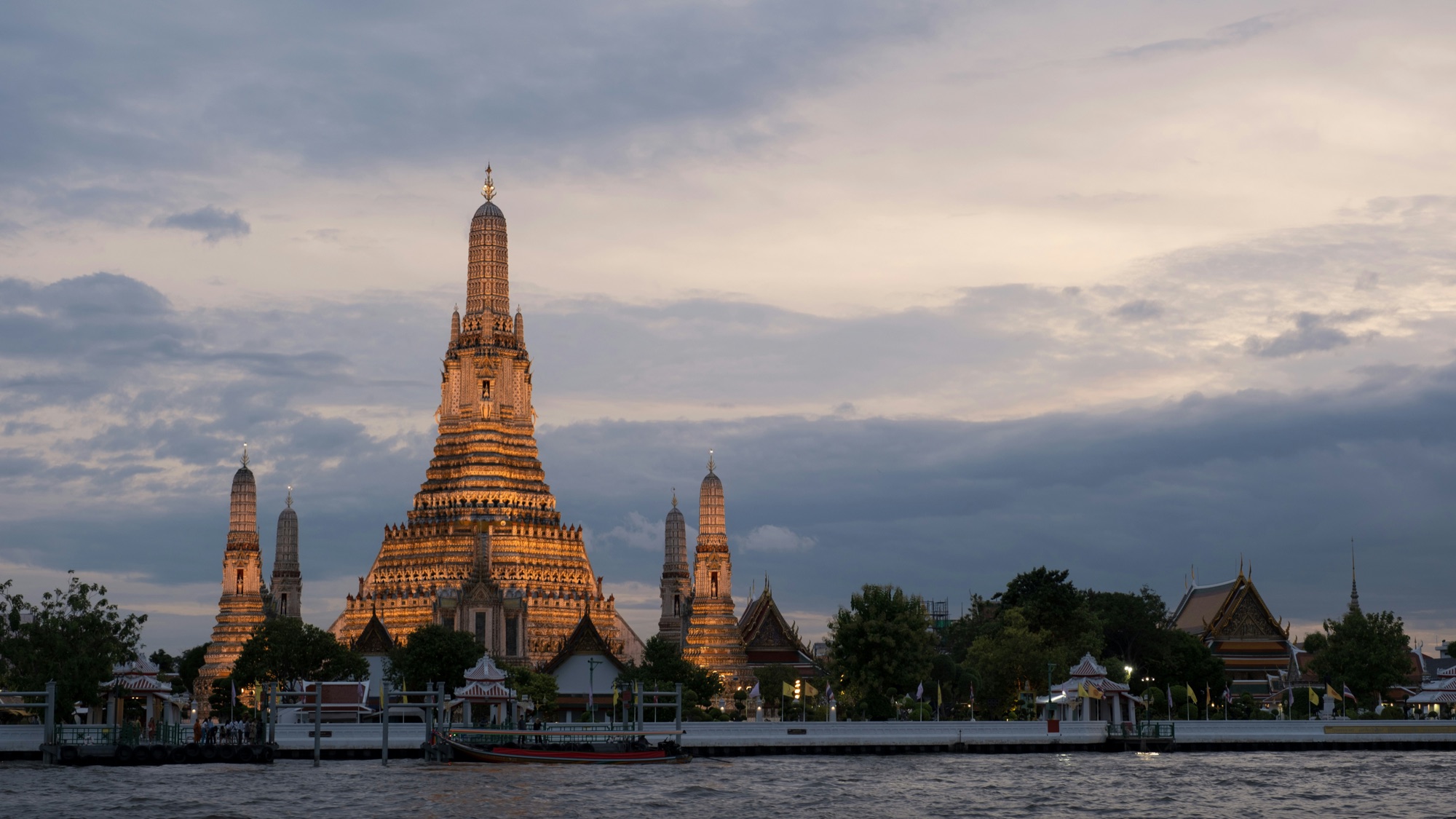
Thailand is the rare long-haul country where the standard two-week itinerary is genuinely good — a few days in Bangkok, a few in the north, a beach finale — and where the difference between a good version and a great one comes down to two decisions most travelers never realize they’re making. The first is which island coast you go to, and that’s not a taste question — it’s a weather question, and the two coasts are on opposite monsoon calendars. The second is how much of the country you try to see, because Thailand tempts you to add a fourth and fifth region and the trip is better when it doesn’t.
Done well, Thailand is a crescendo — the city first, while you’re fresh and jet-lagged and a temple-and-street-food blur is exactly the right energy; then the slower, cooler, more cultural north; then the islands last, when all you want is a beach and a boat and someone bringing you a drink. Done poorly, it’s a flat sequence of nice hotels in the wrong order, an island in the rainy season, and a Bangkok stop so short it’s just an airport with traffic.
Most travelers come to me about Thailand in one of three shapes: as a first big trip to Asia (the dominant one — Bangkok plus the north plus one island, ten to fourteen nights, the classic and correct introduction), as a honeymoon (the same arc, planned for two, ending on the beach with the crescendo doing the emotional work), or as the front or back half of a longer Southeast Asia trip (Bali, Vietnam, Cambodia, or a Mekong river stretch attached to the Thailand core).
Here’s how I think about it.
At a Glance
| Best time to visit | November to early April is Thailand’s cool, dry high season — and the only window when the famous Andaman beaches (Phuket, Krabi, Phang Nga) are reliably sunny. December through February is the sweet spot: dry everywhere, comfortable in the north, peak on the Andaman coast. The catch: the Gulf islands (Koh Samui and its archipelago) run on a different calendar — their best months are roughly February to September (best June–August), exactly when the Andaman is wettest. This two-coast split is the single most important thing to understand about timing a Thailand trip. |
| How long to stay | Ten nights is the floor for city + north + one island; twelve to fourteen is the right length and the one I build most often. Under ten nights, drop a region rather than rushing all three — a four-night Bangkok-and-islands trip beats a hurried city-north-beach sprint. |
| How to get there | Most travelers route through Bangkok (BKK — Suvarnabhumi), the regional hub, often via a Middle East or East Asia connection (Doha, Dubai, Singapore, Hong Kong, Tokyo, Seoul). Domestic flights from Bangkok to Chiang Mai, Phuket, Krabi, and Koh Samui are short, frequent, and cheap — internal hops are an hour or so and the backbone of how the country connects. |
| Currency / language | Thai baht (฿). Cards work at hotels, malls, and upper-tier restaurants; carry cash for street food, markets, taxis, tuk-tuks, and temple donations — and Thailand’s street food is some of the best eating in the world, so you’ll want it. Thai is the language; English is widely spoken in Bangkok, Phuket, and tourist areas, thinner in the rural north. A translation app earns its place. |
| One thing most guides won’t tell you | The wrong-coast mistake is the most expensive error in Thai trip planning — and it’s invisible until you’re standing in the rain. A July honeymoon that ends on Phuket is fighting the Andaman monsoon; the same July honeymoon ending on Koh Samui is in the Gulf’s good season. The coast is not a preference. It’s a function of your dates, and getting it right is most of the planning value. |
Why I Send Travelers Here
Because Thailand is the most complete trip in Asia — a genuine world-class city, a distinct and gentle northern culture, and beaches that hold their own against anywhere on earth, all in one country, on one visa, connected by one-hour flights. It’s the introduction-to-Asia trip I send first-timers on with the most confidence, and it’s a country I know in the way you only know a place after planning it over and over: where the seams are, which version of each region earns its days, and where the standard itinerary quietly costs you the trip.
It’s also a country with real range. The same arc — Bangkok →︎ the north →︎ the islands — works as a culture-forward first trip, a beach-anchored honeymoon, or a food-obsessed deep dive, and the shaping is what makes it one or the other: how many nights against each region, which island coast, where the splurge property sits in the sequence, whether the north is Chiang Mai’s craft-and-temple city or the Golden Triangle’s elephant-camp wilderness.
Here’s how I think about Thailand specifically. The trip-shaping work is mine — what kind of Thailand, how the regions sequence, which coast your dates point to, where the crescendo property lands. That’s the editorial work, the part where the trip earns its money. Bangkok itself I plan with a lighter touch — it’s a sophisticated, navigable, English-friendly city where an independent-minded traveler does beautifully with great hotels, a few reservations, and a couple of fixers for the things worth doing right. The north and the islands are where ground support earns its keep — the private guides who make Chiang Rai’s temples and tea country legible, the elephant-camp logistics, the long-tail boat days through Phang Nga Bay, the transfers and translation that turn a good island stay into a seamless one. My role on that side is matchmaker. The bench is curated, vetted, and sized to the trip. For travelers in the Abercrombie & Kent register — full access infrastructure, bespoke-deep, the brand’s well-known executional layer, with their own offices in Bangkok, Chiang Mai, and Chiang Rai — A&K Thailand is the operator I’d route you to. For the bespoke range below that, the bench includes specialists with deep in-country Thai teams who run the trip with the same care at a more accessible price-quality ratio. The structure is consistent: my strategy, executed through the partner who lives in the country.
Every recommendation across this guide and its five city-and-region pages comes through that lens — how I plan Thailand for the travelers I send, the hotel relationships I rely on, and a clear point of view about which version of each region is worth your days.
The Two Coasts — and Why It’s the Whole Game
This is the section I wish every Thailand traveler read first, because it quietly determines whether your beach week is sunny or soaked.
Thailand has two island coasts on opposite monsoon schedules, and they do not overlap cleanly:
The Andaman coast — the west side, facing the Indian Ocean: Phuket, Krabi, Phang Nga Bay, Khao Lak, the Phi Phi and Similan islands. This is the postcard coast — the limestone karsts rising out of jade water, the James Bond Island scenery, the long-tail boats. Its high season is November to April, dry and sunny, with the December–March stretch the most reliable. May to October is its monsoon — afternoon downpours, rough seas, some boat operators and smaller islands shut down entirely.
The Gulf coast — the east side, facing the Gulf of Thailand: Koh Samui, Koh Phangan, Koh Tao. Its calendar is nearly inverted. The Gulf islands are at their best roughly February to September, with a genuinely good stretch in June, July, and August — exactly when the Andaman is rained out. Samui’s wettest months are October through December, when Phuket is hitting its stride.
So the rule is simple and it’s the whole game: if your trip lands November through April, you go to the Andaman — Phuket and its bay. If it lands June through September, you go to the Gulf — Koh Samui. The shoulder months (May, October) are judgment calls I make trip by trip. Booking a Phuket honeymoon in July, or a Samui one in November, is the classic wrong-coast mistake — and it’s the easiest mistake in Thai planning to make and the most painful to discover on arrival.
This is also why “where should we go in Thailand?” is the wrong first question. The right first question is when can you travel — and the coast follows from that.
The Five Places I’d Send You
Thailand, the way I plan it, is built from five regions. Most trips use three of them — Bangkok, one northern stop, one island — and these five pages are the deep version of each:
Bangkok — the city. The world-class, frenetic, gloriously edible capital. The trip starts here, jet-lag and all, because Bangkok rewards the wide-eyed energy of arrival. Temples on the river, the best street food on earth, rooftop bars, and a hotel scene that runs from legendary riverside grande dames to design-forward boutiques.
Chiang Mai — the cultural north. The old Lanna kingdom’s capital — temples, craft workshops, cooking schools, night markets, and cooler mountain air. The slower, gentler, more cultural counterweight to Bangkok, and the easiest northern stop to love on a first trip.
The Golden Triangle — the wild north. Where Thailand, Laos, and Myanmar meet across the Mekong — Chiang Rai’s white-and-blue temples, the hill-tribe country, tea plantations, and the celebrated ethical elephant camp that’s the centerpiece of the region. The choice when the north should feel like wilderness, not a city.
Phuket — the Andaman beach. The high-season island: Phang Nga Bay’s limestone karsts, private long-tail boat days, and a coastline of luxury resorts from clifftop Amanpuri to design-led boutiques. Where most November–April trips end.
Koh Samui — the Gulf beach. The summer island, on the opposite monsoon calendar — coconut-palm coastline, calmer-paced resorts, and the right beach finale for a June–September trip.
How I’d Sequence It
The arc almost never changes — city first, north second, island last — and the crescendo is the point. You arrive into Bangkok’s energy when jet lag makes you wired anyway; you decompress into the north’s slower rhythm; you finish flat on a beach with nothing left to do but enjoy it. Building the islands first wastes them on travelers who are still keyed up, and ending in Bangkok sends you home from a megacity instead of a hammock. The sequence does real emotional work.
The classic ten-night trip (the one I build most): Bangkok (3 nights) →︎ Chiang Mai (3 nights) →︎ an island (4 nights). It gives each region enough time to register without rushing, and the island gets the longest stay because it should. Coast chosen by your dates — Phuket in the dry Andaman season, Koh Samui in the Gulf’s summer window.
The fourteen-night version adds depth rather than a fourth region: Bangkok (3–4) →︎ the north (4, with the Golden Triangle’s elephant camp added to or substituted for Chiang Mai) →︎ the island (5–6). Two extra island nights change the whole texture of a beach finale, and the longer northern stretch is where a private guide and the elephant experience earn their place.
The honeymoon version is the same arc, planned for two and weighted toward the crescendo — a little more Bangkok glamour up front, the north for the shared cultural day or two, and the longest, best-placed beach stay at the end, in the property that does the emotional closing. (More on that below.)
The Southeast Asia–extension version treats Thailand as the anchor and attaches a neighbor: a Mekong river stretch, a few days in Bali on the back end, or Vietnam/Cambodia on the front — with the Thailand core kept intact and the extension added rather than carved out of it.
What I almost always talk travelers out of: a fourth Thai region. The pull to add Krabi and Phuket, or Chiang Mai and the Golden Triangle and an island, is real — and it turns a paced trip into a packing-and-transferring one. Depth in three regions beats a glance at five.
Specific Things I’d Tell You About
The two-coast monsoon split is the whole timing game. (See the section above — it’s important enough to say twice.) Your dates choose your coast; the coast is not a taste preference. This one decision is most of the planning value in a Thailand beach trip.
Bangkok is far more navigable than its reputation. The traffic is real, but the BTS Skytrain and MRT subway glide over and under it, the Chao Phraya river boats turn the riverside temples into a scenic commute, and the city is genuinely English-friendly. Bangkok is the rare Asian megacity an independent traveler handles comfortably — which is exactly why I plan it with a lighter hand than the north or the islands.
Songkran (Thai New Year, roughly April 13–15) is a nationwide water fight — and you should decide deliberately. The whole country erupts into days of joyful street-wide water-throwing. It’s one of the world’s great festivals if you want in; it’s chaos if you’re expecting a quiet temple trip. Same for Loi Krathong / Yi Peng (the November lantern festival, centered on Chiang Mai) — extraordinary, and worth timing toward on purpose rather than stumbling into.
Temple dress codes are real and enforced. Shoulders and knees covered at the major wats — including Bangkok’s Grand Palace and Wat Phra Kaew, which turn away the underdressed. Carry a light layer; it’s a sign of respect, not a suggestion.
“Same same but different” and sabai sabai are the cultural key. Thailand runs on a genuine ease — sabai sabai means relaxed, comfortable, no-worries — and the trips that go best are the ones that flex with it. The food cart that’s out of the dish you wanted, the boat that leaves on Thai time: roll with it. The country rewards the unhurried.
The food is the trip, not a detail of it. Thailand has some of the best street eating on earth, and the cooking-school morning — markets, then a half-day learning to make the dishes — is one of the most rewarding cultural experiences in the country, not a filler activity. I build at least one into most trips; it’s the kind of day travelers talk about for years. (A honeymoon couple I planned still cites their Bangkok market-and-cooking day as a trip highlight — and that’s the rule, not the exception.)
Private beats group on the water, every time. The Phang Nga Bay day, the island-hopping, the snorkeling runs — the private long-tail or speedboat with your own crew is a different experience from the packed group tour, reaching beaches the big boats skip and running on your clock. I offer both and build the budget around private; it’s consistently the day clients call the highlight.
What I’d Skip
The wrong coast for your dates. Said three times now because it’s the one that actually ruins trips. Don’t let a brochure photo of Phuket’s karsts pull you there in July.
A Bangkok stop so short it’s just the airport. One night in Bangkok “to break up the flights” wastes a genuinely great city. Give it three nights or treat it as a connection — the in-between version is the worst of both.
The full-moon-party / backpacker-island circuit, if that’s not the trip. Koh Phangan’s party scene and the budget-backpacker islands are wonderful for what they are and a mismatch for a honeymoon or a luxury trip. Know which Thailand you’re booking.
Cramming a fourth region. The transfer days eat the trip. Three regions, done with time, is the version that earns the long-haul flight.
The elephant attractions that let you ride. Ethical elephant tourism in Thailand has moved decisively away from riding and shows toward observation-and-care sanctuaries — and the good camps are genuinely good. I only route travelers to the ethical ones; the riding-and-circus operations are a hard no. (More on the right camp on the Golden Triangle page.)
For Honeymooners
Thailand is one of the great Asian honeymoons — and the reason is the crescendo. The arc that works for everyone works especially for two: Bangkok’s glamour and street-food electricity up front, a shared cultural day or two in the north, and then the longest, best stay of the trip on a beach at the end, in a property chosen to do the emotional closing. The whole trip leans toward that final island stretch, and the final hotel matters more than any other single choice.
The coast still follows your wedding date — Phuket for a November–April honeymoon, Koh Samui for June–September — and the island page for your season has the property-by-property read. What I’ll say at the country level: end on the warmest, most personal property, not the flashiest. The crescendo closes on the place that makes you feel looked after, and that’s a deliberate sequencing choice, not an accident of which hotel had availability. I’ve planned this arc enough times to know the last property is the one couples remember — so it’s the one I anchor the budget around.
If you want me to design the full Thailand honeymoon — the Bangkok front, the northern day, the island finale, the cooking class and the private boat day and the property that closes it — that’s exactly the kind of planning I do. Start a discovery call.
For First-Timers to Asia
Thailand is the trip I most often recommend as a first big Asia trip, and the reason is that it’s forgiving in all the right ways — English-friendly where it counts, easy to connect, genuinely safe for the standard traveler, and structured around an arc that almost plans itself once the coast is set. You get a world-class city, a distinct culture, and a beach finale without the steeper learning curve of some neighbors.
The first-timer version is the classic ten-to-twelve-night arc: Bangkok →︎ Chiang Mai →︎ an island. It’s the one I build with the most confidence, and the shaping work — the right number of nights, the coast that matches your dates, the cooking class and the private boat, the hotels that fit how you actually travel — is what turns a good first trip into the one that makes you a return traveler to Asia.
If you want me to design your first Thailand trip, start a discovery call.
Plan Thailand With Me
If you’re thinking about Thailand as a first trip to Asia, a honeymoon, or the anchor of a longer Southeast Asia arc — that’s exactly the kind of planning I do. A 30-minute discovery call is where it starts. No fee, no pressure. We figure out when you can travel first, because that chooses your coast — and from there the trip almost shapes itself: the city, the north, and the island that matches your dates.
Book Your Free Discovery Call →︎
Last updated: May 2026. I keep this guide current. If a hotel I recommend slips, a camp changes hands, or access to a region shifts, the page changes. Travel changes. The work doesn’t stop when the page goes live.
Plan this trip with me.
A 30-minute discovery call is where it starts. No fee, no pressure.
Book a Discovery Call