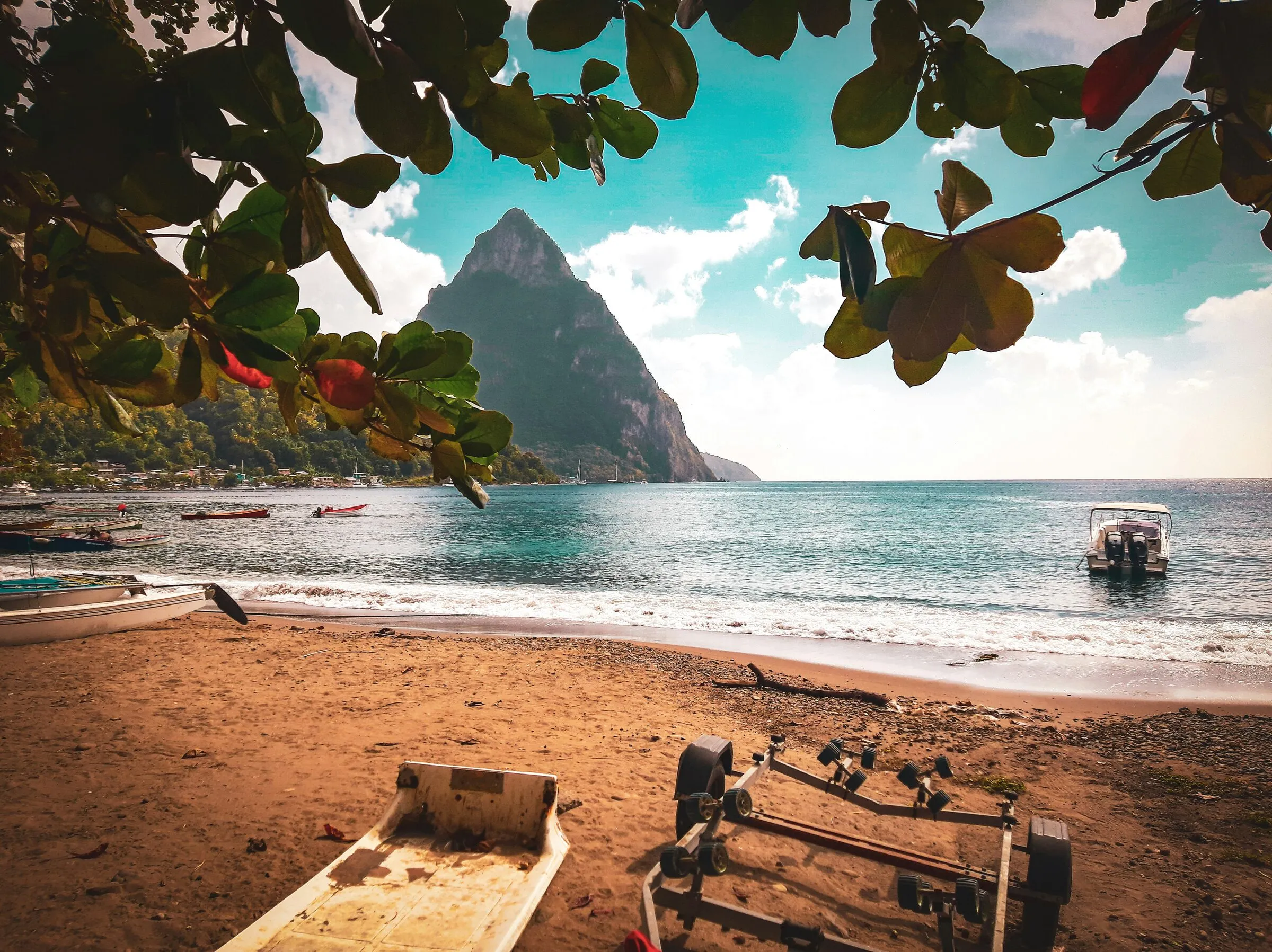
St. Lucia exists in a specific category of Caribbean destination: it’s luxurious enough for a honeymoon, dramatic enough to feel like you’ve gone somewhere real, and small enough to feel manageable in three or four days. The Pitons — those distinctive twin peaks that rise straight from the water — are the island’s signature, and they’re not overclaimed in the brochures. They’re genuinely imposing and genuinely beautiful.
What most couples don’t know before they arrive is that St. Lucia is significantly hillier and more developed than its island neighbors. There’s a real city (Castries), real local commerce, and real Caribbean culture running parallel to the resort strip. This is the island’s advantage over the flatter, more exclusively resort-based alternatives like the Grenadines or Turks and Caicos. You can stay in luxury, but you’re anchored to an island that has a life beyond tourism.
Most clients come to me asking about St. Lucia in one of two contexts: as a honeymoon, or as one leg of a larger Caribbean sweep (often including Barbados or Grenada). Here’s how I think about it.
At a Glance
| Best time to visit | December–April for warm, dry weather and the most stable conditions. May is shoulder season (warm but occasional rain, fewer crowds). June–November is hurricane season — occasional storms but also the quietest and cheapest months. Most honeymooners should anchor to December–March unless you’re chasing a deal and comfortable with tropical showers. |
| How long to stay | Three nights minimum, four or five for a honeymoon. The island rewards a slower pace — you can day-trip around the Pitons, but the anchor experience is the resort itself. |
| How to get there | International flights to Hewanorra International Airport (UVF) on the southern tip, about 90 minutes by car from the northern Pitons resorts, or Vigie Airport (SLU) in Castries on the northern coast if available (flight options are more limited here but significantly closer to the Pitons hotels). Most resorts arrange transfers; confirm the drive time upfront. |
| Currency / language | East Caribbean Dollar (EC$), though USD is accepted everywhere. English is official and widely spoken. French patois is still spoken by older locals, a remnant of the colonial back-and-forth. |
| One thing most guides won’t tell you | The drive from the southern airport to the northern Pitons hotels is long (90+ minutes on a winding road). If you book a resort near the Pitons, factor in the drive time and jet lag accordingly. Also: St. Lucia is humid and can rain suddenly even in dry season. Pack a lightweight rain jacket and don’t let a brief shower stop your plans. |
Why I Send Travelers Here
Because the Pitons are genuinely dramatic and create a sense of place that generic Caribbean islands don’t. Because the island has enough real culture and commerce to feel connected to something real, not just a theme-park version of “the Caribbean.” Because the resorts in the Pitons area — Jade Mountain, Sugar Beach, Ladera — are among the most visually distinctive properties in the Caribbean.
I send couples here for honeymooners who want drama and luxury without leaving the Caribbean. I send travelers doing a longer Caribbean swing who want a strong anchor point. I send milestone anniversaries looking for a fresh take on the Caribbean hotel experience.
Where I’d Anchor
St. Lucia’s resorts cluster in a few geographic zones: the Pitons area (Soufrière, the village nearest the peaks), the south coast beaches, and the Castries area to the north. For honeymoons, the Pitons zone is the only choice — that’s where the geography draws your eye and holds it.
Jade Mountain sits on the cliffs above the Pitons with overwater sanctuaries — glass-walled, open-air suites that cantilever over the sea so dramatically they blur the line between indoors and outdoors. Every suite faces the Pitons directly. It’s the architectural anchor of the island. On my rate at the property, the amenity layer is meaningful and doesn’t book direct — calibrated to your dates and the sanctuary category, and the specifics get walked through on the discovery call.
Sugar Beach, a Viceroy Resort (southern Pitons facing east) is the more traditionally structured hotel — beachfront, overwater suites, a proper spa, better for travelers who want amenity options alongside the Pitons view. Service is Viceroy-standard (warm, professional, attentive). On my rate at the property, the amenity layer doesn’t book direct, deepened materially on the higher suite categories. The specifics get walked through on the discovery call.
Ladera sits between Jade Mountain’s extreme drama and Sugar Beach’s traditional comfort — cliffside but less cantilever, with open-sided rooms, the Pitons visible from bed, and a smaller footprint than Sugar Beach. Best if you want “Pitons drama” with less architectural extremism. On my rate at the property, the amenity layer is calibrated to your stay rather than itemized in advance — what applies depends on dates and the suite category, and we walk through it on the discovery call.
Want one of these? Start a discovery call — I quote rates, walk through room categories and Pitons angles, and confirm what applies to your dates.
On the Water
St. Lucia is also where one of the best ways to see the Eastern Caribbean begins — under sail.
The island is a natural jumping-off point for the Windwards and the Grenadines, and the way I’d do that stretch isn’t resort-to-resort, it’s by tall ship. Star Clippers runs actual clipper ships through these waters — real masts, real canvas — anchoring off the Pitons and threading the small islands the big ships pass, the Caribbean roughly the way it moved a century ago. You wake up somewhere new, the sails go up, and the island-hopping does itself.
It’s a different trip from the cliffside-resort honeymoon above — more movement, more sea, fewer infinity pools — and it’s the one I reach for when there’s a sailor at the table. The full picture lives on my small ship cruises page.
What I’d Do With Four Days
Day One — Arrival and Pitons Introduction
You’ll arrive at Hewanorra and drive north for 90+ minutes to your resort near the Pitons. Use the drive to adjust to the light, the pace, the vegetation. The island shifts from flat to steep around the Pitons area — you’ll feel it.
Check in, settle at your resort. Dinner at the resort restaurant or, if you’re not jet-lagged, at a small casual spot in Soufrière village (10 minutes by taxi/transfer). Early night — the drive is long.
Day Two — Pitons and Sulphur Springs
Morning: boat excursion to the Pitons (a half-day catamaran with snorkeling below the peaks, usually including a visit to the Sulphur Springs — a natural hot-spring area in the water where you can float in warm mineral water). The Pitons from the water are different from the view from your resort; the boat trip earns the time. Lunch usually included.
Afternoon: return to resort. Spa treatment or pool time. Dinner at the resort or back in Soufrière.
Day Three — Drive the Coast
Morning at the resort or a casual beach walk. Late morning: hire a driver or take a guided tour to drive the western coast toward Castries (if that appeals) or south to Vieux Fort and back (about 3-4 hours round trip). The island’s landscape is best understood from a car. Lunch at a local spot — not all resorts, just a casual roadside restaurant in a village.
Afternoon: return to resort. Sunset from your room or the resort terrace. Dinner at a restaurant outside the resort if one appeals, or back at the hotel.
Day Four — Final Hours
No activities. Breakfast at the resort. One last snorkel if your room/beach allows. Pack. Late lunch. Transfer to the airport for your evening flight.
Specific Things I’d Tell You About
The Pitons are genuinely impressive from both the sea and from the air. If you’re arriving by plane to Vigie Airport (north), you’ll see them as you approach. If you’re driving from Hewanorra, you’ll see them as your destination comes into view. Both perspectives are worth experiencing.
Jade Mountain’s glass-walled sanctuaries are as visually striking as they appear in photographs. They feel like you’re sleeping outside on a cliff above the Pitons. The trade-off is that they’re not for travelers who want traditional hotel privacy (the glass walls slide open, and yes, people can see in). It’s theatrical, but it’s intentionally so.
The Pitons boat excursion is worth the time and money. The view from the water is genuinely different from the view from land. Also: the Sulphur Springs warm-water float is surprisingly relaxing.
Soufrière village is genuinely local and worth a meal. There are several casual spots where locals eat, prices are reasonable, and the food is Caribbean-authentic. Pick a spot, sit down, and eat. Don’t overthink it.
The drive from the southern airport is real, but the scenery is worth experiencing. Use it as a transition day. Don’t schedule activities on arrival day — you need the drive to decompress.
St. Lucia can be humid and rainy even in dry season. Pack a lightweight rain jacket and embrace the tropical showers when they come. They usually pass within 30 minutes.
What I’d Skip
Multiple boat excursions. One Pitons boat trip is enough. Adding a fishing excursion or a second boat tour starts to feel like optimization rather than experience.
The “island tour” via minivan with 20 other tourists. If you want to see the island, hire a driver privately or take a guided small-group tour (4-6 people). The mass-tourism version is exhausting.
Trying to “do” Castries. It’s the island’s capital and has real Caribbean character, but most honeymoon couples find it feels tacked on. If you’re interested in a city exploration, plan a day. If you’re not, skip it — the Pitons don’t need contextualization.
Eating every meal at the resort. Most Pitons resorts have good restaurants, but the island has better food in local spots. Pick one dinner out in Soufrière — the change of scenery matters.
Booking activities for each day. One boat trip and one drive or spa treatment is the optimal activation. The Pitons work best when you let them be background to your vacation, not the center of a packed itinerary.
For Honeymooners
St. Lucia for a honeymoon is about the Pitons, the cliffside drama, and the balance of luxury with Caribbean authenticity. Book four nights if possible. Three is the minimum.
Jade Mountain if you want maximum architectural drama and visual intensity. Sugar Beach if you want more traditional hotel comfort with Pitons views. Ladera if you want the middle ground — Pitons drama without the glass walls.
The trip doesn’t need to be complicated. One boat excursion, dinners at the resort, one or two meals in Soufrière, one or two spa treatments. The Pitons are the main event; everything else is support. Design your days around protecting time to actually look at them.
Plan St. Lucia With Me
If you’re thinking about St. Lucia as a honeymoon, as a Caribbean anchor point, or as your first experience with the dramatic Caribbean — that’s exactly the kind of planning I do. A 30-minute discovery call is where it starts. No fee, no pressure. We talk about your pacing preferences, what appeals to you about the Pitons, and which resort character matches your sensibility.
Book Your Free Discovery Call →︎
Last updated: April 2026. I keep this guide current. If a resort changes operators, a boat excursion shifts schedules, or the Pitons (unlikely as it is) go anywhere, the page changes. Travel changes. The work doesn’t stop when the page goes live.
Plan this trip with me.
A 30-minute discovery call is where it starts. No fee, no pressure.
Book a Discovery Call