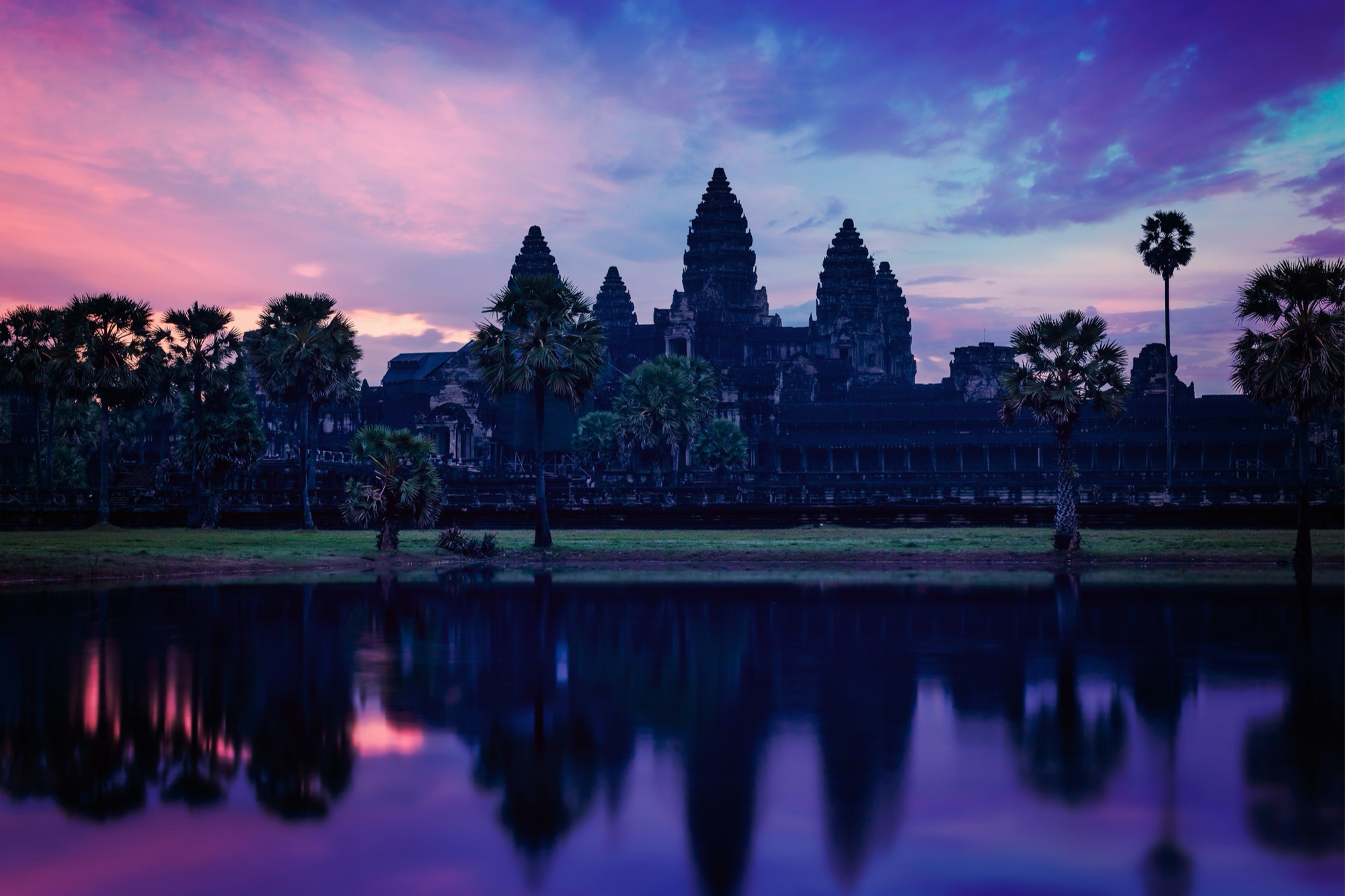
Siem Reap is the gateway to Angkor — the largest religious monument complex on earth, the capital of the Khmer empire for six centuries, and one of the genuine bucket-list sights of the world. For travelers building an Indochina trip, it’s the cultural capstone: the temples that make the whole trip sing, reached either by a short flight from Saigon or, more gracefully, by a Mekong river cruise that carries you up from Vietnam through Phnom Penh.
Done well, Angkor is three nights of temples paced so they don’t blur — the sunrise over Angkor Wat done smart, the face-towers of the Bayon, the tree-swallowed ruins of Ta Prohm, the jewel-box carvings of Banteay Srei — with the town’s dance and food and a Tonle Sap afternoon woven in. Done poorly, it’s a sunrise-to-sunset temple grind that turns the world’s greatest archaeological site into a forced march, the wonders dissolving into temple-fatigue by day two.
The two things that make or break Angkor: pacing (the temples reward a guide and a rhythm, not a checklist) and the sunrise play (the famous Angkor Wat dawn is magical and mobbed, and there’s a smart way to do it). Both are exactly what a ground partner and a good plan deliver.
Most travelers come to me about Siem Reap as the cultural capstone of an Indochina trip — three nights after Vietnam, reached by flight or by Mekong cruise via Phnom Penh.
Here’s how I think about it.
At a Glance
| Best time to visit | November to February — Cambodia’s cool, dry season and the prime window (comfortable temperatures, blue skies). March to May is brutally hot; June to October is the wet season (lush and green, fewer crowds, dramatic skies, occasional downpours — and the temples’ moats and reflections are at their best). November–February is the sweet spot. |
| How long to stay | Three nights is the right length — enough for the great temples paced properly, plus the town and Tonle Sap, without temple-fatigue. Two is a rush; four lets you go deeper (the outlying temples, a slower rhythm). |
| How to get there | Siem Reap–Angkor International Airport (SAI) — a short flight from Saigon, Phnom Penh, Bangkok, or Singapore. Or arrive by Mekong river cruise up from Vietnam via Phnom Penh — the most graceful way to reach the temples. |
| The temples | Angkor Wat (the iconic five-towered temple, the sunrise), Angkor Thom & the Bayon (the walled royal city and its 200 serene stone faces), Ta Prohm (the famous tree-root temple), Banteay Srei (the exquisite pink-sandstone “citadel of women”), and dozens more. A 1-, 3-, or 7-day temple pass covers entry. |
| One thing most guides won’t tell you | The famous Angkor Wat sunrise is magical and mobbed — and the smart play is to see it, then go where the crowds aren’t. Everyone funnels to the same reflecting pool at dawn; the move is to do the sunrise (it’s worth it), then have your guide route you to a quieter temple while the crowds eat breakfast, returning to Angkor Wat’s interior later when the sunrise mob has dispersed. Pacing and routing — that’s the whole game here. |
Why I Send Travelers Here
Because Angkor is, simply, one of the great sights of the world — and because it’s the perfect cultural capstone to an Indochina trip. Angkor Wat itself, the five lotus towers reflected in the dawn pool, is the icon; but the complex is vast and various: Angkor Thom and the Bayon, with its 200-odd enormous serene stone faces; Ta Prohm, where the jungle and the temple have grown into each other (the Tomb Raider temple); Banteay Srei, the small, exquisitely-carved pink-sandstone jewel; and a sprawl of lesser-visited ruins for those who want to go deeper. Around the temples: Siem Reap town (the night market, the Old Market, Khmer cuisine, the acrobatic Phare circus, traditional Apsara dance), and the Tonle Sap great lake with its floating villages.
I send travelers here as the cultural capstone of an Indochina trip — the high note after Vietnam.
Angkor is genuinely ground-partner territory, and the guide is the difference between wonder and fatigue: the pacing (which temples, in what order, at what hours), the sunrise routing (see it, then beat the crowds), the historical and religious context that turns stone into story, and the temple-pass logistics. As across the trip, my role is matchmaker — my shaping executed through the in-country team, with A&K the operator I’d route the full-service traveler to. The editorial work is the rhythm: making the world’s greatest temple complex land as wonder, not a march.
Where I’d Anchor
Siem Reap has an unusually strong set of luxury hotels for a temple town — and three of them are properties I book on my rate:
For the intimate, exclusive pick, Amansara is the call — the former guesthouse of King Sihanouk, a serene 24-suite Aman retreat ten minutes from the Angkor gate, with the ambience of a private home and a celebrated temple-and-culture program. For the design-led town-center pick, Park Hyatt Siem Reap (Bill Bensley’s art-deco-meets-Khmer reimagining of a 1957 landmark, in the heart of town) is the call. And for the grand-historic pick, Raffles Grand Hotel d’Angkor (open since 1932, the original luxury address for Angkor travelers, with its landmark pool and fifteen acres of French gardens) is the classic. On my rate across all three, the amenity layer is real and doesn’t book direct — calibrated to your dates, room or suite category, and length of stay, with the specifics walked through on the discovery call.
Want one of these stays? Start a discovery call — I’ll pull live availability, walk through the intimate-vs-town-vs-grand trade-offs, and confirm which amenities and current promotions apply to your dates. And the small extra at check-in — a welcome note from me, the kind of touch the standard package doesn’t list — is part of how I deliver these stays.
Where I’d Anchor for a Honeymoon
For honeymooners, Siem Reap is a romantic cultural high, and the choice runs from intimate to grand:
Amansara — the intimate, exclusive honeymoon: a serene suite in the former royal guesthouse, the private temple program, the hush. The pick if you want seclusion and exclusivity.
Raffles Grand Hotel d’Angkor — the grand-historic honeymoon: the 1932 landmark, the gardens, the iconic pool, old-world romance. The pick for grandeur and history.
Siem Reap is usually the cultural capstone rather than the beach crescendo of an Indochina honeymoon — so on a Vietnam-and-Cambodia trip, the long, relaxed close often sits on the Vietnam beach coast, with Angkor as the wonder near the end. Matching it to your honeymoon’s rhythm is the discovery-call conversation.
What I’d Do With Three Days
The Angkor rhythm is temples in the cool morning, rest at midday, town or a lighter site in the late afternoon — paced so they never blur.
Day One — The Sunrise and the Heart of Angkor
The Angkor Wat sunrise — at the reflecting pool for the dawn, the five towers turning gold (worth the early start, even mobbed). Then the smart play: while the crowds break for breakfast, your guide routes you to Angkor Thom and the Bayon (the serene stone faces) and the nearby Baphuon and Terrace of the Elephants — quieter in the early morning. Midday rest at the hotel pool. Late afternoon: return to Angkor Wat’s interior after the sunrise mob has gone, for the bas-reliefs and the upper levels in better light and calm.
Day Two — Ta Prohm, Banteay Srei, and the Jungle Temples
Ta Prohm in the morning — the temple and the strangler figs grown into one, the famous tree-root ruins (early, before the crowds). Then out to Banteay Srei, the small, intricately-carved pink-sandstone jewel about 45 minutes from the main group (worth the drive for the finest carving at Angkor), often paired with Banteay Samré or the river-carvings of Kbal Spean. Afternoon at leisure; evening in Siem Reap town — the night market, a Khmer dinner, and the Phare circus (the extraordinary Cambodian acrobatic-and-story performance, a genuine highlight).
Day Three — Tonle Sap, Outlying Temples, or Slow
Your choice: the Tonle Sap great lake and its floating villages (best in the wet season when the lake swells — a window into Cambodian river life); a deeper temple day to the outlying sites (Preah Khan, Neak Pean, Beng Mealea) for those who want more; or a slower day — a cooking class, the Angkor National Museum, a spa afternoon, a last sunset. By day three, paced right, Angkor has been a wonder rather than a grind.
Specific Things I’d Tell You About
The sunrise is worth it — but have a plan for after. See the Angkor Wat dawn, then go where the crowds aren’t while they eat breakfast, and return to the interior later. Sunrise-then-nothing wastes the rest of a magic morning; the routing is everything.
Pacing beats completeness. Angkor has hundreds of temples and you should not try to see them all. Three or four great temples a day, the rest at the hotel pool, is how the wonder survives. Temple-fatigue is the real enemy, and a good guide and rhythm defeat it.
The guide is the difference. Angkor without context is beautiful stone; Angkor with a knowledgeable guide is a thousand years of empire, religion, and meaning. This is not a do-it-yourself site.
Dress code is enforced at Angkor Wat. Shoulders and knees covered to climb to the upper level of Angkor Wat (and as respect throughout). Carry a light layer.
Tonle Sap is seasonal. The great lake’s floating villages are most striking in the wet season (June–October) when the lake swells dramatically; in the dry months it recedes. Worth knowing which version you’ll see.
The wet season has its own magic. June–October is green, dramatic, less-crowded, and the temple moats and reflections are at their best — a real option for travelers who don’t mind some rain and want fewer people.
What I’d Skip
The seven-day temple grind. More is not better at Angkor. Three nights, paced, beats a week of temple-fatigue. Quality of attention over quantity of ruins.
Sunrise, then quitting. Don’t see the dawn and head back to bed — the early morning after sunrise is some of the best, quietest temple time. Use it.
Doing it without a guide. The site is wasted as undecoded stone. A great guide is non-negotiable here.
Pub Street, if that’s not the trip. Siem Reap’s backpacker bar strip is a known quantity and a mismatch for a refined trip. The Phare circus and a good Khmer dinner are the better evenings.
Treating Angkor as a quick stop. It’s the capstone — give it three nights. A one-night dash doesn’t do the wonder of the world justice.
For Indochina Travelers
Siem Reap is the cultural capstone of an Indochina trip — the Cambodia high note after the Vietnam arc. Reach it by a short flight from Saigon, or — more gracefully — by a Mekong river cruise up from Vietnam through Phnom Penh, which turns the cross-border journey into the trip. Three nights here, paced right, and it runs on Cambodia’s November–February dry season.
If you want me to design the full Vietnam-and-Cambodia trip — the Vietnam spine, the Mekong connection, and the Angkor capstone — start a discovery call.
For Honeymooners
Siem Reap is a romantic cultural high on an Indochina honeymoon — Angkor Wat at dawn, the jungle temples, a serene suite at Amansara or the grand gardens of Raffles, the Phare circus, a Khmer dinner. It’s usually the wonder near the end rather than the relaxed close — so the long, slow crescendo of a Vietnam-and-Cambodia honeymoon often sits on the Vietnam beach coast, with Angkor as the high note.
If you want me to design the full Indochina honeymoon — the cities, the cruise, the beach, and the Angkor capstone — start a discovery call.
Plan Siem Reap With Me
If you’re thinking about Siem Reap and Angkor as the cultural capstone of an Indochina trip — that’s exactly the kind of planning I do, and it’s a place where the planning genuinely matters, because pacing and a great guide are the difference between wonder and a forced march. A 30-minute discovery call is where it starts. No fee, no pressure. Just the temples, your trip shape, and the rhythm — and the hotel — to make Angkor land as the high note it should be.
Book Your Free Discovery Call →︎
Last updated: May 2026. I keep this guide current. If a hotel I recommend slips, an operator changes hands, or access to a temple shifts, the page changes. Travel changes. The work doesn’t stop when the page goes live.
Plan this trip with me.
A 30-minute discovery call is where it starts. No fee, no pressure.
Book a Discovery Call