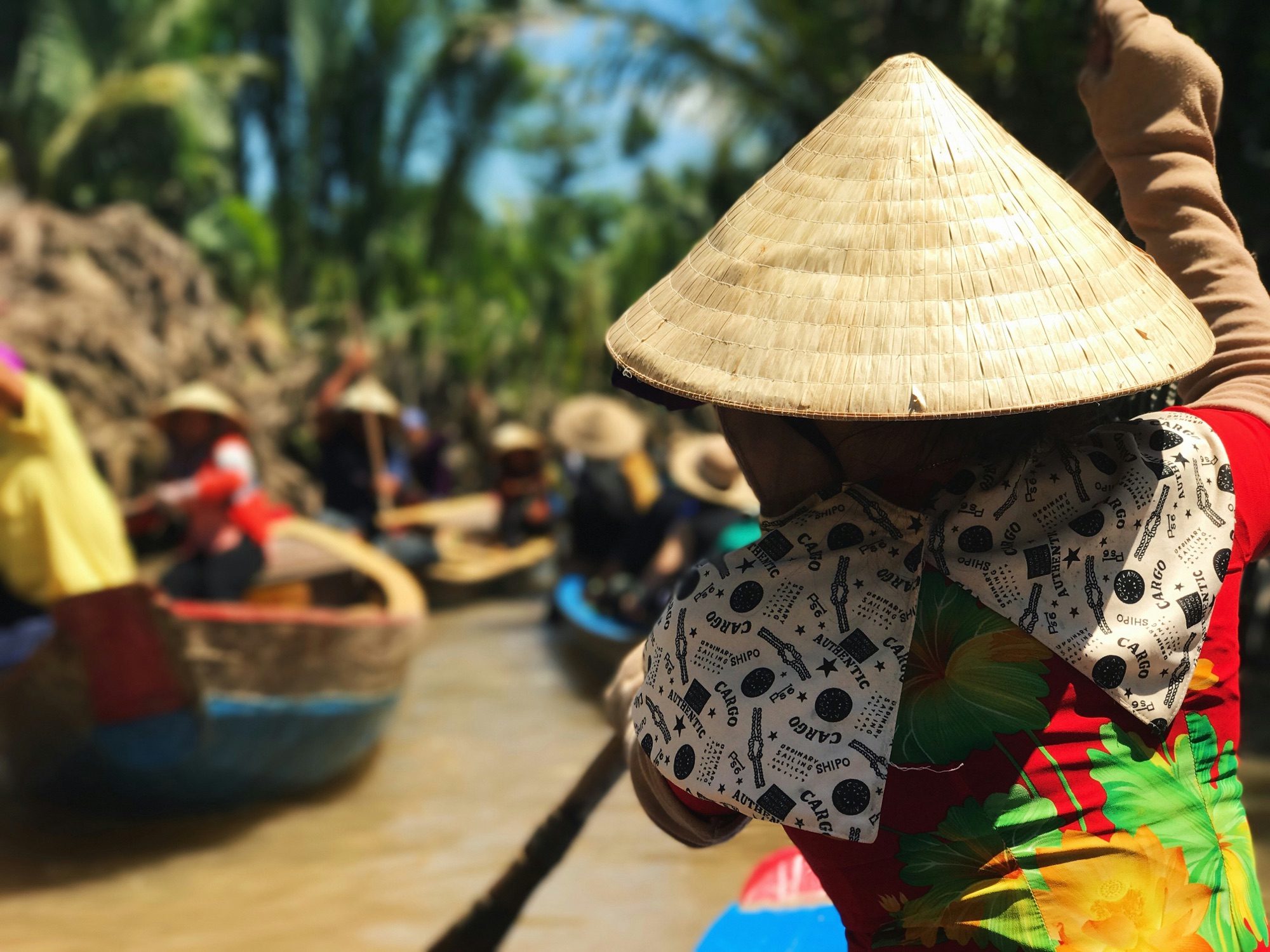
The Mekong Delta is the watery south of Vietnam — the vast, fertile, river-laced lowland where the Mekong finally fans out into the sea through its “nine dragons.” It’s a different Vietnam from the cities and the coast: a slow, green, water-bound world of floating markets, stilt houses, fruit orchards, and narrow canals threaded by sampan. And it’s the country’s natural bridge into Cambodia — because the river that defines the delta runs straight up to Phnom Penh and on toward Angkor.
Done well, the delta is either a deeper overnight (a dawn visit to the great Cai Rang floating market near Can Tho) or — the premium version — a luxury river cruise that turns the Saigon-to-Cambodia journey into the highlight of the trip. Done poorly, it’s a packed, over-touristed day trip from Saigon that shows you a coconut-candy workshop and a souvenir stop and calls it the Mekong.
There are really three ways to do the delta, and the right one depends on the trip:
Most travelers come to me about the Mekong either as a taste from Saigon (a day trip or an overnight), or as the elegant connector into Cambodia via a river cruise — the most graceful way to make the Vietnam-to-Angkor link.
Here’s how I think about it.
At a Glance
| Best time to visit | December to April — the southern dry season (the delta runs on the south’s calendar). The wet season (May–November) brings higher water and afternoon rain; the dry months are the comfortable window, and river levels affect cruise itineraries. |
| How to do it | (1) A day trip from Saigon — a light taste (My Tho / Ben Tre), fine if time is short but the most touristed. (2) An overnight in Can Tho — the real version, built around the dawn Cai Rang floating market. (3) A luxury river cruise — the premium version and the connector into Cambodia. |
| How long to stay | A day trip for a taste; one night in Can Tho for the dawn market and the deeper delta; two to three nights aboard a river cruise for the full experience and the Cambodia connection. |
| How to get there | Can Tho is about 3–3.5 hours by road from Saigon (or a short domestic flight). River cruises typically embark near Saigon (My Tho) and sail upriver toward Phnom Penh and Siem Reap. |
| One thing most guides won’t tell you | The Cai Rang floating market is a dawn event, and that’s the whole point. The big wholesale floating market near Can Tho is at its bustling best around 6–7 a.m. and winds down by mid-morning — so the day-trip-from-Saigon version (arriving midday) largely misses it. To see the real Mekong, you overnight in Can Tho or you’re aboard a boat on the river at dawn. |
Why I Send Travelers Here
Because the delta is the south’s great change of pace — and because the Mekong is the most elegant way to connect Vietnam and Cambodia. The delta itself is a slow, sensory world: the Cai Rang floating market at dawn, where wholesale boats laden with produce trade on the water; the sampan canals too narrow for anything but a paddled boat, threading under palm canopies; the orchards and rice paddies, the stilt houses, the coconut and fruit and river life. And the river keeps going — up to Phnom Penh, on toward Siem Reap — so a river cruise turns the transfer between two countries into the journey itself.
I send travelers here as a taste of the watery south (a day trip or a Can Tho overnight on a Vietnam-only trip) and, more memorably, as the river connector into Cambodia on an Indochina trip.
The delta is ground-partner territory — the right depth (day trip vs overnight vs cruise), the dawn-market timing, the sampan and homestay logistics, and especially the river-cruise choice all want handling. As across the country, my role is matchmaker — my read on how deep to go and which cruise fits, executed through the in-country team. For the river stretch, Aqua Mekong is the luxury small-ship I’d name for the Saigon-to-Siem Reap run; A&K is the operator I’d route the full-service land-trip traveler to. The editorial work is choosing the right version of the delta for your trip.
How I’d Do the Delta
Three ways, matched to the trip:
The day trip from Saigon. The light taste — usually My Tho or Ben Tre, a sampan through a canal, a coconut-candy workshop, lunch. Fine if your time is tight, but it’s the most touristed version and it misses the dawn market. A half-to-full day.
The Can Tho overnight. The real land version — drive (or fly) to Can Tho, stay the night, and rise before dawn for the Cai Rang floating market at its bustling best, then the quieter canals and orchards. One or two nights; the way to see the delta properly without a cruise.
The luxury river cruise. The premium version and the connector into Cambodia — a small ship (Aqua Mekong is the one I’d name) sailing from near Saigon upriver, through the delta, to Phnom Penh and on toward Siem Reap, turning the cross-border journey into the highlight. Two to seven nights depending on the itinerary. The most graceful way to do Vietnam-and-Cambodia as one flowing trip.
For land stays, Can Tho has comfortable river-view hotels (descriptive — no on-rate property here); for the cruise, the cabin is the stay, and the vessel choice is the decision. Matching the right approach to your trip is the discovery-call conversation.
Want help choosing? Start a discovery call — day trip, Can Tho overnight, or the river cruise into Cambodia: the right call depends on the whole trip, and that’s what I’m for.
For a Honeymoon
For honeymooners, the delta is best as the river-cruise stretch — a balcony cabin on a small luxury ship, the slow river days, the dawn markets and the orchards, and the romance of waking up in a different country than you went to sleep in as the boat crosses into Cambodia. It’s an unusual, memorable honeymoon segment that pairs naturally with the Angkor finale. Matching it to your honeymoon’s rhythm is the discovery-call conversation.
What I’d Do in the Delta
The delta rhythm is dawn on the water, slow canals by day, river life all around.
Dawn — the floating market. The Cai Rang floating market near Can Tho at first light — wholesale boats heavy with pineapples and pomelos and dragonfruit, traders hawking from sampan to sampan, each boat flying a sample of its goods on a pole. This is the delta’s signature, and it’s an early start by design.
Morning — the canals and orchards. Off the main river into the narrow canals by paddled sampan, under palm canopies, past stilt houses; a stop at an orchard for tropical fruit, a coconut-candy or rice-paper workshop, a riverside lunch. The pace is deliberately slow.
On a cruise — the river days. A river-cruise itinerary adds villages, temples, and craft stops along the way, the unhurried deck time between, and — on the Cambodia-bound routes — the border crossing and the run up to Phnom Penh and Siem Reap. The river is the experience.
Specific Things I’d Tell You About
Cai Rang is a dawn market — overnight or cruise to see it. The big floating market is at its best at 6–7 a.m. and fades by mid-morning. The midday day-trip-from-Saigon version largely misses it. Overnight in Can Tho or be aboard a boat at dawn.
The river cruise is the elegant Cambodia connector. A Mekong cruise (Aqua Mekong the name I’d give) makes the Vietnam-to-Angkor link the highlight rather than a transfer. If your trip includes Cambodia, this is the most graceful way to join the two.
The day trip is a taste, not the delta. A Saigon day trip is fine if time is tight, but it’s the most touristed and it misses the dawn market. Know what you’re getting.
Don’t come expecting beaches or big sights. The delta’s pleasure is slow river life — markets, canals, orchards, the rhythm of the water. It’s atmosphere, not monuments.
Season affects the river. December–April is the comfortable dry window; water levels in the wet season change what cruises can do. Plan the delta for the southern dry season.
What I’d Skip
The midday day-trip-only version, if the delta matters to you. It misses the dawn market and leans touristy. Overnight or cruise for the real thing.
Expecting monuments or beaches. The delta is river life and atmosphere; come for that, not for big sights.
The most over-touristed My Tho stops. The closest-to-Saigon day-trip circuit is the most worn. Can Tho and the deeper delta — or the cruise — are the better experiences.
Cramming the delta into a trip with no room for it. If the days aren’t there, a Cu Chi or city day from Saigon may serve better than a rushed delta dash. Better to do it properly or save it.
For Vietnam Multi-Region Travelers
The Mekong Delta is the watery finale of the southern half of the Vietnam arc — reached from Saigon as a day trip or overnight, or sailed as a river cruise that connects straight into Cambodia. On an Indochina trip, the cruise is the most graceful way to join Vietnam and Angkor; on a Vietnam-only trip, a Can Tho overnight gives the delta its due. It runs on the southern December–April dry season.
If you want me to design the full Vietnam (or Vietnam-and-Cambodia) trip — including the right Mekong approach — start a discovery call.
For Honeymooners
The Mekong is best, for honeymooners, as the river-cruise stretch — a balcony cabin on a small luxury ship, the slow river days, the dawn markets, and the quiet romance of the boat crossing into Cambodia toward Angkor. An unusual, memorable segment that pairs naturally with the temple finale.
If you want me to design the full Vietnam-and-Cambodia honeymoon — the cities, the cruise, and the Angkor close — start a discovery call.
Plan the Mekong Delta With Me
If you’re thinking about the Mekong Delta as a taste of the watery south or the elegant river connector into Cambodia — that’s exactly the kind of planning I do. A 30-minute discovery call is where it starts. No fee, no pressure. Just the river, your trip shape, and the right way to do the delta — a dawn market, a slow canal, or the cruise that carries you on to Angkor.
Book Your Free Discovery Call →︎
Last updated: May 2026. I keep this guide current. If a cruise I recommend slips, an operator changes hands, or access to a market shifts, the page changes. Travel changes. The work doesn’t stop when the page goes live.
Plan this trip with me.
A 30-minute discovery call is where it starts. No fee, no pressure.
Book a Discovery Call