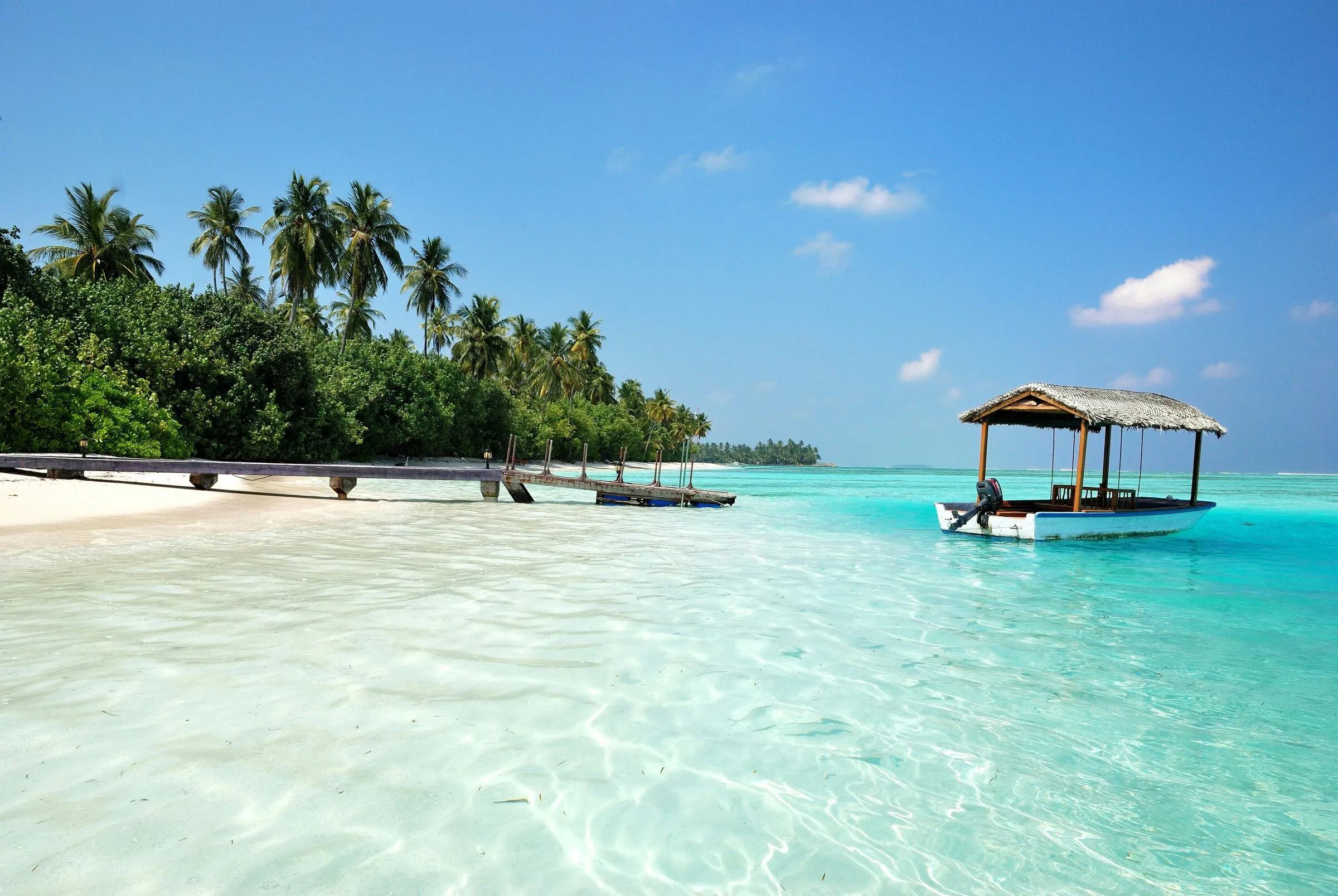
The Maldives sits at a peculiar intersection of world travel: it’s a destination everyone has heard of, almost nobody can actually describe, and many couples book on pure brand recognition without understanding what they’re actually paying for.
Here’s what the Maldives actually is: nearly 1,200 islands in the Indian Ocean, most of them coral-fringed, all of them flat, and — for the luxury traveler — almost entirely resort-based. You can visit inhabited local islands now (guesthouse tourism opened them up in 2009, and many resorts run half-day local-island excursions), but that’s a different, more budget-minded kind of trip; the honeymoon version is the island, the villa on it, and the water around it. There are no ruins or ancient towns, and little dining scene beyond the resorts. What you’re paying for is the island itself, the villa, and the water — and that’s where the decision needs to be made.
Most couples arrive imagining overwater bungalows and white-sand beaches, which is accurate. The trade-off is that the Maldives is expensive, the island experience is entirely resort-contained, and the pace is slow to the point of requiring honesty about what you actually want from vacation. If you want activities, exploration, or a place where you can randomly wander and discover something interesting — the Maldives is not your trip. If you want transparent water, private villas, uninterrupted quiet, and a restorative pace — it’s the place.
Here’s how I think about it.
At a Glance
| Best time to visit | November–March for dry season, stable weather, and guaranteed visibility. December–January is peak (pricier, more crowded). September–October is the shoulder season (wet, but the island is quieter and rates drop). April–May is the shoulder dip toward monsoon (intermittent rain, but still swimmable and increasingly empty). Avoid June–August (rainy, rough seas, lower visibility, though also the cheapest if you accept compromises on weather). |
| How long to stay | Four nights minimum for a honeymoon. Five or six is better. You’ll spend entire days in or around your villa, and rushing through feels like waste. The trip works best when you anchor it and stop trying to optimize. |
| How to get there | International flights to Malé International Airport (MLE), which sits on its own island. From Malé, a speedboat ride (45 minutes–2 hours depending on your resort’s atoll) or short domestic flight to your resort island. Most resorts provide the transfer; confirm in advance. |
| Currency / language | Maldivian rufiyaa (MVR), though USD is widely accepted and often preferred. English is spoken throughout resort settings. Dhivehi is the local language. |
| One thing most guides won’t tell you | The Maldives is a single-resort destination disguised as a multi-island option. Once you’re on your island, you’re there for the duration. There’s no easy way to island-hop or change resorts mid-trip. Plan your resort choice very carefully — it is the trip. Also: the views from above are better than from the islands themselves. If possible, take the seaplane transfer so you can see the atolls and waters from the air. |
Why I Send Travelers Here
Because the Maldives, when anchored correctly, is one of the most genuinely restorative destinations on the planet. The water clarity is exceptional. The privacy is absolute. The pace, if you surrender to it, actually allows you to rest.
I send couples here for deep honeymoons — five or six nights where the entire trip is about the villa, the lagoon, and each other. I send anniversary trips where a couple wants to recalibrate their connection without the distraction of exploration. I send travelers who’ve done the cultural immersion and want to sit still for a week.
I’m also honest about the cost. The Maldives is expensive by any measure. The water and privacy justify it, but only if you understand you’re paying primarily for the resort and the island — not for activities, not for dining variety, not for discovery. Every recommendation below is built on that truth.
Where I’d Anchor
The Maldives has nearly 1,200 islands — only about 200 of them inhabited, and roughly 120 of those exclusive island resorts. They range from ultra-budget to exclusive-by-private-jet. The decision tree is simple: pick the atoll, pick the island, book the resort. Once booked, that’s where you stay.
Most of my honeymoon clients anchor in one of three “tiers,” each with a distinct character:
One&Only Reethi Rah (North Malé Atoll) is the one I’d pick for a first Maldives honeymoon that wants the full, iconic version — large overwater and beach villas, a long private island you can actually walk, and service that anticipates rather than reacts. On my rate at the property, the amenity layer is meaningful and doesn’t book direct — calibrated to your dates and the villa category, and the specifics get walked through on the discovery call.
COMO Cocoa Island (South Malé Atoll) is the intimate, design-led alternative — overwater suites shaped like Maldivian dhoni boats, a serious COMO Shambhala wellness program, and a quiet that never feels like a big resort. It’s the “soul, not just service” pick, and a brand I know well. On my rate at the property, the amenity layer doesn’t book direct and deepens materially on the suite categories; the specifics get walked through on the discovery call.
Soneva Jani (Noonu Atoll) remains the fantasy pick — “jungle in the ocean,” villas with retractable roofs for stargazing, private infinity pools, and a spa worth the trip alone. I book it through channels other than my consortium program, so the amenity layer works differently here; if the Soneva universe is what you’re picturing, I’ll tell you honestly what applies and what doesn’t.
If you want the smallest, most private footprint, Cheval Blanc Randheli (Noonu Atoll) and Four Seasons Landaa Giraavaru (Baa Atoll) are both excellent — I book them outside my consortium program, and I’ll walk through the trade-offs on the call.
Want one of these? Start a discovery call — I quote rates, walk through villa categories, explain atoll differences, and confirm what applies to your dates.
What I’d Do With Five Days
Day One — Arrival and Acclimatization
You’ll arrive at Malé International Airport in late afternoon (assuming standard connections from North America). Clear customs, meet your resort transfer (speedboat or seaplane), and ride to your island. The boat ride or flight is when you’ll understand why the Maldives photographs the way it does — the water shifts from turquoise to emerald to deep blue as you move across the atolls.
Check in, get oriented at your villa (read about the amenities, the snorkel access if applicable, the meal options), and settle. Dinner at the main resort restaurant. Early night — you’re jet-lagged and the island is quiet.
Day Two — Lagoon Immersion
Wake to the water. Breakfast at your villa or the restaurant. Morning snorkel directly from your beach or off the house reef — the Maldives’ selling point is the clarity and the fish, both visible immediately. Spend the morning in the water or around the villa.
Late morning, book a “sunset dolphin cruise” or “house reef snorkel excursion” through the resort (half-day, late afternoon). These are the only real activities most honeymoons need. Dinner at a beachfront restaurant or back at your villa.
Day Three — Quiet Villa Day
No activities. Breakfast at your villa. Snorkel in the morning, spa treatment mid-morning. Long lunch back at the villa, reading or swimming in your private pool. Late afternoon, walk the beach if the island allows. Dinner at a different restaurant just to change scenery. The point of this day is to prove that doing nothing is actually the point.
Day Four — Optional Activity Day
If you want a scheduled activity: a full-day excursion to a nearby uninhabited island for a beach barbecue, or a deeper snorkel to a different reef, or a diving trip if you’re certified. Or: skip it entirely and anchor back to the villa. Most honeymoon clients skip the activity on this day and repeat day three.
Day Five — Final Hours
No activities. Breakfast at the villa. Final snorkel. Pack. Spa treatment if time allows. Late lunch, then boat transfer to Malé and the international flight home. The trip will feel too short, which is intentional — the Maldives works best when you leave slightly too soon.
Specific Things I’d Tell You About
The seaplane transfer is worth the cost if available. It’s not just transportation — it’s the first moment you understand why the Maldives looks the way it does in photographs. The atolls, the shallow waters, the color variation — it’s all visible from the air. Most resorts offer both speedboat and seaplane; take the plane.
Snorkeling directly from your villa beach is genuinely good. If your villa has house reef access, spend time there before booking paid excursions. Most honeymoon couples find that the daily snorkel from the villa is enough.
The meals are expensive and limited. The resorts have monopolies on food. Breakfast is usually good and included. Lunches and dinners are pricey for what they are. Budget accordingly and ask about meal plans upfront. Some resorts bundle meals; others charge à la carte.
One paid activity per stay is usually enough. A sunset dolphin cruise or a snorkel to a different reef adds novelty. A second activity starts to feel like you’re optimizing rather than resting. Resist.
The spa treatments are genuinely good and genuinely expensive. Most resorts have high-end spas. A couples massage or a full day-spa treatment is worth it, especially during the middle of the stay when jet lag has worn off.
Book your resort based on what appeals to you, not on what photos look like. Soneva has jungle and tree villas. Cheval Blanc is minimalist and exclusive. Four Seasons is reliable and service-focused. The water is similar everywhere; the resort character varies widely. Pick the one that matches your sensibility.
What I’d Skip
Paying for multiple excursions. One is novelty, two is exploring, three starts to feel like work. The Maldives works best when you sit still.
The “full day island hopping” excursion. You’ll spend more time on boats than you will on islands, and the islands you visit are usually uninhabited or heavily touristed. Not worth the time.
Water sports you don’t already do. Jet-skis, parasailing, windsurfing — they feel fun on paper and feel regrettable on the day. The water is better appreciated from the villa or on a calm snorkel.
Multiple different restaurants. Pick one or two good ones and book them. The novelty of trying three restaurants feels more like logistical work than pleasure.
Trying to turn a resort honeymoon into a cultural trip. You can day-trip or even stay on inhabited local islands now — guesthouse tourism opened them up — but that’s a different trip from the resort honeymoon, and bolting it on tends to satisfy neither. On a luxury honeymoon, lean into the island and the water; the culture-forward Maldives is a separate plan worth its own trip.
For Honeymooners
The Maldives is the ultimate resort-honeymoon destination — not because of activities, not because of exploration, but because the water and the privacy are genuinely restorative. Book four or five nights if possible. Six is better. You need time for the pace to actually work.
One&Only Reethi Rah is my default for a first Maldives honeymoon — the iconic overwater experience with enough island to keep the pace from feeling empty. COMO Cocoa Island if you want the intimate, design-led, wellness-forward version. Soneva Jani if the “jungle in the ocean” fantasy is the whole point.
The trip is not about activities. It’s about the water, the villa, and surrendering to the slowness. Design your days around protecting that. Book the transfer, book the villa, book one activity, and spend the rest of the time in the water or on your deck. That’s the version that actually works.
Plan Maldives With Me
If you’re thinking about the Maldives as a honeymoon, as a post-anniversary reset, or as your first deep resort escape — that’s exactly the kind of planning I do. A 30-minute discovery call is where it starts. No fee, no pressure. We talk about what kind of pace you actually want, what resort character appeals to you, and which island makes sense for your timeline and budget.
Book Your Free Discovery Call →︎
Last updated: April 2026. I keep this guide current. If a resort closes, rates shift significantly, or atoll conditions change, the page changes. Travel changes. The work doesn’t stop when the page goes live.
Plan this trip with me.
A 30-minute discovery call is where it starts. No fee, no pressure.
Book a Discovery Call