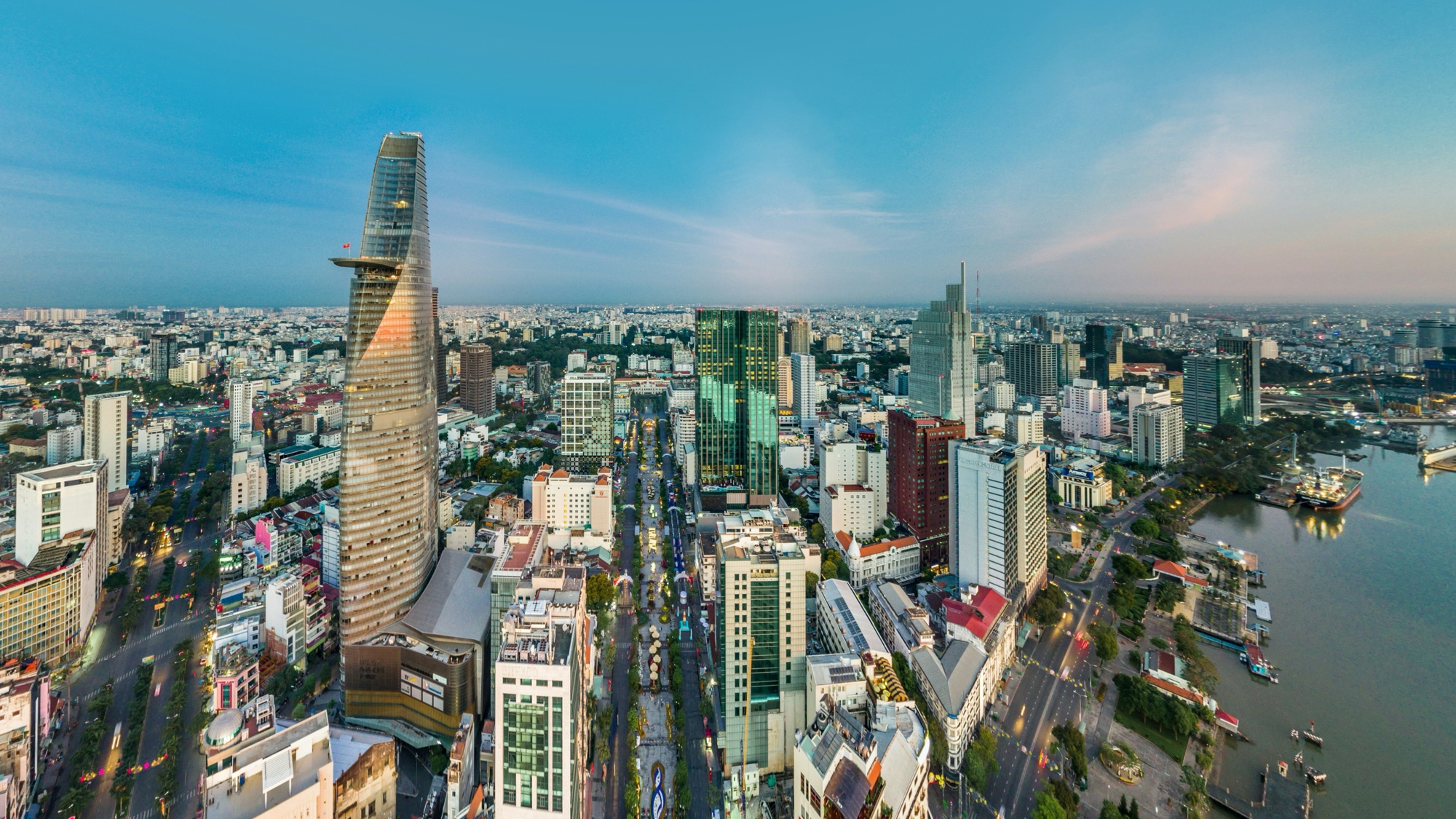
Ho Chi Minh City — Saigon, as most people still call it — is the high-energy engine of southern Vietnam, and the natural southern anchor of a north-to-south trip. After the old-world density of Hanoi and the lantern-lit calm of central Vietnam, Saigon is the country’s loudest, fastest, most forward-leaning city: a French-colonial core threaded with skyscrapers, a scooter river that makes Hanoi’s look tame, some of the best food and coffee in the country, a rooftop-bar scene with a view, and — at its heart — the sobering, essential history of the war that bears the country’s modern name.
Done well, Saigon is two or three nights of contrast: the colonial landmarks of District 1, the genuinely important War Remnants Museum and Reunification Palace, a bánh mì and a Vietnamese coffee on a street corner, a rooftop cocktail over the city at dusk, and a day trip to the Cu Chi Tunnels or out into the Mekong Delta. Done poorly, it’s a jet-frazzled stop that skips the history and the food for a mall and a hotel pool.
As with Hanoi in the north, Saigon is a city I plan with a lighter hand — it’s navigable, energetic, English-friendly in the core, and an independent-minded traveler does beautifully with a great hotel, a couple of reservations, and a guide for the war history (which is far richer explained than read off a placard). The deep ground-partner work in Vietnam earns its keep in Halong, the central coast, and the Mekong — here, the city does most of the work.
Most travelers come to me about Saigon as the southern anchor of a Vietnam trip — two or three nights before the Mekong, the beach, or the flight on to Cambodia.
Here’s how I think about it.
At a Glance
| Best time to visit | December to April — the southern dry season (Saigon runs on the south’s calendar). May to November is the wet season — afternoon downpours that usually pass quickly rather than ruining days, but the dry months are more comfortable. Warm and tropical year-round; no real cool season. |
| How long to stay | Two or three nights. Two covers the colonial core, the war history, and the food; three adds a Cu Chi Tunnels or Mekong Delta day trip and a slower pace. |
| How to get there | Tan Son Nhat (SGN) is the southern gateway and the standard exit for an open-jaw Vietnam trip (in via Hanoi, out via Saigon — or onward to Cambodia). Short domestic flights connect it to Da Nang and Hanoi; it’s the launch point for the Mekong and the beach coast. |
| Getting around | District 1 (the colonial core) is walkable; Grab (rideshare) and metered taxis cover the rest cheaply. The scooter traffic is intense — same street-crossing rule as Hanoi: move slowly and predictably and let it flow around you. A new metro line opened in 2024, opening up the city further. |
| One thing most guides won’t tell you | The War Remnants Museum is heavy, one-sided, and essential — go in the morning, with time after to process. It presents the war from the Vietnamese perspective and it’s genuinely affecting; it’s not a tick-box stop. Pair it with the Reunification Palace and a guide who can give context, and don’t schedule something frivolous right after. Understanding this history is part of understanding the city. |
Why I Send Travelers Here
Because Saigon is the dynamic counterweight to the rest of Vietnam — the city that shows you the country’s energy and its modern history in equal measure. The French-colonial core is genuinely handsome: the Notre-Dame Basilica, the grand colonial Central Post Office, the Opera House, the grand boulevards of District 1. The war history is essential and affecting: the War Remnants Museum, the Reunification Palace (frozen at the moment of the 1975 surrender), and the Cu Chi Tunnels outside the city. The food and coffee are some of the best in the country — bánh mì, the southern bright-and-herby cooking, the famous Vietnamese coffee culture, a street-food scene that rewards a guided evening. And the rooftop bars — over a city of skyscrapers and scooter rivers — give the whole thing a glittering modern edge. Plus, Saigon is the gateway to the Mekong Delta and the launch point for Cambodia.
I send travelers here as the southern anchor of a Vietnam trip (the dominant structure), and as the springboard to the Mekong and Cambodia.
As I said up top, Saigon is a lighter-touch city in my planning. The country-level matchmaker structure — my strategy through a vetted ground team, A&K for the full-service traveler — still stands, and a guide makes the war history immeasurably richer. But the city itself is where a great hotel, a few reservations, and Saigon’s own navigability do most of the work. The editorial value is in the choices — the right hotel, the war-history half-day with the right guide, the food worth seeking, the Mekong or Cu Chi day trip — and the rest you get to wander.
Where I’d Anchor
Most travelers base in District 1, the walkable colonial-and-commercial core where the landmarks, the rooftops, and the best hotels cluster. (Adjacent District 3 is quieter and leafier, a short hop in.)
For the boutique-design pick, Hôtel des Arts Saigon – MGallery is the call — a French-Indochina-themed art-deco property that’s as much an art collection as a hotel, with a beloved rooftop Social Club bar and pool overlooking the city. On my rate at the property, the amenity layer is real and doesn’t book direct — calibrated to your dates, room category, and length of stay, with the specifics on the discovery call.
For the grande-dame and ultra-luxe options, the headline names are the Park Hyatt Saigon (the elegant colonial-classic on Lam Son Square beside the Opera House — long the city’s benchmark) and The Reverie Saigon (a riot of over-the-top Italian opulence in a tower, for travelers who want maximalist glamour). These are descriptive picks rather than on-my-rate, so where they’re the right fit I’m still the one matching you to the room and booking it well; where Hôtel des Arts fits, the amenity layer comes with it. We sort the specifics on the call.
Want help choosing? Start a discovery call — I’ll walk through the boutique-vs-grande-dame trade-off, pull live availability, and confirm which amenities apply to your dates.
Where I’d Anchor for a Honeymoon
For honeymooners, Saigon is a short, glamorous stop rather than a crescendo — so I plan it as two nights of city energy (a stylish hotel, a rooftop sunset, a street-food evening, the colonial core) before the trip continues to the Mekong, the beach coast, or Angkor where the longer, more intimate stays belong. A design-forward hotel with a great rooftop is the move here. Matching it to your honeymoon’s rhythm is the discovery-call conversation.
What I’d Do With Two Days
The Saigon rhythm is colonial core and war history by day, rooftop and street food by night, with a day trip if you have the time.
Day One — The Colonial Core and the War
Morning in District 1: the Notre-Dame Basilica, the Central Post Office, the Opera House, the grand boulevards — a walkable loop of the French-colonial city. Then the essential, sobering stretch: the War Remnants Museum and the Reunification Palace, ideally with a guide for context. Go in the morning and leave time to process; this isn’t a quick stop.
Lunch on a proper bánh mì and a Vietnamese coffee. Afternoon at the Ben Thanh Market and the surrounding streets, or a slower café-and-shopping pace. Evening: a rooftop bar at dusk (the city’s skyline-and-scooter-river view is the one to have), then a guided street-food crawl — Saigon’s southern cooking is bright, herb-forward, and best found with someone who knows the stalls.
Day Two — Cu Chi or the Mekong
A day trip, your choice:
The Cu Chi Tunnels. The vast underground network of the war-era Viet Cong, about 1.5 hours from the city — claustrophobic, sobering, and a powerful complement to the previous day’s history. A half-day.
The Mekong Delta. A day out into the watery south — floating markets, coconut-candy workshops, sampans through the canals, stilt houses. A taste of the delta before (or instead of) a deeper Mekong stretch. A full day.
Back in the city for a final dinner and a last rooftop. With a third day: the other of the two day trips, or a slower city pace — the Jade Emperor Pagoda, the Chinatown (Cholon) district, a cooking class, or the new riverside developments.
Specific Things I’d Tell You About
The War Remnants Museum is essential and heavy — plan around it. It’s affecting and one-sided (presented from the Vietnamese perspective), and it’s a core part of understanding the city. Go in the morning, with a guide for context, and don’t schedule something frivolous immediately after.
The food and coffee are a highlight, not a footnote. Saigon’s southern cooking and its coffee culture (the famous cà phê sữa đá, the new-wave specialty scene) are among the best in Vietnam. A guided street-food evening is the way in; come hungry.
Crossing the street is the same art as Hanoi. Even more scooters here. Move slowly and predictably; let the river of bikes part around you. Don’t bolt.
Cu Chi and the Mekong are the two day trips — pick by appetite. Cu Chi for more war history; the Mekong for the watery delta. If your trip includes a deeper Mekong stretch or a river cruise, do Cu Chi here and save the delta for the real thing.
Saigon is the launch point south and into Cambodia. It’s the gateway to the Mekong Delta, the beach coast, and — by flight or river cruise — to Phnom Penh and Angkor. Plan it as the hinge of the southern half.
What I’d Skip
Skipping the war history because it’s heavy. It’s the point of the city in many ways. Do the museum and the palace; just plan the day around them.
The Bui Vien backpacker strip, if that’s not the trip. The loud, neon, beer-bucket backpacker street is a known quantity and a mismatch for a refined trip. Easy to avoid.
Over-touring a short stop. Two or three nights is enough for the core, the history, the food, and one day trip. Don’t cram; Saigon is the energetic hinge, not a place to exhaust yourself.
Relying on a car in District 1. Walk the core; Grab the gaps. The traffic makes a car in the center pointless.
For Vietnam Multi-Region Travelers
Saigon is the southern anchor of the Vietnam arc — Hanoi and Halong, then central Vietnam, then Saigon and the south. It’s the hinge of the second half: two or three nights here, then the Mekong Delta, the beach coast, or onward to Cambodia — often via an Aqua Mekong river cruise that runs Saigon to Siem Reap by water. It runs on the south’s December–April dry season.
If you want me to design the full Vietnam (or Vietnam-and-Cambodia) trip — the northern start, the central middle, the southern anchor, and the finale — start a discovery call.
For Honeymooners
Saigon is a short, glamorous stop on a Vietnam honeymoon, not a crescendo — so I plan it as two nights of city energy: a design-forward hotel, a rooftop sunset over the skyline, a street-food evening, the colonial core by day. Then the trip continues to the Mekong, the beach coast, or Angkor where the longer, more intimate stays belong.
The honeymoon evening here is the rooftop bar at dusk followed by a guided street-food crawl — glamour and grit in one night. Start a discovery call.
Plan Saigon With Me
If you’re thinking about Ho Chi Minh City as the southern anchor of a Vietnam trip, the gateway to the Mekong and Cambodia, or a glamorous city stop — that’s exactly the kind of planning I do. A 30-minute discovery call is where it starts. No fee, no pressure. Just the city, your timeline, and the version of Saigon that does it justice — the colonial core, the essential history, the food, and the rooftop at dusk.
Book Your Free Discovery Call →︎
Last updated: May 2026. I keep this guide current. If a hotel I recommend slips, a restaurant changes hands, or access to a site shifts, the page changes. Travel changes. The work doesn’t stop when the page goes live.
Plan this trip with me.
A 30-minute discovery call is where it starts. No fee, no pressure.
Book a Discovery Call