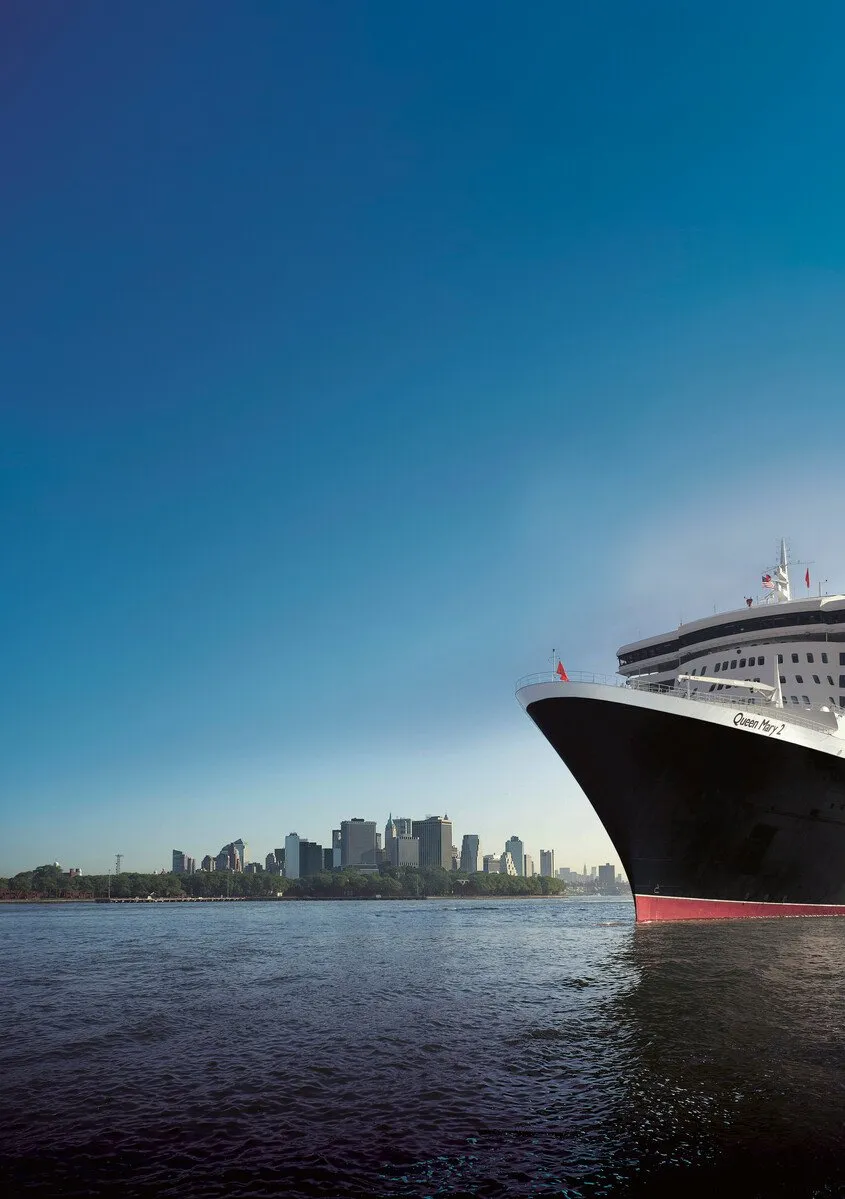
Seven sea days between Brooklyn and Southampton. No airport, no jet lag, no luggage limits. The voyage Cunard built the ship around — and the version of European travel that air travel has spoiled us into forgetting exists.
The transatlantic crossing is the voyage Cunard's communications platform — "iconic luxury travel without compromise" — was written for. Brooklyn or Southampton departure, seven days at sea, the other terminal as arrival. There is no airport. There is no Heathrow customs queue at six in the morning. There are no checked-luggage limits. The ship moves through time zones gradually — clocks shift an hour a day, six of them on a westbound crossing, and you arrive on local time without ever having lived through jet lag. The seven days are the trip; the ship is the destination.
Queen Mary 2 alone runs the schedule. Every other large passenger ship at sea today is a cruise ship — built for ports, for repositioning between them, for warm-water routes. Queen Mary 2 alone is purpose-built for the North Atlantic. The crossing happens because the ship is engineered to make it.
What you're booking
The shape of a Cunard crossing.
Seven
Sea days, no ports
Brooklyn
Cunard's NYC terminal
Southampton
Two hours from London
No jet lag
Time shifts an hour a day
Eastbound or westbound
Direction matters more than the brochure tells you. Westbound — Southampton to New York — gives you the time-gift crossing. You set your watch back by an hour on six of the seven nights. You arrive in New York rested and pre-adjusted. It is the right direction for the return-from-Europe traveler who has been in time-zone debt for a week and wants the ocean to repay it. It is also the right direction for the honeymoon couple closing a European trip.
Eastbound — Brooklyn to Southampton — is the direction I sailed in January 2025. You give back an hour per night, but you gain something else: the slow approach into the English Channel, the cliffs of the Isle of Wight visible on the seventh morning, the immigration arrival into a country at the right time on a quiet pier. Pair it with a London week ahead or a continental rail trip onward. It is the start-of-a-trip direction.
The sea-day rhythm
Seven sea days is the part of the crossing most first-time clients ask me about. The shape of the day is what makes the seven days work. Mornings are Cunard Insights — guest speakers, masterclasses, the Daily Programme of lectures on history, science, geopolitics, the arts. Late mornings are the spa, the library, the gym, the deck. Afternoon Tea (no "signature" — Cunard does not use the word) happens at three thirty in the Queens Room ballroom, with the string ensemble and the white-glove service that the brand actually does. Evenings are Britannia or Princess Grill or Queens Grill, then theatre or the Chart Room cocktail lounge or the Royal Court Theatre or the silent disco. Underneath everything, the slow rhythm of the ocean.
The honeymoon-and-milestone bookend
The crossing makes a particular kind of sense as the bookend on a milestone trip. The eastbound westbound pairing as the opener and closer of a European week. Brooklyn out at the start; Southampton back at the end. Or the reverse — fly to London, train through Europe, sail home rested. The seven days become the trip's centre of gravity rather than its transit. For honeymoons especially: there is something about the formal-dining rhythm and the dress nights and the ocean underneath that holds the trip together in a way a Heathrow turnaround does not.
If you have read this far the right next step is a discovery call. The crossing is a deceptively simple voyage to plan around — direction, season, cabin tier, the European hold on the other end. The first conversation untangles it.
A 30-minute discovery call. We will figure out eastbound versus westbound, the season, the cabin tier, and what the European bookend wants to be. Bring your year.