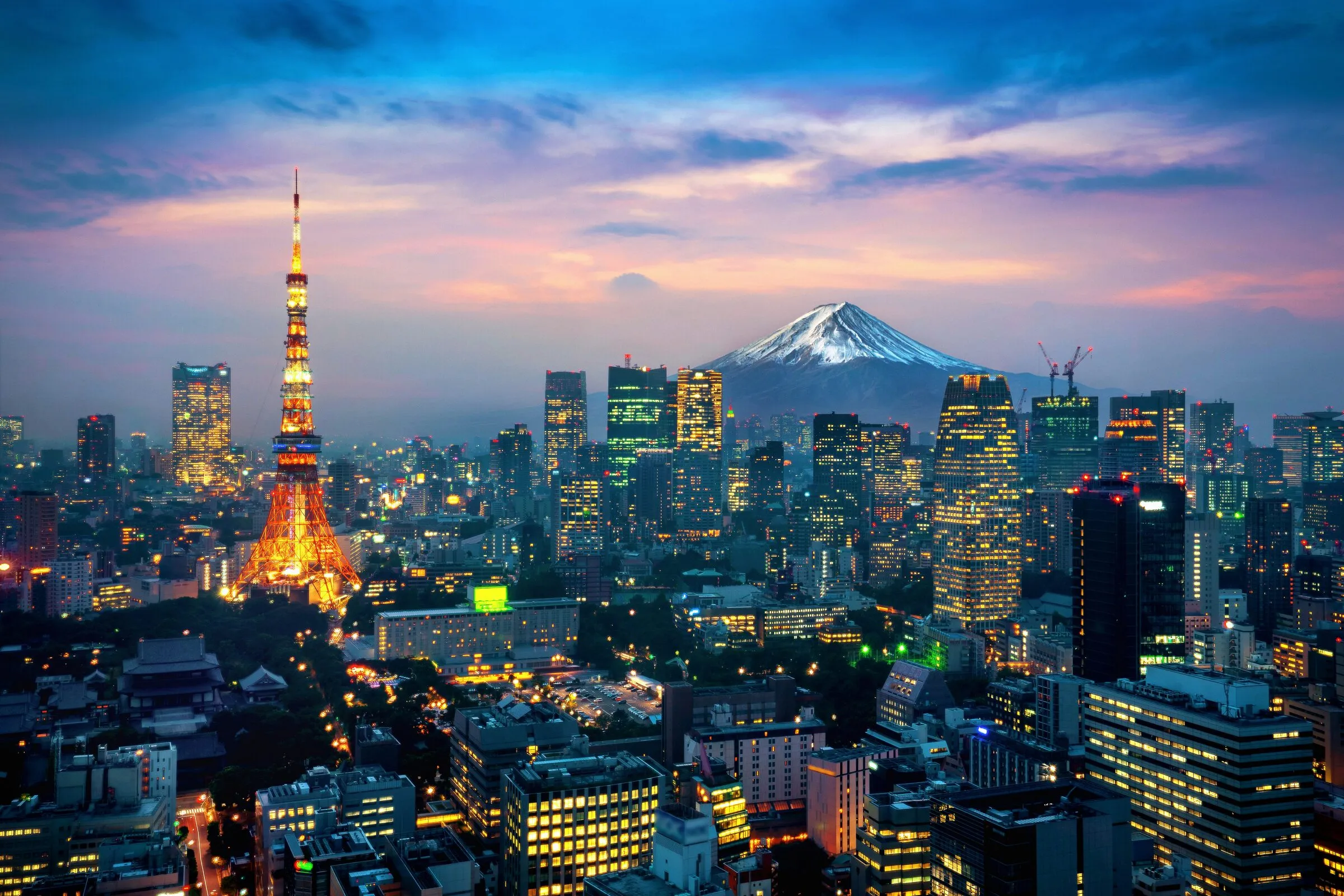
Tokyo is the city most American travelers arrive at underprepared — and not for the reasons you’d expect. The cultural distance isn’t the issue (the city is one of the most welcoming, most navigable, most internally consistent capitals on earth). The travel-time distance isn’t the issue (a 12-hour flight is just a flight). The mistake is calendar-distance: travelers compress Tokyo into 3 nights at the front of a 7-day Japan trip, try to do Shibuya-Shinjuku-Ginza-Asakusa-Harajuku-Roppongi in 48 hours, and arrive in Kyoto feeling vaguely like they’ve been processed by something rather than understanding what they just experienced. Tokyo isn’t the obvious honeymoon city — but for the right couple, food-driven and design-curious and urban, it’s the best one.
Done correctly, Tokyo is one of the most rewarding 4-to-5-night cities in the world. The neighborhoods are genuinely distinct — Shinjuku is not Shibuya is not Ginza is not Asakusa — and the way you encounter the city changes character every six blocks. The food culture is the deepest in the world by every measurable index (most Michelin stars of any city, the highest concentration of restaurants per square kilometer of any major capital, konbini convenience-store food that’s better than mid-range restaurants in most American cities). The transit system is one of the great urban achievements of the 20th century. The architecture layers post-war modernist masterpieces (Kenzo Tange, Tadao Ando, Kengo Kuma, the Pritzker pantheon all worked here) over surviving Edo-period shrines and temples. And the cultural register — Japanese hospitality (omotenashi) at scale, the meticulously-engineered detail of every interaction — produces a consistent traveler experience unlike anywhere else.
Most clients come to me asking about Tokyo in three contexts: as the front of a Japan multi-city trip (the most common — Tokyo + Kyoto, 8 to 12 nights, Shinkansen bullet train between, with optional add-ons for Osaka, Nara, Hiroshima, or onsen-town stops), as a standalone Tokyo deep-dive (5 to 7 nights — the city is rich enough to deserve it, and the deeper-dive version is the one most travelers say later they wish they’d planned), or as the embarkation or disembarkation city of an Asia cruise (Tokyo is the major Japanese port for Princess, Holland America, Royal Caribbean, and luxury Asia itineraries).
Here’s how I think about it.
At a Glance
| Best time to visit | Late March–early April for the sakura (cherry-blossom) season — the most dramatic 7-to-10-day window in the Japanese calendar, with prices and crowds to match. October–early December is the autumn-foliage equivalent (the kōyō season is genuinely beautiful and 60% as crowded as cherry blossom). Avoid August — peak heat plus the Obon holiday week when much of Tokyo closes; avoid December 28–January 3 (the Shogatsu New Year holiday when restaurants and shops shut for several days). |
| How long to stay | Three nights is the floor for a multi-city pause; four or five is the right length for a real Tokyo experience; six-plus for a deep-dive or for travelers including a day trip to Hakone, Kamakura, or Nikko. |
| How to get there | Haneda (HND) is closer to central Tokyo and is the better arrival airport when available; Narita (NRT) is 60 km out and adds an hour each way to airport transfers. From Haneda — Keikyu Line train to Shinagawa in 14 minutes; from Narita — Narita Express to Tokyo Station in 60 minutes. From Kyoto — Shinkansen (bullet train) to Tokyo Station in 2h15m, the right way to do the city pair. |
| Currency / language | Japanese yen (¥). Cards work at most major restaurants, hotels, and chains; carry ¥10,000–20,000 cash for smaller restaurants, taxis, and convenience-store life. Japanese is official; English signage is universal in Tokyo’s tourist-facing infrastructure (every train station, most major restaurants, all hotels), and Google Translate’s camera-translate function is genuinely good for menu work. |
| One thing most guides won’t tell you | Tokyo’s konbini convenience stores — 7-Eleven, FamilyMart, Lawson — are not the convenience stores you know. They serve better food, fresher coffee, and more reliable bathrooms than most American mid-range restaurants, and they’re open 24 hours throughout the city. The egg salad sandwich at any 7-Eleven is genuinely worth eating. The konbini are part of how Tokyo feeds itself; once you understand them, Tokyo gets meaningfully easier. |
Why I Send Travelers Here
Because Tokyo, planned correctly, is the European-grand-capital equivalent for Asia — but with materially deeper food culture, more architectural diversity, and a different quality of urban experience than anywhere else. The city absorbs scale (37 million people in the metropolitan area — the largest urban region on earth) into something that feels intimate and walkable at the neighborhood level, because every neighborhood functions as its own small city. Done right, you don’t see Tokyo — you experience six neighborhoods deeply and pleasantly.
I send travelers here as the front of a Japan trip (Tokyo + Kyoto is the dominant first-Japan structure), for honeymoons that want a bucket-list trip without the cliché Italy-or-Greece versions, for first-time Asia travelers who want a culturally distinctive trip with low logistical friction, and for clients building a 2027 Japan slate specifically (Japan tourism in 2027 is shaping up to be one of the strongest rebound years for the country since the pandemic, with major exhibitions, the post-Expo Osaka momentum, and the sakura-and-foliage seasons both opening at full capacity).
Here’s how I think about Japan in particular. The trip-shaping work is mine — which neighborhoods earn your nights, how the nights split against Kyoto, how the Michelin and omakase reservations get sequenced months out, which season gets the priority. That’s the editorial work — the part where the trip earns its money. The on-the-ground execution — the local guides who read the city past the obvious, the counters and reservation-only rooms that don’t take foreign bookings without an introduction, the transit threads past what the IC card and JR Pass cover, the layer of cultural translation a first Tokyo visit quietly needs — runs through a ground partner I match to the trip. My role on that side is matchmaker. The bench is curated, vetted, and sized by the trip. For travelers in the Abercrombie & Kent register — full access infrastructure, bespoke-deep, the brand’s well-known executional layer — A&K Japan is the operator I’d route you to. For the bespoke-honeymoon range below that, the bench includes specialists with deep local Japan teams who run the trip with the same care at a more accessible price-quality ratio. The structure is consistent: my strategy, executed through the partner who lives in the country.
Every recommendation below comes through the lens of how I plan Tokyo for the clients I send, the hotel relationships I rely on (Tokyo has 15+ program-eligible properties — the deepest hotel inventory in any single city across this guide library), and a clear point of view about which neighborhoods earn your nights and which version of Tokyo earns the long flight.
Where I’d Anchor
Three neighborhoods cover almost any traveler’s reason for being in the city:
Marunouchi & Otemachi (around Tokyo Station and the Imperial Palace). The financial-and-government district directly adjacent to the Imperial Palace gardens, with the most concentrated luxury-hotel inventory and walking access to Ginza, the Tokyo Station shopping concourses, and direct Shinkansen boarding for Kyoto. Stay here on a first visit — central, quiet at night (it’s an office district that empties on evenings), Imperial Palace running paths and morning walks, and the Marunouchi shopping streets are some of Tokyo’s most refined.
Shinjuku. The denser-energy alternative — Tokyo’s busiest train station (the busiest in the world), the lit-up Kabukicho entertainment district at night, the Shinjuku Gyoen national garden by day, and the cinematic Lost in Translation-era cityscape from the high-floor hotel rooms. Better for travelers who want the high-energy version of Tokyo and don’t mind the noise of the surrounding streets.
Roppongi. The international-business-and-art district — Roppongi Hills and Tokyo Midtown developments, the Mori Art Museum, the National Art Center, and one of Tokyo’s strongest restaurant rows. Good for second visits or for travelers prioritizing contemporary art and a younger nightlife scene.
For the Otemachi-Imperial-Palace flagship pick — Aman Tokyo is the urban-luxury retreat. The hotel occupies the top six floors of the Otemachi Tower with a famous 30-meter-ceiling lobby and panoramic views over the Imperial Palace gardens and the Tokyo cityscape. Eighty-four suites, a serene Aman Spa, an inner garden, the kind of meditative-modern-Japanese aesthetic that defines the Aman brand at its purest. On my rate at the property, the amenity layer is real and quiet — calibrated to your dates and the suite category, deepened materially on longer stays, and the specifics are the discovery-call conversation. The property also runs seasonal stay-length promotions that meaningfully shift the value math on Tokyo deep-dives; we’ll check what’s active for your dates.
For the Marunouchi heritage-and-Imperial-Palace pick, Palace Hotel Tokyo is the cultural anchor. The property sits directly across the moat from the Imperial Palace gardens at 1-1-1 Marunouchi — one of the most prestigious addresses in Japan. Family-owned (one of the very few remaining family-owned grand hotels in Tokyo), rebuilt from the ground up and reopened in 2012 as part of a $1.2 billion mixed-use development. 290 rooms, 10 restaurants and bars, the Alpine-inspired evian SPA that integrates French savoir-faire with Asian therapies, and the kind of Japanese-hospitality-at-its-finest service character that makes the property a regular fixture on every “best hotel in Asia” list. On my rate at the property, the amenity layer doesn’t book direct, and the specifics get walked through on the discovery call. Palace Hotel also runs seasonal stay-length promotions that materially change the math on three-plus-night stays; we’ll check what’s live for your dates.
For the Shinjuku cinematic-cityscape pick — Park Hyatt Tokyo is the iconic alternative. The hotel that was the Lost in Translation hotel (1995-present, where Bill Murray and Scarlett Johansson stayed in the 2003 film) occupies the 39th to 52nd floors of Shinjuku Park Tower, designed by Pritzker Prize-winner Kenzo Tange. The New York Bar on the 52nd floor is one of the most photographed cityscape-bar views in any global city. The hotel underwent a comprehensive multi-year refresh and reopened mid-2025 as Park Hyatt Tokyo: A Timeless Classic Refined. On my rate at the property, the amenity layer is calibrated to your stay rather than itemized in advance — what applies depends on dates and the room category, and we walk through it on the discovery call.
A few words about price. Tokyo at this tier is unapologetically expensive — Japan’s top hotels sit at the very top of Asia’s luxury hotel ladder, and the Aman, Palace Hotel, and Park Hyatt each represent a different version of the most you can spend on a hotel in Tokyo. For travelers with the budget to plan Japan the way the country earns to be planned, these three are the answer. The discovery call below is where we figure out if that’s you.
Want one of these stays? Start a discovery call — I’ll pull live availability, walk through suite categories, and confirm which amenities and current promotions apply to your dates. And the small extra at check-in — a welcome note from me, the kind of touch the standard amenity package doesn’t list — is part of how I deliver these stays.
Where I’d Anchor for a Honeymoon
For honeymooners, Tokyo is one of the few cities where the hotel choice is the honeymoon experience:
Aman Tokyo (Otemachi, above the Imperial Palace) — the meditative-modern choice. Thirty-meter-ceiling lobby, inner garden, views over the Imperial Palace grounds, the Aman Spa, the kind of serene contemporary-Japanese aesthetic that lets you exhale the moment you arrive. The hotel reads as a retreat despite being in the middle of the financial district.
Palace Hotel Tokyo (Marunouchi, directly across from the Imperial Palace moat) — the heritage-grand-hotel choice. Family-owned, one of the very few remaining in Tokyo, rebuilt from the ground up in 2012. Sits at one of the most prestigious addresses in Japan with the kind of omotenashi service character that makes the property feel like the entire city is here to support your stay. The Lost in Translation version of luxury without the cinematic noise.
Park Hyatt Tokyo (Shinjuku, 39th–52nd floors) — the cinematic-Tokyo angle if you want the famous hotel. The New York Bar on the 52nd floor is one of the most photographed views in any global city. The hotel was comprehensively renovated and reopened in 2025; it’s the Pritzker-Prize-architecture version of Tokyo luxury, and the view is genuinely part of the room.
On my rate across all three, the amenity layer is meaningful and doesn’t book direct — pairing the right property to your honeymoon’s rhythm and the right suite category to the trip is the discovery-call conversation, and the specifics are calibrated property by property.
What I’d Do With Four Days
The discipline for a real Tokyo experience is neighborhood-depth over checklist-breadth. Pick fewer neighborhoods and experience them properly rather than racing across six in 96 hours. The four-day version lets you anchor in 2–3 neighborhoods and understand Tokyo as a collection of small cities rather than as a list of sights.
Day One — Marunouchi & Ginza (Stay Put)
Early morning at the Imperial Palace East Gardens. The only public-access portion of the Imperial Palace grounds opens at 9 a.m., with the surviving stone walls of Edo Castle and the formal Japanese gardens. Free; allow 90 minutes. Go slowly. The garden is designed for walking meditation, not rushing through.
Walk into Marunouchi afterward — coffee at one of the small specialty-coffee shops along Marunouchi Naka-dori. Walk to Tokyo Station itself; the 1914 red-brick Marunouchi-side façade is one of the city’s iconic photographs, and it’s the same station you’ll board the Shinkansen from on day four.
Late morning into Ginza. This is where the four-day version diverges from the three-day rush: rather than racing through Ginza, stay in the neighborhood for lunch and the afternoon. Walk Itoya (the legendary stationery store, eight floors of paper and writing implements, genuinely a destination for design travelers), Mitsukoshi (the historic department store), and the small galleries along the side streets.
Lunch here. The depachika food halls beneath Mitsukoshi and Matsuya are worth serious time — better than rushing to a 3-Michelin counter where you’re speed-eating between sights. Or book Ginza Kojyu (3-Michelin kaiseki) weeks ahead if that’s your rhythm.
Afternoon: stay in Ginza. Walk the Hama-Rikyu Gardens (a former feudal-lord garden on Tokyo Bay with a tea house on a small island; the contrast of skyscrapers framing the garden is one of Tokyo’s most distinctive photographs). End at Ginza Six rooftop garden for sunset. The point here is not to see all of Tokyo; it’s to understand one neighborhood in depth.
Dinner in Ginza proper — at a small counter or alley restaurant you’ve found, not at a famous name in a different neighborhood. Stay in the neighborhood you’ve anchored in.
Day Two — Asakusa & Yanaka (Old Tokyo)
Early morning at Senso-ji Temple. Be at Asakusa temple by 8 a.m., the moment the crowds thin. Senso-ji is Tokyo’s oldest and most important Buddhist temple (founded 645 AD), with the iconic red Kaminarimon (Thunder Gate), the Nakamise-dori approach lined with traditional shops, and the five-story pagoda. The early-morning version is the quiet version. Allow 90 minutes.
Walk Asakusa slowly. The neighborhood surrounding the temple has its own character — traditional shops, small restaurants, the rhythm of Old Tokyo. Spend an hour walking the small streets around the temple rather than rushing onward.
Afternoon in Yanaka. Take the train to Yanaka — the Old Tokyo neighborhood that survived the 1923 earthquake and the WWII firebombings. This is where pre-war Tokyo still exists: narrow streets, small shops, wooden buildings, the kind of urban fabric that’s almost entirely lost elsewhere in the city. Walk Yanaka Ginza (the small shopping street), the Yanaka Cemetery, and the small temples scattered throughout. Spend 3–4 hours here. This is not a checklist stop; it’s the neighborhood that makes Tokyo legible as a city with layers rather than a city with sights.
Lunch in Yanaka — at a small ramen or tempura shop, not at a name-brand restaurant. The afternoon walk is the point. Most travelers don’t realize Yanaka exists; by day four, you’ll understand why getting there is worth it.
Dinner back in Asakusa or in Yanaka if you’ve found somewhere you want to stay. The idea is to end the day where you began it, so the neighborhood settles in.
Day Three — Shinjuku Neighborhood Deep-Dive (or Shibuya & Harajuku paired)
Morning at Meiji Shrine in Yoyogi Park — the Shinto shrine set in a 175-acre forested park that’s an oasis of quiet in central Tokyo. Walk the long forested approach, the torii gates, and the inner courtyard at your own pace. Watch for Shinto wedding processions on weekends — the bride in white kimono, the priests leading.
Harajuku and Omotesando option: Walk south through Harajuku along Takeshita-dori (the youth-fashion street), then into the more refined Omotesando avenue (Tokyo’s Champs-Élysées, with flagship architecture by nearly every recent Pritzker laureate). Lunch in Aoyama or Daikanyama — the design districts with strong restaurants at every price point. Afternoon at Nezu Museum (private Asian-art museum with a beautiful contemporary building and traditional garden) or 21_21 DESIGN SIGHT.
Or, the quieter Shinjuku option: If Harajuku feels too crowded, anchor your day in Shinjuku instead. Walk the quieter streets away from the station — the small galleries, the residential-feeling neighborhoods, the local cafés. Shinjuku Gyoen is a beautiful national garden; spend an unhurried afternoon there. The point is not to see Shibuya Crossing on your schedule; it’s to understand a neighborhood on its own terms.
End with dinner in whichever neighborhood has claimed you — Aoyama, Daikanyama, or Shinjuku proper. The rhythm is: pick a place, stay, let it reveal itself.
Day Four — A Day Trip, or Slower Tokyo
Three options:
Hakone. The onsen town an hour west of Tokyo, with views of Mount Fuji on clear days, the famous Hakone Open-Air Museum sculpture park, the Hakone-jinja shrine on Lake Ashi, and a network of traditional hot-spring inns (ryokan). A day trip is realistic; an overnight at a high-end ryokan is materially better and one of the most distinctive Japanese experiences.
Kamakura. An hour south of Tokyo, the medieval samurai capital from 1185 to 1333. The Great Buddha of Kamakura (a 13.35-meter bronze Buddha cast in 1252), the Hase-dera temple complex, and a string of smaller shrines and gardens make for a satisfying day trip. Pair with lunch in the surfer-and-shop town of Kamakura proper.
Slower Tokyo. Morning at the TeamLab Borderless digital-art museum in Azabudai Hills (newly relocated 2024, the immersive-projection art experience that’s been one of Tokyo’s most popular cultural attractions for years), lunch at the Toyosu Fish Market (the new wholesale market that replaced the old Tsukiji — sushi breakfast at one of the inner-market counter shops is the version of “Tokyo sushi morning” that still works), and a slow afternoon at the Edo-Tokyo Museum or in one of the older neighborhoods you haven’t yet seen.
By day four, Tokyo makes its own recommendations.
Specific Things I’d Tell You About
The konbini are not the convenience stores you know. 7-Eleven, FamilyMart, and Lawson in Tokyo serve onigiri (rice balls), egg salad sandwiches, karaage (fried chicken), bento boxes, hot coffee, fresh fruit, and the kind of efficient quality-controlled basic food that’s better than most American mid-range restaurants. Open 24 hours. The egg salad sandwich at any 7-Eleven is genuinely the gold standard for fast food (Anthony Bourdain wrote about this; he was right). The konbini are part of how Tokyo feeds itself; using them well makes the trip materially easier.
Tokyo has more Michelin stars than any city in the world. Roughly 200 stars across roughly 180 restaurants (the count varies by year). The 3-star rooms — Sukiyabashi Jiro, Ginza Kojyu, Quintessence, Ryugin — book months ahead and require dinner-deposit or non-refundable reservations. The 1-star and 2-star rooms are where most travelers find the right level — same culinary-craft register, much easier to book, often more interesting cooking. The Tokyo Michelin guide is one of the few in the world worth using as an actual reference rather than a marketing document.
The trains are the city, and the IC card unlocks everything. Suica or PASMO rechargeable IC cards work on every train, subway, and bus in Tokyo (plus most chain stores and konbini). Buy one at the airport on arrival and load ¥5,000 to start; tap on, tap off, no thinking required. The system is the cleanest, most punctual, and most navigable urban-transit network on earth. Don’t try to use cash for individual tickets — the IC card is genuinely transformative.
The Park Hyatt Tokyo is the Lost in Translation hotel. Opened 1995, occupies the top floors of Shinjuku Park Tower (Kenzo Tange architecture), and is the exact hotel where Bill Murray and Scarlett Johansson stayed in the 2003 film. The hotel hosted Sofia Coppola during the film’s production; she based the Tokyo settings on her own experiences staying there. The New York Bar on the 52nd floor is the cinematic karaoke-and-cocktails room from the film — the windows, the view, the same room. Worth the cocktail visit even if you’re not staying at the property.
Tokyo’s neighborhoods change character every six blocks. Shinjuku (high-energy, late nightlife, pedestrian-density extreme) is not Shibuya (younger, fashion-led, the world’s busiest crossing) is not Ginza (refined, art-and-luxury, older money) is not Asakusa (traditional, temple-and-shrine, the Old Tokyo register) is not Yanaka (working-class pre-war fabric, narrow lanes, the city that survived the 20th century) is not Daikanyama (design-and-fashion-and-coffee, the contemporary-creative-class register). Plan Tokyo neighborhood-by-neighborhood, not by checklist.
Cherry-blossom season is real, and the timing is brutal. The sakura peak in Tokyo runs roughly March 25 – April 5, with significant year-to-year variance (the Japan Meteorological Agency publishes increasingly accurate forecasts starting in late February). Hotels at peak quadruple their rates; international flights run 2-3x normal. The window is genuinely worth the cost if you can plan around it — the city visibly changes during the bloom — but lock dates and hotels six months ahead if you’re targeting it.
What I’d Skip
Trying to recreate the Tsukiji 5 a.m. sushi-breakfast experience at Toyosu. The Toyosu Market opened October 2018 with indoor-only auctions and restricted public viewing. The sushi stalls at Toyosu are still excellent for breakfast — but the open-air pre-dawn spectacle of old Tsukiji is gone. The outer Tsukiji market still operates and is the better cultural visit; pair it with Toyosu sushi if both are on your list. For the experience, eat at a normal Tokyo lunch hour instead, at a reservation you’ve made in advance, at any of the city’s hundreds of strong counters.
Restaurants on Shibuya Crossing with English-only menus. Same tourist-tax pattern as every European city in this library. Walk three blocks off Shibuya Crossing in any direction — the food gets meaningfully better.
Driving anywhere in Tokyo. The trains are the city. The driving is hostile and the parking is impossible. Use the Suica/PASMO, take taxis when needed (Tokyo taxis are cheap and reliable for short hops), and don’t even consider a rental car.
Trying to do “all” of Tokyo in 2 days. The most common avoidable mistake. Tokyo earns at minimum three nights, and four or five is the right length for a real experience. If your time is genuinely tight, pick fewer neighborhoods deeply — Shinjuku + Asakusa + Marunouchi done well beats Shibuya-Ginza-Asakusa-Harajuku-Roppongi rushed.
Skipping Yanaka because it doesn’t appear in the standard guides. It’s the version of Tokyo most travelers don’t realize they want until they walk it. Go for the afternoon.
For Tokyo + Kyoto Multi-City Travelers
Tokyo + Kyoto is the dominant first-Japan-trip structure, and the right pacing matters. Three or four nights in Tokyo, three or four nights in Kyoto is the floor; seven or eight nights total is the right length for first-time Japan travelers. The Shinkansen (bullet train) connects the two in 2h15m — Tokyo Station to Kyoto Station, faster than flying once you count airports, and the train ride past Mount Fuji on a clear day is its own moment.
The classic 8-night Japan trip: four nights in Tokyo (city deep-dive), four nights in Kyoto (slower temple-and-garden pace). The 10-night version adds two nights at a ryokan in Hakone (between Tokyo and Kyoto) or two nights in Osaka (after Kyoto). The 12-night version adds Hiroshima + Miyajima for a southwestern extension, or Nikko for a temple-and-shrine northern extension.
If you want me to design the full Japan multi-city trip — train timing, ryokan bookings, Michelin-restaurant reservations months ahead, the seasonal-window navigation for cherry blossoms or autumn foliage — that’s exactly the kind of planning I do. Start a discovery call.
For Honeymooners
Tokyo is the underrated honeymoon city, and the version that delivers is not the bachelor-party-energy Shinjuku-Roppongi version most travelers default to. Anchor at Aman Tokyo for the Otemachi-zen experience (the Imperial Palace gardens, the 30-meter-ceiling lobby, the Aman Spa, the kind of meditative-modern-Japanese aesthetic that defines the brand), at Palace Hotel Tokyo for the heritage-grand-hotel-across-from-the-Imperial-Palace experience, or — for the cinematic-Tokyo angle — at Park Hyatt Tokyo for the Lost in Translation hotel and the New York Bar on the 52nd floor.
The honeymoon evening, in my read, is dinner at one of Tokyo’s 2-or-3-Michelin counters (book three to six months ahead — seriously) followed by a slow walk through the lit Marunouchi or a nightcap at the New York Bar with Tokyo spread beneath you. The setup does the work.
If you want me to design the full Japan honeymoon — Tokyo plus Kyoto plus optional Hakone ryokan days plus optional onsen-island finale — that’s exactly the kind of planning I do. Start a discovery call.
Honeymoon Planning — Couples-Specific Notes
Three things that matter for a couple planning Tokyo as a honeymoon:
The 3-night-Tokyo mistake. Couples pack Tokyo too short on the front end of Japan trips, then scramble for time in Kyoto. If you’re doing Tokyo + Kyoto as a honeymoon, the version I’d steer most couples away from is 3 nights Tokyo / 4 nights Kyoto. The version I’d push toward is 4 nights Tokyo / 5 nights Kyoto — or better yet, pair them into 8–10 nights total and let each city reveal itself rather than racing between them. Tokyo earns 4 nights alone; Kyoto earns 5. A 3-night Tokyo honeymoon feels like a checklist.
Tokyo + Kyoto as the canonical honeymoon arc. The flow is the story: Tokyo’s intensity and food culture and neighborhood-depth for 4 nights, then the Shinkansen moment (watching Mount Fuji emerge in the distance), then Kyoto’s slow pace and temple-and-garden rhythm for 5 nights. The rhythm — high-energy then contemplative — is what makes the pair work as a honeymoon. Neither city alone delivers it; the pair does.
Dinner reservations as honeymoon anchor. Book the 8:30 p.m. and 9 p.m. tables at Tokyo’s 2- or 3-Michelin rooms, not the 6:30 p.m. seatings. Tokyo’s evening rhythm runs late — dinner should too. The kaiseki or omakase counter at 8:30 p.m., followed by a nightcap at the New York Bar or a quiet walk through Marunouchi at 10:30 p.m. — that’s the honeymoon rhythm. The 6:30 p.m. version is eating quickly between sights.
For First-Time Japan Travelers
Three things to know before the trip:
The transit system runs on time. Trains, subways, and Shinkansen arrive within seconds of their scheduled times. Plan accordingly — if Google Maps says the train leaves at 14:23, it leaves at 14:23, not 14:24. Build in a five-minute buffer for unfamiliar stations.
Cash is still important. Cards work at most major restaurants, hotels, and chains, but smaller restaurants, traditional shops, taxi short-fares, temples, and shrines often require cash. Carry ¥10,000–20,000 on you at all times; the konbini ATMs accept foreign cards reliably (Seven Bank ATMs at 7-Eleven are the gold standard).
The cultural register is genuinely different. Tipping is not customary (and often actively rejected). Speaking loudly on trains is not done. Standing in line is the cultural default — at every taxi rank, at every restaurant, at every train platform. Following local rhythms is part of the experience, not a constraint on it.
If you want me to design the full first-Japan trip with the cultural-context briefing built in, that’s exactly the kind of planning I do. Start a discovery call.
Plan Tokyo With Me
If you’re thinking about Tokyo as the front of a Japan multi-city trip, as a standalone deep-dive, or as the embarkation city of an Asia cruise — that’s exactly the kind of planning I do. A 30-minute discovery call is where it starts. No fee, no pressure. Just the city, your timeline, and what you actually want to feel when the Shinkansen announcement chime plays at Tokyo Station and you board the train for Kyoto.
Book Your Free Discovery Call →︎
Last updated: April 2026. I keep this guide current. If a hotel I recommend slips, a restaurant changes hands, or access to a site shifts, the page changes. Travel changes. The work doesn’t stop when the page goes live.
Plan this trip with me.
A 30-minute discovery call is where it starts. No fee, no pressure.
Book a Discovery Call