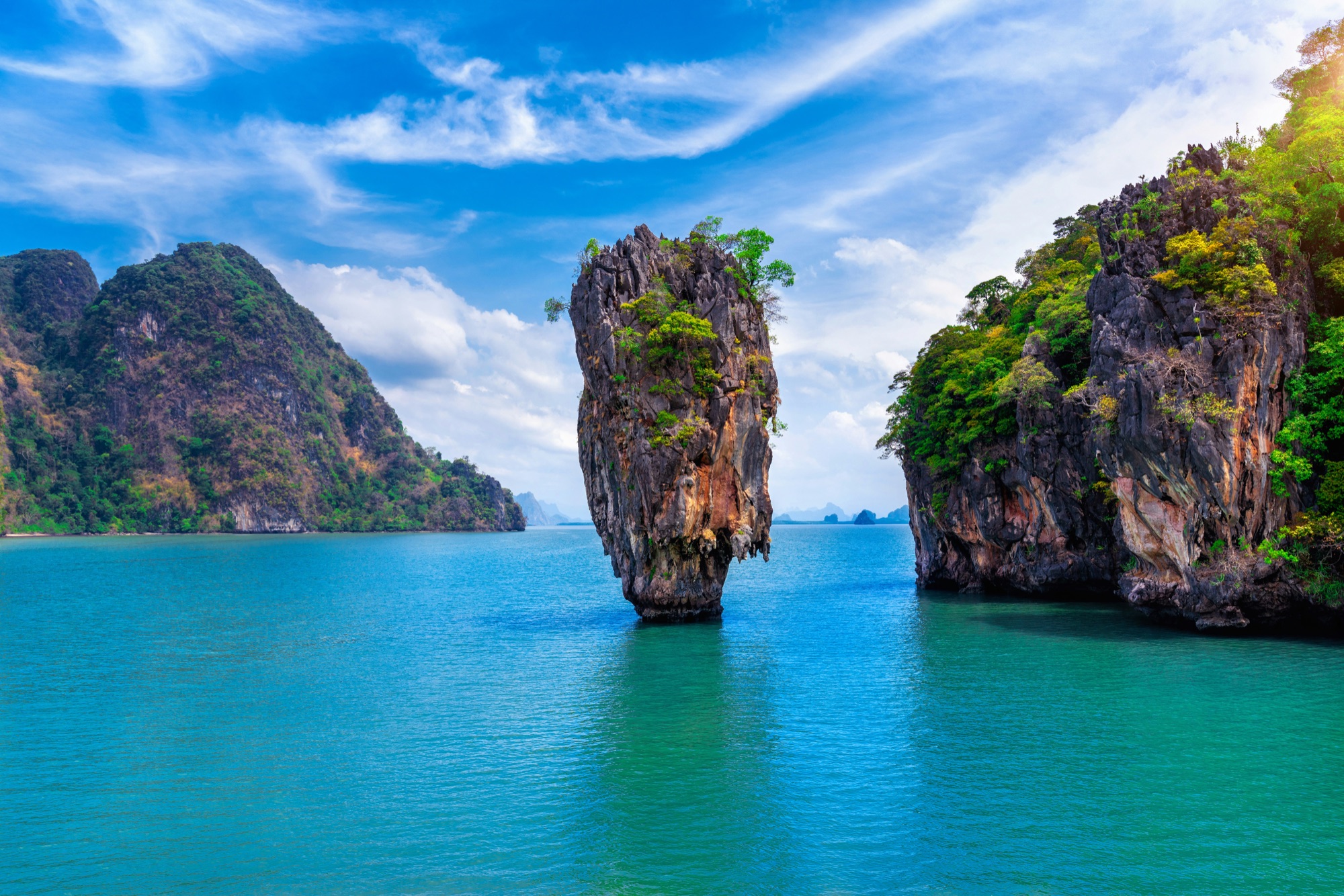
Phuket is the beach that closes a Thailand trip — at least, the November-to-April version of one. It’s the Andaman coast’s anchor island: the limestone karsts of Phang Nga Bay rising out of jade water, the private long-tail boat days, the beaches that run from buzzy to barefoot, and a hotel scene that spans clifftop Aman pavilions to rainforest boutiques. It’s where most dry-season trips end, on the warm, looked-after note a crescendo is supposed to land on.
Done well, Phuket is four to six nights of decompression with one or two showpiece days woven in: a private boat through Phang Nga Bay to James Bond Island and the hidden lagoons, a morning in the Sino-Portuguese lanes of Old Phuket Town, and the rest of it spent doing very little at a property chosen to match the trip’s close. Done poorly, it’s a packed group “booze cruise,” a strip of Patong nightlife that isn’t your trip, and a beach in the wrong season getting rained out.
The single most important thing to know: Phuket is the Andaman coast, and the Andaman’s season is November to April. Come in the dry months and it’s paradise; come in the May-to-October monsoon and you’re fighting the weather — which is exactly when you’d send a beach trip to the Gulf and Koh Samui instead. The coast follows your dates.
Most travelers come to me about Phuket as the beach finale of a Thailand trip (the dominant structure — the crescendo after Bangkok and the north), as a honeymoon close (the same, planned for two, in the property that does the emotional work), or as a standalone Andaman beach week with island-hopping built in.
Here’s how I think about it.
At a Glance
| Best time to visit | November to April — the dry, sunny Andaman high season, with December through March the most reliable. May to October is the southwest monsoon — afternoon storms, rough seas, some boat operators and smaller islands closed. If your trip lands May–October, the beach finale belongs on the Gulf coast at Koh Samui, not here. The two-coast split is the whole game. |
| How long to stay | Four nights is the floor for a beach finale with one boat day; five or six is the right length to truly decompress and add island-hopping. As the crescendo, the island gets the longest stay of the trip. |
| How to get there | Phuket (HKT) is a one-hour-plus domestic flight from Bangkok, frequent and cheap — the standard way to reach the Andaman finale. The island is connected to the mainland by bridge, so transfers are by road from the airport (30–60 minutes depending on the beach). |
| The two sides of the island | Phuket’s west coast (Patong, Kata, Kamala, Surin, Bang Tao, Mai Khao) has the sunset-facing sand beaches and most of the resorts; the east coast (Cape Yamu, Cape Panwa) is calmer, faces Phang Nga Bay, and trades surf-beach for serene-water-and-views. Which side you stay on shapes the whole feel — I match it to the trip. |
| One thing most guides won’t tell you | The private boat day is the trip, and it’s worth every baht over the group tour. Phang Nga Bay by your own long-tail or speedboat — your crew, your clock, the beaches the big boats skip — is a different experience entirely from the packed group “James Bond Island” cattle-cruise. I offer both and build the budget around private; it’s the day clients consistently call the highlight of the whole trip. |
Why I Send Travelers Here
Because Phuket, planned right, is one of the great beach finales in Asia — and because the Andaman coast is genuinely world-class scenery. Phang Nga Bay is the showstopper: a maze of limestone karsts and sea caves and hidden lagoons rising out of emerald water, with James Bond Island (Khao Phing Kan, from The Man with the Golden Gun) the famous one and dozens of quieter ones the right boat reaches. Beyond the bay: Old Phuket Town, with its restored Sino-Portuguese shophouses and a genuinely good food-and-café scene; the island’s spread of beaches; and the jumping-off point for island-hopping to Phi Phi, the Similans (seasonal), and the quieter outer islands.
I send travelers here as the dry-season beach finale of a Thailand trip (the dominant structure), for honeymoons that want the crescendo on the Andaman coast, and for standalone beach weeks with the boat days and island-hopping built in.
The islands are where ground support earns its keep again — the private boat days want a vetted operator and crew, the transfers and island logistics want handling, and the difference between a great water day and a frustrating one is the operator. As across the country, my role is matchmaker — my shaping, executed through a vetted in-country team; for the full-service traveler, A&K Thailand is the operator I’d route you to, with the bench below running the same days at a more accessible tier. But the editorial heart of a Phuket trip is the property and the boat day, and that’s mine: which beach, which side of the island, which hotel for the crescendo, and the private water day built around your pace.
Where I’d Anchor
Phuket’s character changes completely by beach and by coast. The right anchor depends on what the close of the trip should feel like.
For the clifftop-icon experience, Amanpuri is the call — the original Aman, opened on Pansea Beach in 1988, the property that arguably invented the modern luxury-resort genre: black-tiled pool, Thai-pavilion suites stepping down a coconut grove to a private beach, a service register that set the global standard. For the polished west-coast resort, InterContinental Phuket at Kamala Bay is a beautifully-run hillside-and-beach property; for something genuinely original, Keemala above Kamala is the fantastical rainforest hideaway (clay-pool cottages and bird’s-nest villas tucked into the jungle); and for a wellness-led, quieter east-side stay, Amatara on Cape Panwa (Ao Yon) is the call. On my rate across these, the amenity layer is real and doesn’t book direct — calibrated to your dates, room category, and length of stay, with the specifics walked through on the discovery call.
And then there are the two properties I book couples into for reasons beyond a rate sheet — the relationship picks.
COMO Point Yamu, on the quiet east-coast Cape Yamu, is a design-led property (Paola Navone’s vivid Italian-meets-Thai interiors) with a long infinity pool looking out over Phang Nga Bay and the karsts — a serene, stylish counterpoint to the busier west-coast beaches. It’s a property I have history with and book with confidence: I placed a couple here before its Michelin Key arrived and ahead of the wave of attention Thailand’s been getting lately — the kind of timing that’s the quiet advantage of working with someone who watches this market closely. The bathrooms alone have generated more “I’m never getting out of this tub” texts than almost any property I send people to.
Sala Phuket at Mai Khao, up on the long quiet beach in the island’s northwest, is the boutique beach property I reach for when a trip should close on warmth — sand at the villa door, a small-property attentiveness that makes you feel looked after, the kind of place that delivers the emotional close a crescendo needs. It’s a boutique relationship pick rather than a points-and-amenities resort, so the value I add there is the personal layer — the right villa, a note at check-in, the touches that make a small property feel like it was expecting you.
Want one of these stays? Start a discovery call — I’ll pull live availability, walk through the beach-and-coast trade-offs, and confirm which amenities and current promotions apply to your dates. And the small extra at check-in — a welcome note from me, the kind of touch the standard package doesn’t list — is part of how I deliver these stays.
Where I’d Anchor for a Honeymoon
For honeymooners, Phuket is the crescendo — the last and longest and most important stay of the trip — and the property choice matters more here than anywhere else in Thailand:
Amanpuri — the clifftop-icon honeymoon: the pavilion privacy, the Pansea Beach, the service that defined the genre. The pick if the close should feel like the pinnacle.
COMO Point Yamu — the design-and-serenity honeymoon: the quiet east cape, the infinity pool over Phang Nga Bay, the bathtub you won’t leave. The pick for couples who want style and calm over scale.
Sala Phuket (Mai Khao) — the warm-boutique close: sand at the door, small-property intimacy, the looked-after feeling that ends a trip on the right note. The pick when the crescendo should close on warmth rather than grandeur.
End the honeymoon here, on the warmest, most personal property — that’s the deliberate sequencing, not the flashiest hotel but the one that closes the trip. Matching the right property to your honeymoon’s rhythm is the discovery-call conversation, and the specifics are calibrated property by property.
What I’d Do With Four Days
The Phuket rhythm is decompression with showpieces woven in — beach and pool by default, one big boat day, one town morning, and an island-hop if you want it.
Day One — Settle and the Beach
Arrive, settle into the property, and do nothing of consequence. The point of the finale is rest. A beach afternoon, a sunset (the west-coast beaches face it), a long dinner. Let the trip downshift.
Day Two — The Private Phang Nga Bay Boat Day
The showpiece. A private long-tail or speedboat into Phang Nga Bay — the limestone karsts, the sea caves you paddle into by canoe, the hidden lagoons (hongs), James Bond Island, and the quiet beaches the group boats skip. Your crew, your clock, snorkeling where the water’s clear, lunch on the water or a deserted beach. This is the day people remember; give it the full day and do it private.
Day Three — Old Phuket Town and a Slower Day
A morning in Old Phuket Town — the restored Sino-Portuguese shophouses in their pastel colors, the cafés and galleries and the genuinely good local food (Phuket has its own Hokkien-influenced cuisine). Then back to the beach for the afternoon, or a spa session. The contrast — a culture morning, a beach afternoon — is the right texture for the finale.
Day Four — Island-Hopping or More Nothing
Either an island-hopping day (Phi Phi’s cliffs and Maya Bay, or the quieter outer islands, or — in season — a Similan Islands snorkel/dive run for the clearest water in Thailand), or simply more of the beach-and-pool nothing that a finale is for. By now the trip has landed; the only job left is to enjoy where it landed.
With five or six nights, stretch all of the above and add a second water day or a full spa day.
Specific Things I’d Tell You About
Private boat beats the group tour, every time. Phang Nga Bay by your own boat — your crew, your pace, the beaches the big boats can’t reach — is a fundamentally different and better experience than the packed group cruise. It’s the single best money you’ll spend on the island, and the day clients call the highlight of the whole trip.
Phuket is the Andaman coast — season is everything. November to April is paradise; May to October is monsoon. If your dates fall in the wet months, the beach finale belongs on the Gulf at Koh Samui. The coast is a function of your calendar.
Choose your beach and your side of the island deliberately. Patong is the loud, nightlife-and-crowds beach; Kata and Karon are family-friendly and lively; Surin, Bang Tao, and Mai Khao are quieter and more upscale; the east cape (Yamu, Panwa) is serene and faces the bay rather than the sunset. Where you stay shapes the whole trip — and it’s exactly the kind of match I make.
Old Phuket Town is worth a morning. The Sino-Portuguese architecture and the island’s distinctive food culture are a genuine counterpoint to the beach. Most travelers skip it; the ones who don’t are glad.
The east cape is the quiet luxury secret. Cape Yamu and Cape Panwa trade the surf-beach for serene water, Phang Nga Bay views, and a calmer, more design-forward set of properties. For travelers who want stylish and quiet over beach-scene, it’s the move — and it’s where a couple of my favorite properties sit.
What I’d Skip
The wrong season. A Phuket trip in July or August is fighting the monsoon. Wrong-coast-for-your-dates is the most painful Thai-beach mistake; if it’s the wet season, go to Koh Samui.
The group “booze cruise” to James Bond Island. The packed cattle-boat version of Phang Nga Bay is a pale shadow of the private day. Do it private.
Patong’s nightlife strip, if that’s not the trip. Patong’s bar-and-club scene is a known quantity and a mismatch for a honeymoon or a refined finale. Easy to avoid by choosing a different beach — just know it’s there.
Elephant riding and animal attractions. Same rule as the north — only ethical sanctuaries, never riding or shows. (Phuket’s ethical sanctuaries are a worthwhile half-day if you didn’t get elephants up north.)
Over-touring the finale. The island is the rest part of the trip. One big boat day and a town morning is plenty; don’t fill the crescendo with day tours. The point is to land.
For Thailand Multi-Region Travelers
Phuket is the dry-season finale of the Thailand arc — Bangkok first, the north second, the island last — and it gets the longest stay because it’s the crescendo. A one-hour-plus flight from Bangkok brings you down for four to six nights of decompression with the Phang Nga boat day as the showpiece.
The one rule: Phuket is the November-to-April finale. If your trip lands in the May-to-October monsoon, the beach close belongs on the Gulf at Koh Samui instead. Your dates choose your coast.
If you want me to design the full Thailand trip — Bangkok, the northern stop, the Andaman finale, and the property that closes it — start a discovery call.
For Honeymooners
Phuket is the crescendo of a dry-season Thailand honeymoon — the last, longest, most important stay, in the property chosen to do the emotional close. Anchor at Amanpuri for the clifftop-icon pinnacle, COMO Point Yamu for design-and-serenity on the quiet east cape, or Sala Phuket for the warm-boutique close with sand at the door. Build in the private Phang Nga boat day — the showpiece couples remember — and otherwise let the island be the rest the trip has been building toward.
End on the warmest, most personal property, not the flashiest — that’s the deliberate sequencing, and it’s the choice I anchor the budget around. The honeymoon here is the private boat day and the long, unhurried evenings at a property that makes you feel looked after. Start a discovery call.
Plan Phuket With Me
If you’re thinking about Phuket as the beach finale of a Thailand trip, a honeymoon crescendo, or a standalone Andaman week — that’s exactly the kind of planning I do. A 30-minute discovery call is where it starts. No fee, no pressure. We confirm your dates first (because they decide whether it’s Phuket or Koh Samui), then build the close: the right beach, the right property, and a private boat day through Phang Nga Bay that lands the whole trip.
Book Your Free Discovery Call →︎
Last updated: May 2026. I keep this guide current. If a hotel I recommend slips, a boat operator changes hands, or access to a beach shifts, the page changes. Travel changes. The work doesn’t stop when the page goes live.
Plan this trip with me.
A 30-minute discovery call is where it starts. No fee, no pressure.
Book a Discovery Call