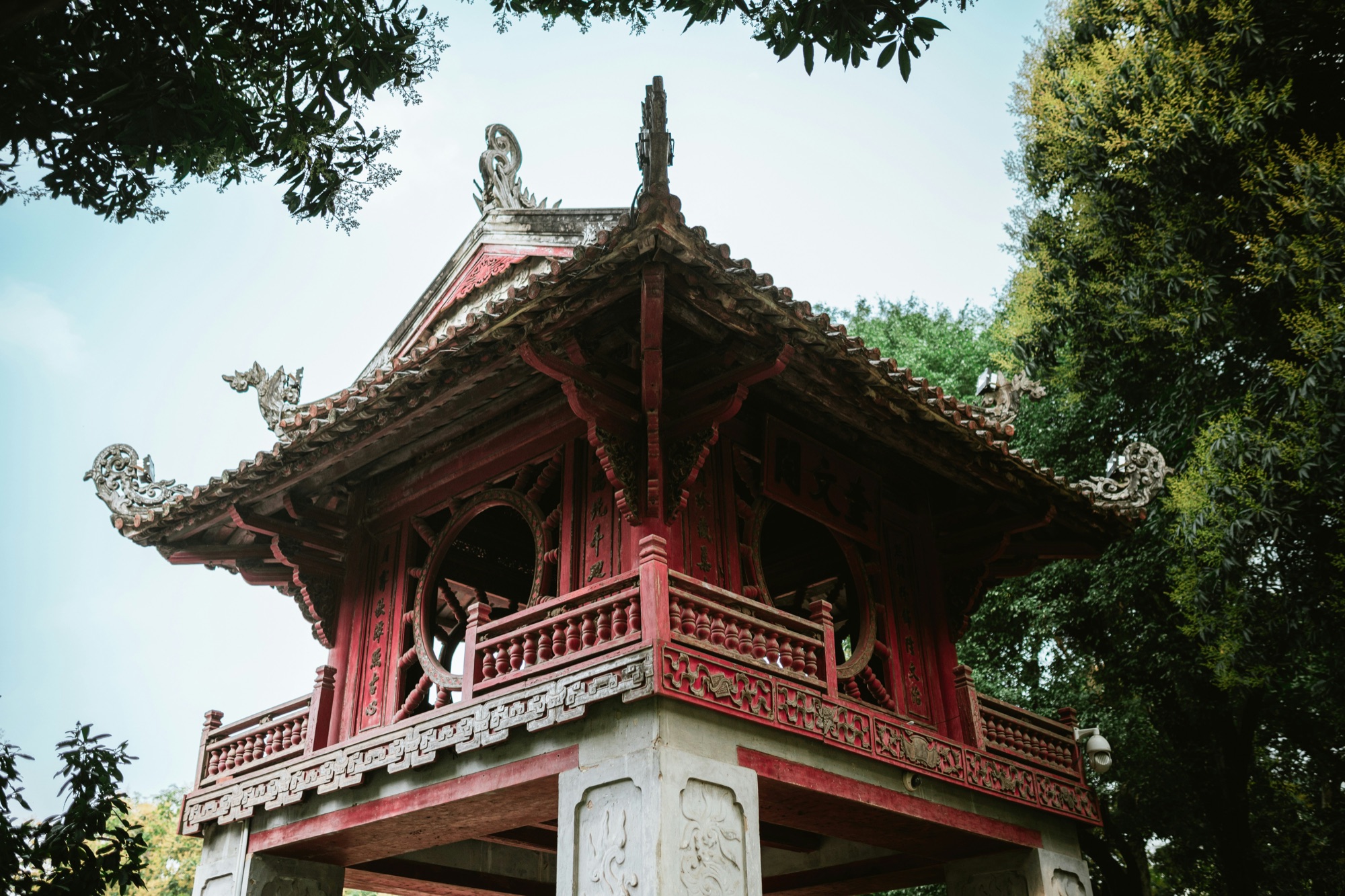
Hanoi is where a Vietnam trip should begin — in the north, in the oldest and most atmospheric of the country’s cities, while arrival energy is high and the senses are wide open. It’s a thousand years old, layered with a French-colonial overlay, dense and chaotic and beautiful, and it has — by a margin I’ll defend — the best street food of the entire trip. After the long flight, Hanoi’s Old Quarter is exactly the right first act: a maze of lantern-lit lanes, scooter rivers, lake temples, and a bowl of phở steaming on a plastic stool at dawn.
Done well, Hanoi is two or three nights of high-contrast pleasure: the Old Quarter’s thirty-six trading streets, the serene Hoan Kiem Lake with its red bridge and island temple, the Confucian calm of the Temple of Literature, the French Quarter’s Opera House and grand cafés, a water-puppet show, and an egg coffee and a bún chả lunch that you’ll still be thinking about weeks later. Done poorly, it’s a jet-lagged blur of one rushed morning before the Halong Bay bus, the city reduced to traffic and a single temple.
As with Saigon in the south, Hanoi is a city I plan with a lighter hand — it’s navigable, the people are warm, English gets you a long way in the tourist core, and an independent-minded traveler does beautifully here with a great hotel, a couple of key reservations, and a fixer for the street-food evening. The deep ground-support work in Vietnam earns its keep in Halong, the central coast, and the Mekong — not so much here. So this guide is opinionated about where to stay, what to eat, and what to skip, and relaxed about the rest, because the joy of Hanoi is being a little loose in it.
At a Glance
| Best time to visit | October to April is the northern dry season and the right window. October–November and March–April are the sweet spots — mild, dry, pleasant. December–February is cool and often misty (genuinely chilly by Southeast Asia standards — pack a layer; the mist makes Halong atmospheric but grey). May–September is hot, humid, and wet. For a Vietnam trip, Hanoi’s timing usually anchors the whole north-to-south route. |
| How long to stay | Two or three nights. Two is enough for the Old Quarter, the lake, and the key sights; three adds the French Quarter, a cooking class, and a slower pace before the Halong cruise. One night is the common mistake — it wastes a great city as a layover before the bay. |
| How to get there | Noi Bai (HAN) is the international gateway for the north and the standard entry point for an open-jaw Vietnam trip (in via Hanoi, out via Saigon). It’s about 45 minutes by car from the Old Quarter. From Hanoi, Halong Bay is a 2.5-hour drive and the central coast a short domestic flight. |
| Getting around | The Old Quarter is walkable (chaotically — crossing the scooter-filled streets is a learned art: move slowly and predictably and the traffic flows around you). Grab (the rideshare app) and metered taxis cover the rest cheaply. You don’t need a car in the city. |
| One thing most guides won’t tell you | Crossing the street is the real first lesson, and it’s a metaphor for the whole city. The scooters never stop, so you don’t wait for a gap — you step out at a slow, steady, predictable pace and let the river of bikes part around you. Hesitating or bolting is what gets you in trouble. Hanoi rewards the traveler who moves calmly into the chaos rather than fighting it — which is also exactly how to enjoy the city. |
Why I Send Travelers Here
Because Hanoi, planned right, is one of the great atmospheric cities in Asia — and because it’s the correct opening to a Vietnam trip. The sights are genuinely worth it: the Old Quarter, the thousand-year-old commercial heart where each of the thirty-six original streets was named for the trade once practiced there; Hoan Kiem Lake with its photogenic red Huc Bridge and the Ngoc Son Temple on its island; the Temple of Literature, Vietnam’s first university (1070), a serene Confucian complex of courtyards and pavilions; the somber Ho Chi Minh Mausoleum complex and the delicate One Pillar Pagoda; the French Quarter with its Opera House, grand boulevards, and St. Joseph’s Cathedral; and the water-puppet theater, a uniquely northern Vietnamese art form staged over water. And then the food — Hanoi is the birthplace of phở and bún chả and egg coffee, and its street-food culture is, for my money, the best eating of the whole country.
I send travelers here as the northern start of a Vietnam trip (the dominant structure — two or three nights before Halong and the journey south), and occasionally as a standalone northern base for trips that pair Hanoi with Halong, Ninh Binh, and Sapa.
As I said up top, Hanoi is a lighter-touch city in my Vietnam planning. The country-level matchmaker structure — my strategy executed through a vetted in-country ground partner, with A&K the operator I’d route the full-service traveler to — still stands, and the ground team handles the seamless transfers and any private guiding you want (the history, especially, is richer with a good guide). But Hanoi itself is where a great hotel, a few reservations, and the city’s own navigability do most of the work. The editorial value here is in the choices — the right neighborhood, the right hotel, the meals worth booking, the half-day that’s worth a guide — and the rest you get to wander.
Where I’d Anchor
Two patterns cover most travelers:
The Old Quarter / Hoan Kiem area. The atmospheric heart — steps from the lake, the night market, the street food, and the chaos. The pick for a first visit that wants to be in the old city, with everything walkable.
The French Quarter. The grander, leafier colonial district just south of the lake — wide boulevards, the Opera House, the grand hotels, a touch more calm and space. The pick for a more refined, slightly-removed base that’s still a short walk to the Old Quarter.
For the French Quarter grande-dame experience — and one of the most storied hotels in Asia — Sofitel Legend Metropole Hanoi is the call. Open since 1901, it’s the city’s legendary address: colonial-classic elegance, a history that runs through Graham Greene and Charlie Chaplin and visiting heads of state, the genuinely moving wartime bomb shelter beneath the garden (guests can tour it), and a clutch of excellent restaurants and the Indochine-era Bamboo Bar. It’s the hotel I’d anchor a Hanoi stay on for the romance and the sense of place. On my rate at the property, the amenity layer is real and doesn’t book direct — calibrated to your dates, room category, and length of stay, with the specifics walked through on the discovery call.
For a contemporary-design alternative, Capella Hanoi (Bill Bensley’s theatrical opera-themed hotel beside the Opera House) is the most distinctive recent opening — maximalist, romantic, and a complete contrast to the Metropole’s colonial restraint. Where a property is one I hold a rate or relationship with, the amenity layer and personal touches come with it; where it isn’t, I’m still the one matching you to the right room and booking it well. We sort the specifics on the call.
Want one of these stays? Start a discovery call — I’ll pull live availability, walk through room categories, and confirm which amenities and current promotions apply to your dates. And the small extra at check-in — a welcome note from me, the kind of touch the standard package doesn’t list — is part of how I deliver these stays.
Where I’d Anchor for a Honeymoon
For honeymooners, Hanoi is the atmospheric opening act, and the choice is mostly colonial-romance versus contemporary-drama:
Sofitel Legend Metropole — the colonial-romance opening: the 1901 grande dame, the history, the garden, the Bamboo Bar at dusk. The pick if you want Hanoi to open on old-world elegance.
Capella Hanoi — the theatrical-design opening: Bensley’s opulent, opera-themed maximalism, romantic in a completely different register. The pick if you want drama and design.
Hanoi is the opening, not the crescendo — so I usually keep it to two or three nights here and weight the long, emotional stay toward the beach coast or a Halong cruise cabin and a Hoi An pool villa. Matching the right Hanoi opening to your honeymoon’s rhythm is the discovery-call conversation.
What I’d Do With Two Days
The Hanoi rhythm is walk the Old Quarter in the cool morning, see the lake and the temples, eat constantly, and let the evening bring the water puppets and the street food.
Day One — The Old Quarter and the Lake
Start in the Old Quarter on foot — the thirty-six streets, the trade-named lanes (Silk Street, Silver Street, Tin Street), the temples tucked between shops, the morning markets. Let it be a wander, not a checklist. Coffee stop for the famous egg coffee (cà phê trứng) — a Hanoi invention, a meringue-like whipped-egg-yolk-and-condensed-milk topping over strong coffee, far better than it sounds.
Down to Hoan Kiem Lake — the Huc Bridge and Ngoc Son Temple on its island, the lake walk that locals do at dawn. Lunch on bún chả — grilled pork and noodles in a herb-and-broth bowl, the dish Hanoi does better than anywhere (and the one Anthony Bourdain and President Obama famously shared here).
Afternoon: the Temple of Literature (the 1070 Confucian university, serene courtyards and pavilions — the calm counterpoint to the Old Quarter’s energy). Evening: the Thang Long Water Puppet Theater (the uniquely northern art form, staged over a pool), then a street-food dinner — ideally guided the first time, because the best stalls are the ones you’d never find alone.
Day Two — The French Quarter, History, and Slower Hanoi
Morning at the Ho Chi Minh Mausoleum complex (the mausoleum itself, the Presidential Palace grounds, and the delicate One Pillar Pagoda), or — for the more textured version — Hoa Lo Prison (the “Hanoi Hilton,” sobering and well-presented). Then the French Quarter — the Opera House, St. Joseph’s Cathedral, the grand colonial boulevards, and a coffee or a Metropole afternoon.
This is also the day for a cooking class, if you want one — Hanoi’s market-to-table classes are excellent and a fine way to take a piece of the food home. Afternoon at leisure — West Lake and the lakeside Tran Quoc Pagoda (the city’s oldest) for a quieter, leafier corner, or shopping the Old Quarter and the night market.
With a third day: a day trip to Ninh Binh / Trang An (“Halong Bay on land” — karst peaks rising from rice paddies and rivers, by sampan; a genuinely spectacular and less-crowded alternative) before the Halong Bay cruise itself.
Specific Things I’d Tell You About
The street food is the best of the whole trip — come hungry. Hanoi is the birthplace of phở and bún chả, the home of egg coffee, and a street-food culture that rewards the guided first evening (the great stalls are unmarked and unfindable otherwise). Don’t fill up on hotel food; eat on the plastic stools.
Crossing the street is a skill — move slowly and predictably. The scooters don’t stop; you step out at a steady pace and let them flow around you. It’s the city’s whole personality in one motion: move calmly into the chaos.
The Metropole’s bomb shelter is worth the tour. Rediscovered during a 2011 renovation, the wartime air-raid shelter beneath the hotel garden is a genuinely moving 20 minutes of history, offered to guests. A small, specific, unforgettable thing.
“Train Street” is mostly closed now — manage expectations. The famous narrow lane where the train passes inches from the cafés has been repeatedly restricted for safety; access comes and goes. Don’t build the trip around it; if it’s open and your guide can arrange a safe café visit, fine, but it’s not the city.
Ninh Binh is the underrated day trip. If you have a third day, Trang An / Ninh Binh — the “Halong on land” karst-and-rice-paddy landscape by sampan — is spectacular and far less crowded than the bay. A strong addition for travelers who want more of the north.
Pack a layer for winter. December–February in Hanoi is genuinely cool and damp — not tropical at all. Travelers expecting Southeast Asian heat are caught out every year.
What I’d Skip
One night in Hanoi before the Halong bus. The worst way to do the city — give it two or three nights, or you’ve reduced a great place to a layover.
Building the trip around “Train Street.” It’s frequently closed and over-hyped. A nice moment if it’s open; never the reason to come.
The mistimed northern season. Said on the country page too — the north is October–April. A July Hanoi-and-Halong stretch is hot, wet, and grey on the water.
Over-relying on a car in the Old Quarter. Walk it. The whole pleasure is on foot, scooters and all.
Skipping the street food because it looks intimidating. The plastic-stool stalls are the city’s great cuisine. The guided first evening solves the intimidation; after that you’ll be seeking them out.
For Vietnam Multi-Region Travelers
Hanoi is the northern start of the Vietnam arc — north to south: Hanoi →︎ Halong Bay →︎ central coast →︎ Saigon →︎ Mekong or the beach. Fly in here, spend two or three nights while arrival energy is high, then drive to Halong for the overnight cruise and work your way south, flying out of Saigon (or continuing into Cambodia) so you never backtrack.
The dates set the route: October–April runs the north comfortably; the best all-country window is February–April. If you want me to design the full Vietnam (or Vietnam-and-Cambodia) trip — the northern start, the Halong cruise, the central coast, the south, and the beach or Angkor finale — start a discovery call.
For Honeymooners
Hanoi is the atmospheric opening act of a Vietnam honeymoon, not the crescendo — so I plan it as two or three nights of high-contrast romance: a grande-dame or design-forward hotel, a lake-and-Old-Quarter wander, an egg coffee and a guided street-food evening, the water puppets. Then the trip heads to Halong Bay for the overnight cruise cabin and builds south toward the beach coast where the longest, most intimate stay belongs.
The honeymoon evening here, in my read, is the street-food crawl followed by a nightcap at the Metropole’s Bamboo Bar — the chaos and the colonial calm in one night. The setup does the work. If you want me to design the full Vietnam honeymoon — the Hanoi opening, the Halong cabin, the Hoi An villa, the beach finale — start a discovery call.
Plan Hanoi With Me
If you’re thinking about Hanoi as the northern start of a Vietnam trip, a honeymoon opening, or a base for the north — that’s exactly the kind of planning I do. A 30-minute discovery call is where it starts. No fee, no pressure. Just the city, your timeline, and the version of Hanoi that opens a trip the right way — the Old Quarter at dawn, the lake and the temples, the water puppets, and a bowl of something extraordinary on a plastic stool after dark.
Book Your Free Discovery Call →︎
Last updated: May 2026. I keep this guide current. If a hotel I recommend slips, a restaurant changes hands, or access to a site shifts, the page changes. Travel changes. The work doesn’t stop when the page goes live.
Plan this trip with me.
A 30-minute discovery call is where it starts. No fee, no pressure.
Book a Discovery Call