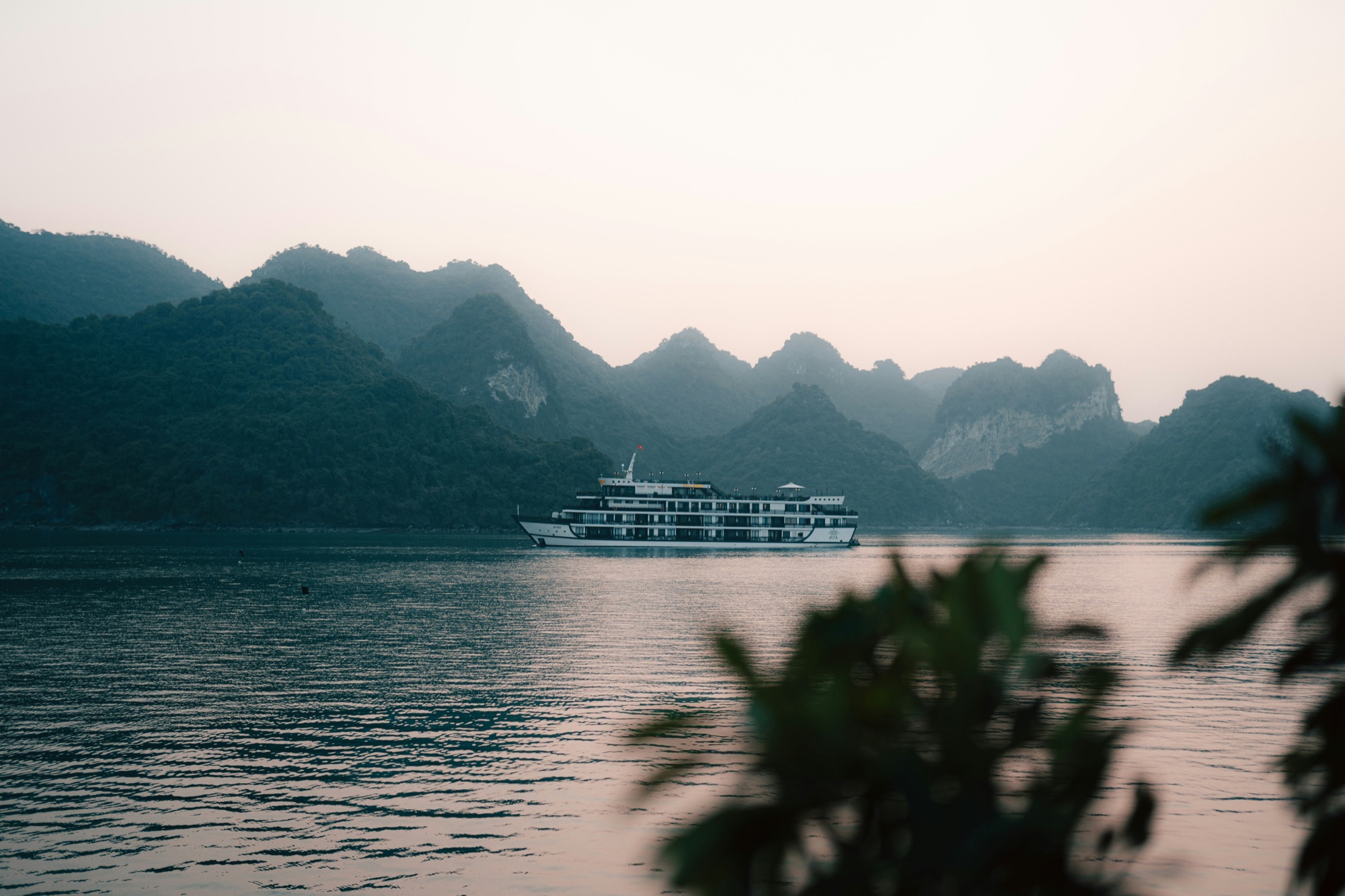
Halong Bay is Vietnam’s signature image — sixteen hundred limestone karsts rising out of jade water in the Gulf of Tonkin — and it’s also the one most travelers do wrong, by treating it as a day trip from Hanoi. The bay rewards a night on the water: sunset and sunrise among the islands, kayaking into quiet lagoons after the day boats have gone, dinner on deck under the karsts, and the kind of stillness that only exists when you’ve stopped moving through a place and started staying in it.
Done well, Halong is one or two nights aboard a beautifully-run cruise — and, increasingly, in the quieter bays next door (Bai Tu Long and Lan Ha), where the karst scenery is identical but the boat traffic is a fraction of the main bay’s. Done poorly, it’s a packed day boat from Hanoi, four hours each way for three hours among the karsts shoulder-to-shoulder with a hundred other tourists, the whole point missed.
The single thing to understand about Halong: the vessel is the decision. Unlike a city where the hotel is one of many choices, here the boat is the experience — your room, your restaurant, your sundeck, your itinerary, your fellow guests, all of it. Getting the right cruise on the right bay is the entire planning task, and it’s exactly where a ground partner earns its keep.
Most travelers come to me about Halong as the second stop on a Vietnam trip — one or two nights aboard, right after Hanoi, before flying south. That’s the dominant and correct structure.
Here’s how I think about it.
At a Glance
| Best time to visit | October to April — the northern dry season (Halong runs on the north’s calendar). October–November and March–April are the sweet spots — clear and mild. December–February is cool and often misty, which makes the karsts atmospheric and moody but can grey out the views. Summer (May–September) is hot, humid, and the season for storms that occasionally cancel sailings. |
| How long to stay | One night aboard is the standard and it’s genuinely good; two nights is better and almost always means the quieter, more remote bays (Bai Tu Long, Lan Ha) and a slower, less-scripted itinerary. The day trip is the mistake — it’s mostly the drive. |
| How to get there | A 2.5-hour drive from Hanoi to the cruise harbor (the route improved dramatically with the expressway). Some luxury operators offer a seaplane transfer for a splurge with an aerial view of the karsts. Transfers are arranged with the cruise; you don’t navigate this yourself. |
| Which bay | Main Halong Bay — the famous one, the most karsts and the most boats. Bai Tu Long Bay — to the east, identical scenery, a fraction of the traffic, the quiet-luxury pick. Lan Ha Bay — to the south near Cat Ba Island, dramatic and less-visited, increasingly the connoisseur’s choice. I steer most travelers toward Bai Tu Long or Lan Ha. |
| One thing most guides won’t tell you | The boat is everything, and the bay matters as much as the boat. Two cruises at the same price can be wildly different experiences depending on the vessel’s size, the cabins, and — crucially — which bay it sails. A smaller boat in quiet Bai Tu Long is a different world from a big boat in the main-bay crush. The vessel-and-bay match is the whole game, and it’s not something the booking sites make legible. |
Why I Send Travelers Here
Because Halong Bay, done as an overnight cruise on the right boat in the right bay, is one of the genuinely magical experiences in Asia — and because it’s the natural second act of a Vietnam trip, the slow exhale after Hanoi’s intensity before the journey south. The scenery is UNESCO-listed and deserves the cliché: thousands of forested limestone towers, hidden lagoons you kayak into, caves like the vast Sung Sot (Surprise) Cave, the panoramic climb up Ti Top Island, floating fishing villages, and the sublime quiet of dawn among the karsts with a cup of coffee on the sundeck.
I send travelers here as the overnight-cruise centerpiece of the north — one or two nights aboard after Hanoi, before flying to the central coast or Saigon.
Halong is the most vessel-dependent decision in Vietnam, and it’s pure ground-partner territory: the right boat (size, cabins, crew, food), the right bay (away from the crowds), the right itinerary length, and the transfers all matter enormously and aren’t legible from a booking site. As across the country, my role is matchmaker — my read on which cruise fits how you travel, executed through the in-country team; A&K is the operator I’d route the full-service traveler to. The bench includes the boutique cruise lines that run small, beautifully-appointed vessels in the quieter bays. The editorial work is the vessel-and-bay match — and it’s the whole trip here.
Which Cruise I’d Put You On
There’s no hotel to choose at Halong — there’s a boat and a bay, and that pairing is the entire decision. Three patterns:
A small luxury cruise in Bai Tu Long Bay. The quiet-luxury pick — identical karst scenery to the main bay, a fraction of the boat traffic, and a smaller, more intimate vessel. My default recommendation for travelers who want the magic without the crowds.
A boutique cruise in Lan Ha Bay. The connoisseur’s pick — the dramatic southern bay near Cat Ba Island, less-visited, with the most striking scenery and the fewest boats. The choice for travelers who want the road-less-traveled version.
A polished cruise in the main bay. The classic — the most famous karsts, the named highlights (Sung Sot Cave, Ti Top Island), and more boats around you. Fine on a well-run smaller vessel; I’d steer you to the quieter bays if your dates and itinerary allow.
The Vietnamese luxury-cruise market is deep and the quality varies enormously — there are gorgeous boutique vessels and there are floating party boats at similar prices, and the booking sites don’t make the difference obvious. The boutique lines running small ships in Bai Tu Long and Lan Ha are where I’d point you, and matching the specific vessel to how you travel (cabin category, crowd tolerance, one night vs. two, the dawn-kayak crowd vs. the cocktail-deck crowd) is the discovery-call conversation. Because the cruise is a packaged product rather than a hotel, the value I add is the vetting and the match — the right boat in the right bay, booked right, with the transfers and the Hanoi connection seamless.
Want help choosing the boat? Start a discovery call — the vessel-and-bay match is the whole game here, and it’s exactly what I’m for.
The Honeymoon Cabin
For honeymooners, Halong is one of the most romantic nights of a Vietnam trip — a private balcony cabin on a small boat in a quiet bay, the karsts at sunset, a private dinner on deck, the dawn kayak before anyone else is up. Two nights aboard in Bai Tu Long or Lan Ha is the move; the top suites on the boutique vessels have private terraces and outdoor tubs. It’s a cabin, not a resort, so the romance is in the vessel-and-bay choice — and that’s the discovery-call conversation.
What I’d Do With a Night Aboard
The overnight rhythm is the whole pleasure — board midday, cruise into the karsts, kayak the lagoons, dinner on deck, dawn among the islands.
Midday — board and sail out. Transfer from Hanoi, board, lunch as the boat sails out among the first karsts. The scenery starts immediately and only deepens as you move into the bay.
Afternoon — kayak and a cave. The afternoon is the active stretch: kayaking into hidden lagoons and through limestone arches (the best part, and far better once the day boats have turned back), a swim from the boat, and often a cave — the cathedral-sized Sung Sot (Surprise) Cave in the main bay, or quieter grottoes in Bai Tu Long. Some itineraries include a floating fishing village or a pearl farm.
Sunset and evening — the deck. Cocktails on the sundeck as the light goes gold and the karsts turn to silhouettes, a multi-course dinner aboard, and — a Halong tradition — squid fishing off the back of the boat after dark. The bay at night, with the karsts as black shapes against the stars, is the quiet you came for.
Dawn — tai chi and Ti Top. Early risers get the best of it: tai chi on the sundeck at sunrise, the dawn kayak before the bay wakes, and (on main-bay itineraries) the climb up Ti Top Island for the panoramic view over the karst-studded water. Brunch as the boat sails back. On a two-night cruise, the middle day goes deeper into the remote bays, away from everything.
Specific Things I’d Tell You About
Overnight, not a day trip. This is the single most important Halong decision. The day trip from Hanoi is mostly the four-hour round drive; the overnight is where the magic — sunset, dawn, the empty bay after the day boats leave — actually lives. Always stay aboard.
Choose the quiet bay. Bai Tu Long and Lan Ha have the same karst scenery as the main bay with a fraction of the boats. Unless there’s a reason to be in the main bay, the quieter bays are the better experience — and steering you there is part of the match.
The vessel quality varies enormously at the same price. Gorgeous boutique boats and floating party boats sell for similar numbers, and the booking sites blur the difference. The vetting is the value; this is not a “book the cheapest 4-star” decision.
Winter mist is a real variable. December–February can be beautiful-and-moody or grey-and-socked-in. It’s atmospheric either way, but travelers wanting blue-sky karst photos should aim for October–November or March–April.
One night is good; two is the upgrade. A single night is genuinely satisfying. Two nights almost always means a smaller boat, a remoter bay, and a slower, less-scripted itinerary — the connoisseur’s version.
What I’d Skip
The day trip from Hanoi. The cardinal Halong mistake — it’s mostly the drive. Stay aboard.
The cheapest party boats. The bottom of the market is loud, crowded, and a different trip entirely. The boat is the experience; this is not the place to bargain-hunt.
The most crowded main-bay routes in peak season. If your dates fall in a crowded window, the quieter bays (Bai Tu Long, Lan Ha) are the move — same scenery, far fewer boats.
Over-scheduling the cruise. The point of Halong is to stop and be still among the karsts. Resist the urge to cram; the kayak, the deck, and the dawn are the whole thing.
For Vietnam Multi-Region Travelers
Halong Bay is the second act of the Vietnam arc — Hanoi first, then one or two nights aboard at Halong, then south to the central coast, Saigon, and the Mekong or beach. It’s the slow exhale after the city, and it runs on the north’s October–April season.
If you want me to design the full Vietnam (or Vietnam-and-Cambodia) trip — the Hanoi start, the right Halong cruise, the journey south, and the finale — start a discovery call.
For Honeymooners
Halong is one of the most romantic nights of a Vietnam honeymoon — a private-balcony cabin on a small boutique boat in quiet Bai Tu Long or Lan Ha, the karsts at sunset, dinner on deck, the dawn kayak before the bay wakes. Two nights aboard is the move. It’s a cabin rather than a resort, so the romance lives in the vessel-and-bay choice — which is exactly what I’m for.
If you want me to design the full Vietnam honeymoon — the Hanoi opening, the Halong cabin, the Hoi An villa, the beach finale — start a discovery call.
Plan Halong Bay With Me
If you’re thinking about Halong Bay as the overnight-cruise centerpiece of a Vietnam trip — that’s exactly the kind of planning I do, and it’s a place where the planning genuinely matters, because the vessel and the bay are the experience. A 30-minute discovery call is where it starts. No fee, no pressure. Just the karsts, your dates, and the right boat in the right bay to do them justice.
Book Your Free Discovery Call →︎
Last updated: May 2026. I keep this guide current. If a cruise I recommend slips, a vessel changes hands, or access to a bay shifts, the page changes. Travel changes. The work doesn’t stop when the page goes live.
Plan this trip with me.
A 30-minute discovery call is where it starts. No fee, no pressure.
Book a Discovery Call