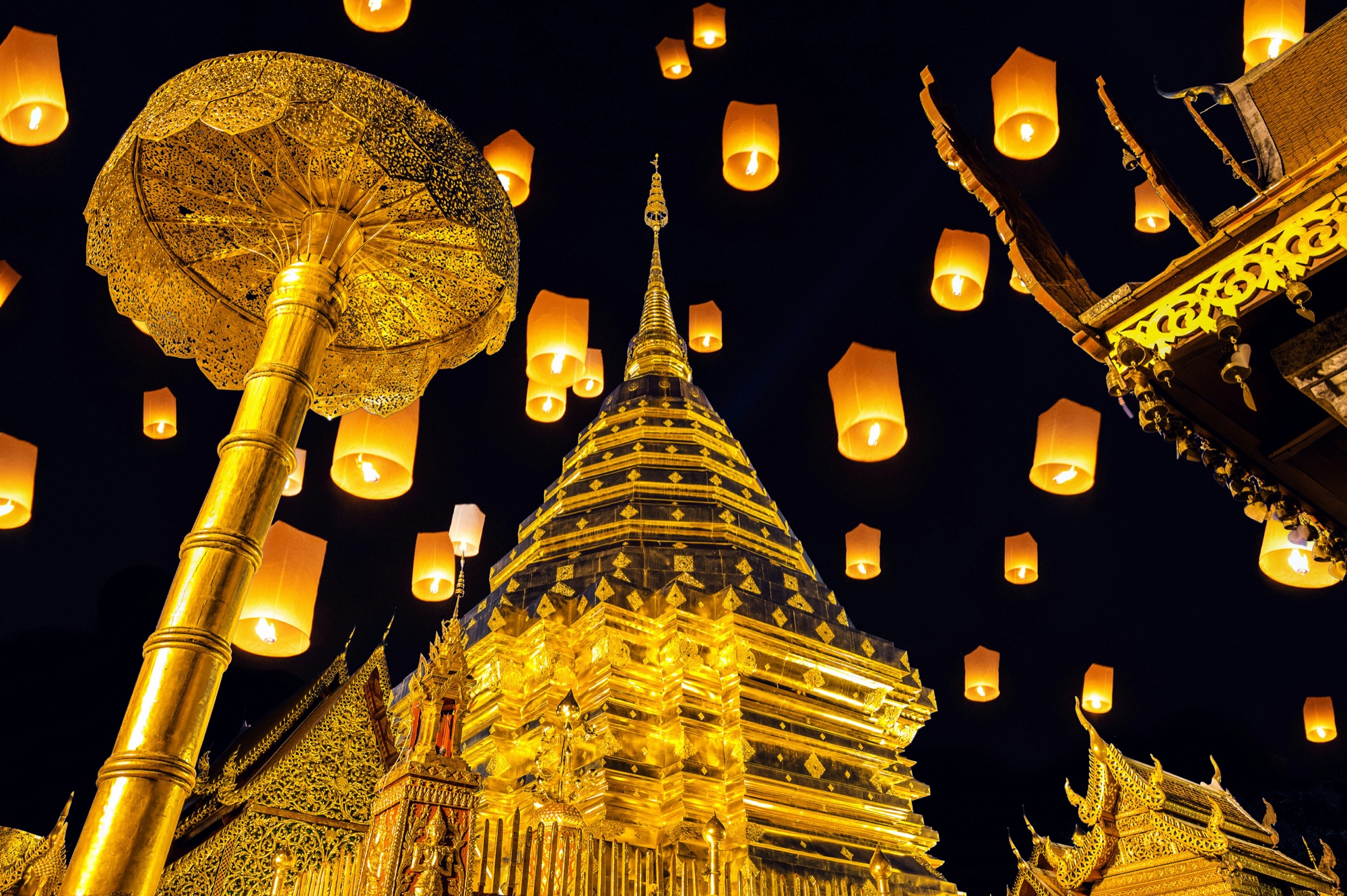
Chiang Mai is the part of Thailand that slows the trip down, and it’s the reason a Thailand itinerary feels complete rather than just “city and beach.” After the heat and electricity of Bangkok, the old capital of the Lanna kingdom is a different country in temperament — cooler, quieter, greener, built around temples and craft and food rather than skyscrapers and traffic. It’s the middle act of the Thailand arc, and it’s the one travelers are surprised to love most.
Done well, Chiang Mai is three or four nights of gentle cultural immersion: a moated old city you can walk, more than 300 temples (a few of them genuinely unmissable), a mountain-top temple at dawn, a craft tradition you can watch being made, a cooking class that starts in a market, and an afternoon with rescued elephants at a sanctuary that does it the right way. Done poorly, it’s a rushed temple checklist and a night-market trinket run, missing the thing that makes the north worth the flight.
Most travelers come to me about Chiang Mai as the northern stop on a Thailand trip — three or four nights between Bangkok and an island, the cultural breather in the middle of the arc. A few come for the wilder north instead — the Golden Triangle and its elephant camp — and I’ll help you choose between the two (city-craft-culture vs. river-and-wilderness) based on what the trip wants. And a few build a longer northern week, pairing Chiang Mai with the Golden Triangle and the hill country.
Here’s how I think about it.
At a Glance
| Best time to visit | November to February — the cool, dry season, and genuinely pleasant in the north (cooler than Bangkok, comfortable days, cool evenings). November also brings Yi Peng and Loi Krathong, the lantern festivals, which are extraordinary and worth timing toward. Avoid late February through April — the “burning season,” when agricultural fires blanket the north in smoke and air quality drops sharply. This is the single most important timing rule for Chiang Mai, and one most travelers don’t know. |
| How long to stay | Three nights is the right length for the temples, a craft-and-cooking day, and an elephant day; four if you want a slower pace or a day trip (Doi Inthanon, the hill country). |
| How to get there | A one-hour domestic flight from Bangkok (frequent, cheap) into Chiang Mai (CNX). The flight is the backbone of the city-to-north hop; the overnight train is romantic but eats a day. From here it’s a short hop onward to the Golden Triangle / Chiang Rai or back to Bangkok for the island leg. |
| Getting around | The Old City is walkable (it’s about a mile square inside the moat); songthaews (shared red trucks) and tuk-tuks cover the rest, and Grab (the rideshare app) works well. You don’t need a car. |
| One thing most guides won’t tell you | Be at Wat Phra That Doi Suthep — the mountain-top temple — early. The golden chedi overlooking the city from Doi Suthep mountain is Chiang Mai’s signature, and by mid-morning the terrace is packed with tour groups. At opening, in the cool mountain air with the city spread below through the haze, it’s a different, quieter, more reverent place. The early start is the move. |
Why I Send Travelers Here
Because Chiang Mai is the cultural heart of northern Thailand, and because it gives a Thailand trip a middle — a slower, deeper, more hands-on couple of days between the city and the beach. It was the capital of the Lanna (“million rice fields”) kingdom for centuries, and that history is everywhere: in the more than 300 temples (the gilded Wat Phra Singh and the ancient ruined chedi of Wat Chedi Luang inside the Old City, the mountain-top Wat Phra That Doi Suthep above it), in the craft villages where umbrellas and silver and woodcarving are still made by hand, and in a food culture distinct from the rest of Thailand (the northern khao soi curry noodle is reason enough to come). It’s also the country’s center for ethical elephant tourism — the rescue-and-sanctuary model that’s the right way to encounter these animals.
I send travelers here as the cultural north of a Thailand trip (the dominant structure — the breather between Bangkok and the islands), and for travelers who want a craft-and-culture immersion with cooler weather and a gentler pace than the south.
The north is where I plan with a heavier hand than Bangkok — this is genuinely ground-partner territory. The temples reward a guide who can explain the Lanna history and the Buddhist context; the craft villages and cooking schools are better with the right introductions; the elephant sanctuary needs the ethical one chosen and booked correctly; and the logistics of a day in the hill country want a driver-guide who knows the roads. As across the country, my role is matchmaker — my strategy and shaping, executed through a vetted in-country team. For the full-service traveler, A&K Thailand (with its own office in Chiang Mai) is the operator I’d route you to; the bench below that runs the same itinerary with deep local guides at a more accessible tier. The editorial work — which temples, which craft, which sanctuary, how the three days sequence — is mine.
Every recommendation below comes through that lens.
Where I’d Anchor
Three patterns cover most travelers:
The Old City (inside the moat). The historic square mile of temples, walkable lanes, and the Sunday Walking Street market. The pick for a first visit — you can walk to a dozen temples and the night markets, and the city’s history is your front door. Boutique hotels and converted-Lanna-house properties cluster here.
The Riverside (Mae Ping). Along the Ping River just east of the Old City — quieter, leafier, with the grand riverside hotels and a short hop to the center. The pick for a more resort-style base with river calm and easy access in.
The Mae Rim valley (north of the city). The rice-terrace-and-foothills countryside 20–30 minutes out, where the destination resorts sit. The pick for a retreat-style stay that trades walkability for landscape and seclusion.
For the riverside-resort experience, Anantara Chiang Mai is the call — a serene, design-led property on the banks of the Ping River, a short walk from the night bazaar, with one of the city’s best restaurants and a calm that belies its central location. On my rate at the property, the amenity layer is real and doesn’t book direct — calibrated to your dates, room category, and length of stay, with the specifics walked through on the discovery call.
For the countryside-retreat register, the Four Seasons in the Mae Rim valley is the landscape pick — terraced rice paddies, resident water buffalo, and the kind of seclusion that makes a northern stay feel like a different trip. And inside the Old City, a cluster of boutique Lanna-house hotels — restored teak properties with courtyards and pools — is the pick for travelers who want character and walkability over resort scale. Where a property is one I hold a relationship or rate with, the amenity layer and the personal touches come with it; where it isn’t, I’m still the one who matches you to the right room and books it well. We sort the specifics on the call.
Want help choosing? Start a discovery call — I’ll pull live availability, walk through the Old City vs. riverside vs. valley trade-off, and confirm which amenities and promotions apply to your dates.
Where I’d Anchor for a Honeymoon
For honeymooners, Chiang Mai is the cultural-intimacy middle of the trip, and the choice is mostly seclusion-versus-walkability:
The Mae Rim valley resort (countryside) — the romantic, secluded choice: rice terraces, a private pool, spa afternoons, and the feeling of being away from everything. The pick if the north should feel like a retreat.
A riverside or Old City boutique — the characterful, in-the-life-of-the-city choice: walk to temples and night markets, dinner along the river, the texture of the old capital around you. The pick if you’d rather be in it than above it.
Chiang Mai is the middle act, not the crescendo — so I usually keep it to three or four nights and weight the long, emotional stay toward the island finale. Matching the right northern base to your honeymoon’s rhythm is the discovery-call conversation.
What I’d Do With Three Days
The Chiang Mai rhythm is gentler than Bangkok’s — cooler air, shorter distances, more time to linger. A temple morning, a craft or cooking afternoon, and one day given to elephants and the mountains.
Day One — The Old City and Doi Suthep
Start at the mountain — be at Wat Phra That Doi Suthep early, before the tour buses. The golden chedi on Doi Suthep mountain, reached by a 300-step naga-staircase (or a funicular), overlooks the whole city; at opening, in the cool air, it’s serene. Allow 90 minutes including the drive up.
Back down into the Old City for the temple cluster: Wat Phra Singh (the city’s most revered, with its gilded Lanna-style assembly hall), Wat Chedi Luang (the massive, partially-ruined 14th-century chedi at the city’s heart — atmospheric and quiet), and a few of the smaller wats you’ll pass between them. A guide makes this legible rather than a blur. Lunch on khao soi — the northern coconut-curry noodle soup that’s the city’s signature dish.
Afternoon at leisure, then the evening market: if it’s Sunday, the Sunday Walking Street down Ratchadamnoen Road is the great one (crafts, street food, the Old City lit up); otherwise the Night Bazaar near the river. Eat your way through.
Day Two — Craft and Cooking
Morning at a cooking class — the best versions start at a local market, where your teacher walks you through northern ingredients, then move to a kitchen for a hands-on session ending in the meal you’ve made. It’s one of the most rewarding mornings in the north, and travelers consistently rate it a trip highlight.
Afternoon with Lanna craft: the Sankampaeng road east of the city is the traditional craft corridor — hand-painted umbrellas, silverwork, woodcarving, celadon and lacquerware, much of it still made in open workshops you can watch. Or stay central for the contemporary-craft and design scene in the Nimmanhaemin neighborhood (the city’s stylish café-and-boutique district). Dinner at a riverside restaurant.
Day Three — Elephants and the Mountains
The day for the elephants — at an ethical sanctuary, the no-riding kind. Chiang Mai is the center of Thailand’s rescue-and-care sanctuary movement (the well-known Elephant Nature Park is the model, and there are several others doing it right), where you observe, feed, and walk with rescued elephants rather than ride or watch them perform. A half- or full-day visit is one of the most memorable experiences in the north — and choosing the genuinely ethical operation, not a riding-and-show camp dressed up as a sanctuary, is exactly the kind of thing the ground partner and I get right.
Alternatively (or with a fourth day), Doi Inthanon National Park — Thailand’s highest peak, with the twin royal chedis, cloud forest, and waterfalls — makes a beautiful full-day trip.
By the end of three days, the north has done its work: the trip has a middle, and you’re ready for the beach.
Specific Things I’d Tell You About
Avoid the burning season — late February through April. Agricultural burning across the north blankets Chiang Mai in smoke haze for weeks; air quality drops to genuinely unhealthy levels and the mountain views vanish. This is the one timing rule that matters most for the north. November to February is the window; if your trip lands in March or April, I’d steer the northern stop elsewhere or skip it.
Time toward Yi Peng / Loi Krathong if you can. In November, Chiang Mai releases thousands of sky lanterns (Yi Peng) and floats candle-lit krathong on the rivers (Loi Krathong) — one of the most beautiful festivals in Asia. The dates shift with the lunar calendar and the best lantern-release events book out far ahead. If your trip is flexible, this is a reason to aim for November; if not, I’ll tell you honestly whether your dates catch it.
Be at Doi Suthep early. The mountain temple is the signature, and the early-morning version — cool, quiet, the city below — is a different experience from the mid-day tour-bus crush.
Northern food is its own cuisine. Khao soi (coconut-curry egg noodles), sai ua (northern herb sausage), nam prik ong (a tomato-pork chili dip) — Lanna food is distinct from central Thai and genuinely worth seeking out. The cooking class is the best way in.
Choose the elephant sanctuary carefully — and never the riding kind. Ethical elephant tourism means observation and care, not riding or shows. Thailand has moved decisively this direction and the good sanctuaries are wonderful; the riding-and-circus operations are a hard no. This is a place where the right introduction matters.
What I’d Skip
The burning season (late Feb–April). Worth repeating — the smoke haze genuinely degrades the experience. Plan the north for the cool, clear window.
Elephant riding and elephant “shows.” The painting, the riding, the circus tricks — all of it. Only the ethical observation-and-care sanctuaries.
Tiger attractions. The “tiger temple”–style operations are animal-welfare problems, full stop. Skip them.
Exploitative “long-neck village” visits. Some hill-tribe village tours are run as human zoos. If you want to understand the hill cultures, the Golden Triangle page covers the respectful way to do it with the right guide; the bus-in-photograph-leave version is not it.
Trying to see thirty temples. Same trap as everywhere — pick the four or five that matter and visit them properly. The Old City rewards a slow morning, not a sprint.
For Thailand Multi-Region Travelers
Chiang Mai is the cultural middle of the Thailand arc — Bangkok first, the north second, an island last. Three or four nights here, a one-hour flight on either side, and the trip has the breather that makes the whole sequence work.
The most common question I get: Chiang Mai or the Golden Triangle for the northern stop? Chiang Mai is the craft-temple-cooking city; the Golden Triangle is the river-and-wilderness north with the elephant camp as its centerpiece. On a longer trip you can do both; on a standard ten-to-fourteen-night arc, you pick one, and I’ll help you choose based on whether the north should feel like a city or a wilderness.
If you want me to design the full Thailand trip — Bangkok, the northern stop, the island finale, and the coast that matches your dates — start a discovery call.
For Honeymooners
Chiang Mai is the cultural-intimacy middle of a Thailand honeymoon — the shared cooking class, the temple morning, the afternoon with elephants, the dinner along the river — before the trip builds toward the island crescendo. Anchor at the Mae Rim valley resort for seclusion or an Old City boutique for character; keep it to three or four nights; and let the north be the deep, slow, hands-on part of the trip before the beach.
The honeymoon day here, in my read, is the elephant sanctuary in the morning and the lantern-lit Old City in the evening — the two experiences couples remember most. Start a discovery call.
Plan Chiang Mai With Me
If you’re thinking about Chiang Mai as the cultural north of a Thailand trip, a craft-and-culture immersion, or part of a longer northern week — that’s exactly the kind of planning I do. A 30-minute discovery call is where it starts. No fee, no pressure. Just the old capital, your timeline, and the version of the north that gives your trip its middle — temples at dawn, a market-to-table cooking morning, and an afternoon with elephants done the right way.
Book Your Free Discovery Call →︎
Last updated: May 2026. I keep this guide current. If a hotel I recommend slips, a sanctuary changes hands, or access to a site shifts, the page changes. Travel changes. The work doesn’t stop when the page goes live.
Plan this trip with me.
A 30-minute discovery call is where it starts. No fee, no pressure.
Book a Discovery Call