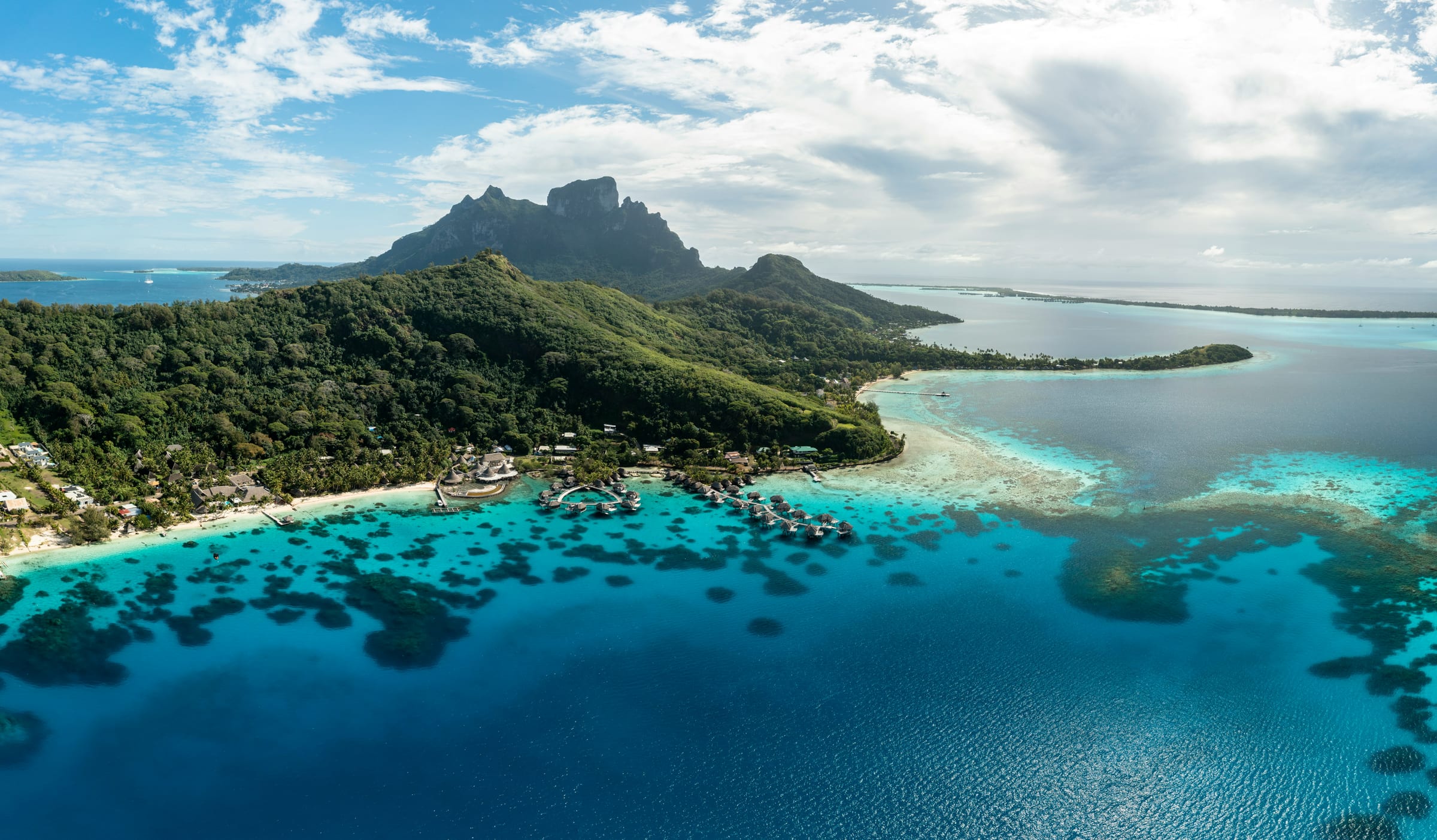
Bora Bora has been called many things by many travelers. James Michener said it was the most beautiful island in the world. Other writers have called it overbuilt and touristy. The truth, as with most polarized opinions about travel, is somewhere in the practical middle: Bora Bora is genuinely beautiful, genuinely expensive, and genuinely worth the money — but only if you anchor the trip correctly and understand what you’re actually paying for.
The island’s steep mountain peak and luminous blue-green lagoon deliver exactly what the photographs promise. The overwater bungalows are real — you can slide open your glass floor table and watch fish swim beneath your living room. Resorts close early in the day and the island shuts down by nightfall, which means the pace, set right, is exactly what honeymooners say they’re looking for: quiet, private, and all about the view.
What most clients don’t know before they arrive is that Bora Bora isn’t a destination for the island itself — it’s a destination for the resort experience. There’s no classic village to wander, no hiking culture, no food scene that transcends the hotels. The “sights” on Bora are functional rather than essential. And that’s fine. You came here for the lagoon, the bungalow, and three uninterrupted days with your person. Everything I recommend below is built around delivering exactly that, and nothing more.
At a Glance
| Best time to visit | May–October for warm, dry weather and reasonable crowds. December–February is hot, humid, and rainy — but also the quietest and cheapest season if you can weather the weather. July brings the Heiva festival (Bastille Day celebrations + traditional dance competitions), which draws crowds but is culturally worth the timing. Avoid mid-July if peak season feels claustrophobic. |
| How long to stay | Three full nights minimum. Four or five if it’s a honeymoon and you want actual relaxation, not a lap of the island. You’ll spend most of your time at the resort. Plan accordingly. |
| How to get there | International flights to Tahiti-Faa’a (PPT), then a one-hour connection to Bora Bora Airport (BOB), which sits on a motu (motus are the small islands forming the coral ring). From the airport, a shuttle boat crosses the lagoon to the main island — expect 15-20 minutes and stunning views if the clouds cooperate. Most resort transfers are included in room packages. |
| Currency / language | CFP franc (Polynesian franc), linked to the euro. French and Tahitian are official; English is widely spoken in resort settings. “Ia ora na” (hello) and “mauruuru” (thank you) go a long way. |
| One thing most guides won’t tell you | Bora Bora is the most expensive island in French Polynesia, and probably the South Pacific. Everything costs more — meals, activities, transfers, even groceries. Budget accordingly and don’t be surprised by sticker shock. Also: the island closes early. Most restaurants stop seating at 9 p.m., and being away from your resort after dark requires planning. |
Why I Send Travelers Here
Because overwater bungalows on Bora actually justify the cost in a way they don’t everywhere else in the world. The lagoon clarity and color are genuinely exceptional. The resorts deliver privacy and service at the level you’re paying for. The pace — slow, quiet, resort-anchored — matches what most honeymooners say they want but rarely find.
I send couples here for honeymoons that are about water, views, and uninterrupted time together. I send milestone anniversaries. I send travelers who’ve done the cultural-immersion circuit and want a trip that’s purely about luxury and restoration.
I’m also honest about what Bora is not: it’s not a food destination, it’s not a cultural deep-dive, it’s not a place where you’ll discover a hidden village or a local way of life. It’s a resort destination, period. Every recommendation below is built on that truth.
Where I’d Anchor
Bora Bora’s geography is simple: the main island is small, surrounded by a lagoon, ringed by motus. Most resorts sit either on the main island or on one of the offshore motus. The resorts that sit on motus (accessed by boat) are quieter and more secluded — trade-off is that you’re entirely resort-dependent for food and activity. Main island resorts offer easier access to Vaitape village (the only real settlement) but feel less isolated.
Four Seasons Bora Bora sits on a motu in the Vaitape Bay. Overwater and beachfront bungalows, lagoon views from everywhere, and the service standard you’d expect from Four Seasons. The property sprawls across 35 acres, giving it an uncrowded feel despite the scale. On my rate at the property, the amenity layer is meaningful and doesn’t book direct — calibrated to your dates and the bungalow category, deepened materially on the overwater categories. The specifics get walked through on the discovery call.
St. Regis Bora Bora is the island’s other flagship — overwater bungalows with glass-floor viewing tables, private infinity pools, and the iconic St. Regis butler service. The location is motu-set (Vaitape side), which means full privacy. This is the resort that earns the hype. On my rate at the property, the amenity layer doesn’t book direct, deepened materially on the overwater bungalow categories. The specifics get walked through on the discovery call.
Conrad Bora Bora Nui recently reopened (April 2026) following a major renovation. The property occupies a large motu with overwater and beachfront bungalows, a lagoon-view infinity pool, and the Conrad’s reliable comfort-meets-luxury balance. Less celebrity-driven than St. Regis, slightly less formal than Four Seasons. On my rate at the property, the amenity layer is calibrated to your stay rather than itemized in advance — what applies depends on dates and the bungalow category, and we walk through it on the discovery call.
Want one of these stays? Start a discovery call — I quote rates, walk through bungalow categories and amenities, and confirm what applies to your dates and season.
What I’d Do With Three Days
Day One — Arrival and Lagoon Introduction
You’ll arrive on the shuttle boat from the airport, crossing the lagoon in the late afternoon (assuming standard flight connections). Check in, unpack, and watch the light shift over the water from your bungalow or suite terrace. Don’t feel pressure to do anything. This is the day your brain shuts down.
If you arrive early enough and aren’t tired, a casual lunch at the resort restaurant, then an afternoon snorkel directly off your bungalow deck or from a nearby resort beach. The fish are plentiful and come within feet of the bungalow. Dinner at the resort — most properties have a lagoon-view restaurant that’s worth the setting if not the food. Early night.
Day Two — Lagoon Activity Day
Morning: book one of the half-day or full-day lagoon tours offered by your resort or independently. The standard tour includes snorkeling (the water clarity earns the reputation), swimming with rays and sharks in a shallow lagoon pen (safer than it sounds, dozens of tourists do this daily), and usually a scenic boat cruise around the inner lagoon. The shark-feeding part can feel theatrical — some operators don’t do it, which is worth asking about.
Afternoon: come back to the resort and spend time at the pool or bungalow. Late afternoon, walk or bike around the nearby motu if your resort allows it, or take the boat shuttle to Vaitape village for dinner. Vaitape is small (30 minutes on foot, less by taxi), has a few decent casual restaurants, and worth seeing once if only to contextualize how isolated the resorts actually are. Bloody Mary’s Restaurant is the famous one — open-air, sand floor, celebrity photos, good fresh fish. Arrive by 6 p.m. for sunset seating or plan a late dinner (9 p.m. is around when they stop seating).
Day Three — Quiet Day
Skip the organized activities. Spend the morning snorkeling, reading, or lounging. Late morning, a spa treatment if the resort offers it (most do, most are good). Long lunch at the resort, no schedule. Afternoon at the pool or bungalow. This is the version of the day your body is actually craving. Dinner at a smaller resort restaurant or back at your bungalow if room service appeals. Final evening on the lagoon.
Specific Things I’d Tell You About
The overwater bungalow glass-floor experience is exactly as good as it sounds. Sliding the glass table open and watching tropical fish, rays, and the occasional shark swim beneath you is hypnotic. You’ll spend more time on that deck than you expected. The bungalows are worth the premium.
Bloody Mary’s is famous for a reason, but go early or go late. The sunset crowd is thick and the experience can feel more about the crowd than the view. If you time it right (early dinner or after 8 p.m.), it’s atmospheric and the seafood is genuinely good.
Vaitape village is worth a dinner excursion, but not much more. There are gift shops, pearl boutiques, and a few roulottes (food trucks) if you want local-casual eating. Mostly it’s functional — supplies, taxis, a yellow church. See it once, then spend the rest of your trip at the resort.
Book lagoon tours through your resort, not independently. The resort coordinators know the operators, the safety records, and can adjust if weather or crowds are bad. You’ll also get resort pickup and transfer built in.
The island closes early — plan accordingly. Restaurant kitchens close around 9 p.m. If you want a late dinner, commit by early afternoon and make the reservation. If you’re out in Vaitape, have your resort arrange a transfer back or plan to eat dinner there.
Snorkeling equipment: Bring your own mask and fins if you’re experienced; resort rentals are available but can be mediocre. The lagoon is shallow and clear enough that snorkeling directly from the bungalow deck is genuinely good.
What I’d Skip
The Bora Bora Lagoonarium. It’s a penned-in area where you can swim safely with rays while sharks are fenced off. The novelty feels theme-park-ish and you’ll get a better fish-and-ray experience on an open lagoon tour.
Multiple lagoon tours. One is enough. The second starts to feel like you’re optimizing the experience rather than living it, which defeats the purpose of a honeymoon.
Shopping for black pearls unless you know what you’re looking at. They’re heavily marketed everywhere. If pearls interest you, learn the grading criteria first or bring someone who knows. Prices vary wildly and impulse buys can feel regrettable.
The World War II cannon sites and ancient marae. They exist, they’re documented, but most honeymooners don’t care. You came for the lagoon, not the history. Time is precious — spend it at the water.
Driving a rental car. The island is small enough to make a car unnecessary. Taxis and resort transfers handle what you need. The roads are narrow and winding, and rental rates are high.
For Honeymooners
This is honeymoon shorthand for a reason. Bora Bora is built for couples who want luxury, privacy, and uninterrupted water views. The overwater bungalow is the anchor point of the trip — it’s worth the cost, worth the trip, and worth protecting your time around it.
I’d book four or five nights if possible. Three is the minimum, but it takes a full day just to decompress and settle into the pace. By day three or four, you’re finally relaxed enough to remember why you came.
Four Seasons if you want service that’s warm and anticipatory without feeling intrusive. St. Regis if you want maximum privacy and butler service. Conrad if you want the premium experience at a slightly lower price point. All three deliver what honeymooners actually want: a view, a private deck, and being left alone.
The trip isn’t about activities. It’s about the bungalow, the lagoon, the pace. Design your days around protecting that. One lagoon tour, one dinner out, the rest at the resort. That’s the version that works.
Plan Bora Bora With Me
If you’re thinking about Bora Bora as a honeymoon, as an overwater-bungalow milestone trip, or as your first (or fifth) visit to French Polynesia — that’s exactly the kind of planning I do. A 30-minute discovery call is where it starts. No fee, no pressure. Just the island, the resorts, your timeline, and what you actually want to feel when you wake up in an overwater bungalow.
Book Your Free Discovery Call →︎
Last updated: April 2026. I keep this guide current. If a resort changes hands, a lagoon tour shifts operators, or access to sites changes, the page changes. Travel changes. The work doesn’t stop when the page goes live.
Plan this trip with me.
A 30-minute discovery call is where it starts. No fee, no pressure.
Book a Discovery Call